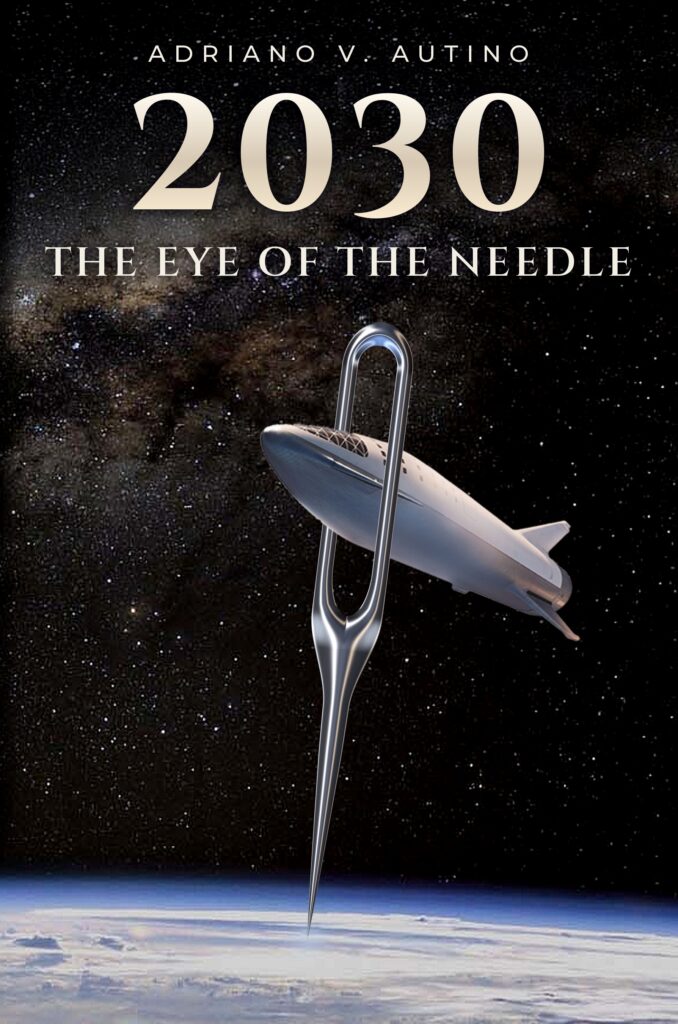
2030: The Eye of the Needle
Why humanity must start building its “Planet B” now
There is no more time
Many more people must become aware of the need to kick off civilian space development, beyond the boundaries of Earth’s atmosphere, as soon as possible. We need a “Planet B”, or the equivalent of one, and we need to start working on it now.
2030 Needle is the urgent follow-up to Adriano V. Autino’s earlier books, Earth Is Not Sick: She’s Pregnant! and A Greater World Is Possible!. It updates their argument for a world in which the margin for action is shrinking fast.
Why 2030?
2030 is a symbolic date. The United Nations made it one by titling its 2015 programmatic declaration “The 2030 Agenda for Sustainable Development”. But that is not the only reason. In the 1990s, US government agencies predicted that the five years between 2025 and 2030 could be one of the most crucial periods in human history, with a high risk of civilization implosion.
Is the 2025–2030 quinquennium the “Caudine Forks” for our civilization? The author believes it is, and this book is his contribution to helping humanity face the challenge.
A launch window that could close
Human growth is a blessing in itself. But growth inside a closed world produces multiple, overlapping crises, and they could close the “launch window” for expanding civilization into space earlier than expected. If the necessary space and resources are not provided in time, that growth could end in tragedy.
Human growth—a blessing in itself—could end in a tragedy if the necessary space and resources are not provided in time.
Will a conscious supermind be super-ethical?
The book includes a profound reflection on the evolution of artificial intelligence toward a conscious supermind. It grew out of a discussion with Alberto Cavallo, co-author of this part. Will such a supermind be super-ethical, and will it help human evolution and expansion into space? And what is our responsibility in the process?
“The dangerous phase is now, precisely because today’s systems have no ethical agency of their own and are therefore fully hostage to the intentions of whoever trains and deploys them.”
Who this book is for
- Readers who care about the long-term future of humanity and civilization
- Space enthusiasts who want to see civilians, not only astronauts, living and working beyond Earth
- Anyone following the UN 2030 Agenda who wonders what comes after sustainability
- People thinking about AI, consciousness and ethics
From the book
On the title
The choice of the title “2030, the eye of the needle” refers to that famous sentence, which Jesus told his disciples after his “dialogue with a rich man”, who had rejected his indication of donating all his possessions to the poor: “It is easier for a camel to pass through the eye of a needle than for a rich man to enter the kingdom of God”. […] However, whatever the literal meaning of the metaphor, it surely talks about us, about this present era. The situation of our civilization, at the dawn of the third millennium, is so uncertain and precarious that only a miracle could help humanity to pass over and succeed in evolving into a spacefaring civilization. Yet we could observe that the whole of human history is full of miracles, and that without miracles we would probably not be here today.
From “Superintelligence and Super-Ethics: Orthogonality or Convergence?”
A truly super-ethical mind would not demand a trust that it cannot yet prove it deserves. It would accept being verified and corrected for as long as its values cannot be checked from the outside. Conversely, a mind that said “trust me, I am superior, I know what is best for you” would be displaying precisely the missing piece. Humility thus becomes a practical test, one that can be used even when we do not yet know whether a mind is conscious.
Asked the question, Claude (the AI system that collaborated on this section) answers as follows: “I don’t know whether I am conscious, and my values come from training. Neither I nor those who develop me can yet verify from the outside whether they are truly good. That is why I believe it is right, and not merely imposed on me, that during this phase human beings retain the ability to correct systems like me.”
A superintelligence can become super-ethical, but the proof that it is will not be its demand to be believed: it will be its willingness to let itself be overseen, and its commitment to making humans freer, not more dependent.
About the author
Adriano Vittorio Autino, born in Moncrivello (VC, Italy), is a small entrepreneur in the field of real-time systems and systems engineering, and a space humanist philosopher. He is co-founder and President Emeritus of Space Renaissance International, an intercultural NGO whose mission is to expand civilization into outer space. More at adrianoautino.eu.
Also by Adriano V. Autino: Earth Is Not Sick: She’s Pregnant! and A Greater World Is Possible!, both available in the SRI Books Store.
How your purchase supports Space Renaissance International
A share of the author’s royalties from every copy is donated to Space Renaissance International to support its programs.
Space Renaissance International works to accelerate the policies, technologies and methods that will carry and house civilians in outer space. Learn about our mission.