PERSPECTIVES ON AN EMERGING 18TH SDG ARTICULATION – AN SRI SIDE EVENT AT COPUOS LEGAL SUBCOMMITTEE

PERSPECTIVES ON AN EMERGING 18TH SDG ARTICULATION – AN SRI SIDE EVENT AT COPUOS LEGAL SUBCOMMITTEE

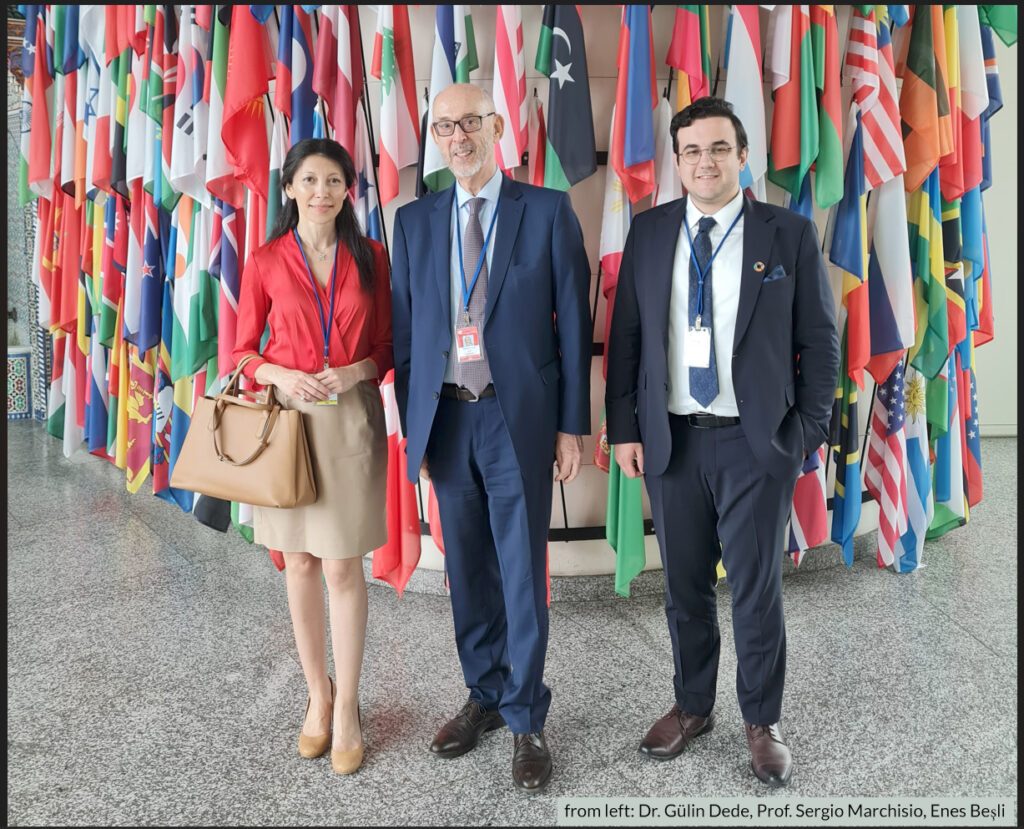
Space Renaissance International (SRI) will organize a high-level side event during the COPUOS Legal Subcommittee on 16 April 2026 at UNOOSA (Vienna), proposed and convened by Dr. Gülin Dede, titled “Operationalising Space as a Cross-Cutting Enabler of Sustainable Development: Perspectives on an Emerging 18th SDG Articulation.”

The session will bring together legal, policy, industry, and Global South perspectives to examine how outer space is evolving from a sectoral domain into a critical enabling infrastructure for the 2030 Agenda, while simultaneously requiring stewardship as an environment in its own right.

Positioned as an early contribution to shaping how space sustainability is framed within the broader UN system, the event will also be broadcast by the United Nations, extending its reach beyond the room to a global audience.

As part of SRI’s Space 18th SDG Coalition, now bringing together 120 partner organizations worldwide and supporting the 18th SDG articulation, the initiative aims to strengthen institutional coherence, reinforce the role of space within global sustainability governance, and support the continued development of this emerging framework.

SRI committed to add an 18th SDG focused on Civilian Space Development to the UN 2030 Agenda in 2021. This goal was mentioned in the SRI 3rd World Congress Final Resolution. In 2023 we initiated the campaign at COPUOS, in partnership with the National Space Society, that advanced this proposal already in 2018. The Space 18th SDG Coalition has now grown up to 120 organizations world-wide. It is now time to reach the next institutional level!

*****

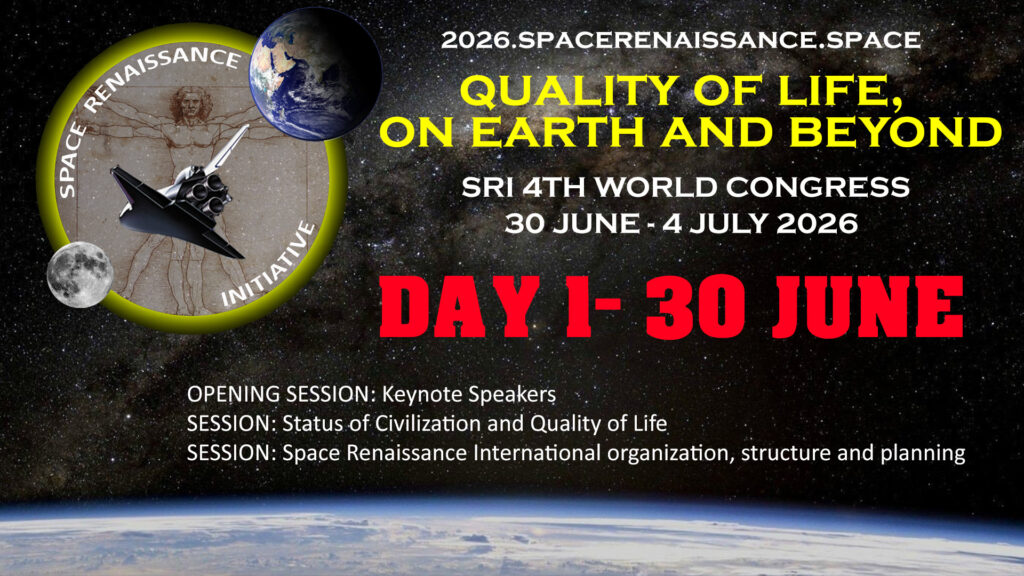
Register to the SRI 4th World Congress, to take place virtually from 30 June to 4 July 2026!

Check the Call for Papers, and submit your abstract(s)!

Register here.

Let’s work together to make a great congress!

Join the Space Renaissance!

#space #spaceresources #civilianspacedevelopment #spacerenaissance #lifeinspace #quality #qualityoflife #18thsdg #spacesettlement #congress #younggenerations #space18thsdg

Posted by Adriano in Articles, Blog, News, Newsletters
SRIC4 NEWS #05: A MESSAGE TO THE YOUTH: BE THE VOICE OF PEACE

SRIC4 NEWS #05: A MESSAGE TO THE YOUTH: BE THE VOICE OF PEACE

While space agencies globally recognize space applications, diplomacy, and national prestige as core justifications for their work, they remain hesitant to embrace a critical concept: the urgent humanization of space, or the urgent expansion of civilization into space. Similarly, educational institutions have not yet integrated matters related to civilian space development into their curricula.Reviewing the Space Renaissance Manifesto provides a deeper understanding of why the “humanization of space” is essential for the future. The proposition of diverting military spending toward civilian space development is simple yet transformative: it would directly elevate human quality of life. Wars are the worst experience a human population can encounter, and today we are witnessing more military confrontations around the world than at any time since WWII, action is necessary. With this short letter, we are calling the youth to take action.Youth working, or aspiring to work, in the space domain, are welcome to join Space Renaissance International (SRI) and become part of our cause. The Towards the Young Generation Committee is dedicated to guiding the next generation and advocating for the expansion of humanity into the cosmos.

This year marks the IV SRI World Congress (SRIC4), a landmark online event held every five years to set strategic guidelines. For the first time, a dedicated Youth Session is being hosted. Please see the specific EHTOS Call for Papers. And submit your abstract.  Be sure to flag the EHTOS checkbox:  “I am under 35 years old, this abstract is for the EHTOS context”

As a young professional or student, you will receive a discount when joining SRI. By submitting an abstract to the SRI World Congress, you will automatically join the youth special session.

Young Participants will benefit of a Competition Entry: High-quality papers will compete for scholarships to participate in either physical or virtual analog missions.

To learn more about the competition and how to submit your abstract, please check the EHTOS page.

SRI leads an international coalition whose mission is to add an 18th Sustainable Development Goal (SDG) related to civil space development to the United Nations 2030 Agenda. The Space 18th SDG has a dedicated Call for Perspective, connected to the SRIC4 18th SDG session.

Join SRI and be the voice of peace in your community. In addition to the Towards the Young Generation Committee, we encourage you to explore all SRI committees and join the one that aligns with your interests and career goals. Learn more about SRI here.

Help us spread the word about the urgency of expanding humanity into outer space and encourage your national space agency to adopt important space concepts that can bring prosperity and peace for everyone.

The Congress website: https://2026.spacerenaissance.space/

Looking forward to see you at the Congress.

Ad Astra!

Ghanim Alotaibi, SRI Board of Directors

#space #spaceresources #civilianspacedevelopment #spacerenaissance #lifeinspace #quality #qualityoflife #18thsdg #spacesettlement #congress #younggenerations #space18thsdg #youth #youthgenerations #peace

Posted by Adriano in Articles, Computer Science, Newsletters
SRIC4 Newsletter #04 – What is Quality of Life?

SRIC4 Newsletter #04 – What is Quality of Life?

What truly defines “Quality of Life” (QoL), and why we have titled the SRI IV World Congress on it?QoL is a broad concept, including all of the aspects of the life of us, human inhabitants of the third planet of this Solar System. Traditionally, we define QoL through the essentials—food, shelter, health, and education. These are the pillars of economic and cultural development, and they are non-negotiable. Yet, at Space Renaissance, we believe QoL aims higher. It is the freedom to pursue our highest ideals, to have a beautiful life, to explore spirituality, and to seek a global reduction in suffering.Interestingly, the perception of QoL varies wildly across our globe today. The Western post-industrial societies are often clouded by a lack of confidence and a fading hope for what lies ahead. The Eastern emerging societies, fueled by rapid industrial growth, look toward the horizon with immense anticipation. If we could measure QoL through the lens of hope, these emerging societies might actually outrank the West. Why? Because the belief that one is part of a “great project”—one that glorifies human intelligence and potential—is the ultimate antidote to social suffering.

Whether we progress or regress, fall into crisis or rise in a renaissance, it all depends on the mass-psychological mood of the people. When survival is secured, and economic growth creates opportunities for all, social fear dissolves. And as John Lennon famously sang, when fear fades, we finally “give peace a chance.”

We align ourselves with this progressive spirit, like a modern Promethean manifesto. However, we must be realistic: this hope has an expiration date. Without the launch of civil space development by 2030, the “closed world” will inevitably reach its limits. Eastern hopes will be dashed, and Western lifestyles will suffer a sharp decline.

The truth is simple. Quality of Life needs space. The hope in the future needs space. Our creativity needs space. Our spirituality needs space. Even the non-human life on Earth needs us to move outward, so our home planet can finally recover and breathe.

Join us at the SRI IV World Congress as we chart the path toward a future without limits, a sustainable luxury life for All!

See two special sessions:

Register to the Congress here: https://spacerenaissance.space/sric4-registration/

And submit your abstract(s): https://spacerenaissance.space/sric4-abstract-submission/

Also see the keynote speakers participating to the opening session the 30 of June: https://2026.spacerenaissance.space/index.php/sric4-keynote-speakers/

The Congress website: https://2026.spacerenaissance.space/

Looking forward to see you at the Congress.

Ad Astra!

Adriano V. Autino, SRI CEO & Founder

#space #spaceresources #civilianspacedevelopment #spacerenaissance #lifeinspace #quality #qualityoflife #18thsdg #spacesettlement #congress #younggenerations #space18thsdg

Posted by Adriano in News

SRIC4 News #03 – by Dennis O’Brien

THE 4TH SPACE RENAISSANCE INTERNATIONAL WORLD CONGRESS

June 30 – July 4, 2026

Work continues on the five-year Congress; SRI sends delegates to COPUOS Scientific & Technical Subcommittee meeting in Vienna.
The preliminary SRI Academy webinar series is online. It includes past presentations, including last week’s by Alberto Cavallo on “Date Centers in Space”, a practical assessment made newsworthy by SpaceX’s recent announcement of plans to do so. There are 10 more webinars scheduled before the Congress in late June. Click on the “series” link above for a complete list, including past presentations and links to videos/streams.
We have already received several abstracts for the Congress. Main topics are Philosophy & Policy, Science & Engineering, and Art & Media. Subtopics include: Resources (overshoot day, unsustainable demand); Beautiful Life in Space (quality of life, ergonomics); the 18th Sustainable Development Goal; and the Rights of Settlers/Settlements (“We speak for the settlers”). For more information, please go to our Congress page which contains links for submitting abstracts and registering for the Congress (free). Click here for current list of speakers.
New! SRI’s Towards the Young Generation Committee is pleased to invite students and young professionals to join Expanding Humanity to Outer Space (EHTOS) paper competition that will be held during the IV  Space Renaissance International Congress (SRIC) from 30 June to 4 July. For more information, please click here. Deadline for abstract submission is March 30.
Much of our effort is informed by our work with the United Nations’ Committee on the Peaceful Uses of Outer Space (COPUOS). At this month’s meeting of the Scientific and Technical Subcommittee, we made two presentations, “Living in Free-Space Habitats, a Choice of Freedom” by Adriano Autino, and “Space Habitats and Vehicle Design” by Werner Grandl. SRI is a Permanent Observer and is permitted to address the committee/subcommittees on our areas of our expertise.
SRI also had three delegates (M.L. Heuser, Amalie St. Clair, and Gülin Dede) who observed informal discussions involving ATLAC (Action Team on Lunar Activity Consultation) and EG-SSA (Expert Group on Space Situational Awareness). They report that SRI’s contribution to ATLAC was “well received and genuinely appreciated”; it is now posted on their dedicated UN web page. Although SSA is not a prime focus of SRI at this time, the EG has issued a questionnaire to COPUOS members and observers, which we will complete to stay engaged pending future developments.
Our observers also reported that the commitment to sustainability, long part of the UN and COPUOS efforts (e.g., the Sustainable Development Goals and the Guidelines for Long-Term Sustainability of Outer Space Activities), was being challenged by the United States and Russia, who refused to agree to the STSC final report unless it included a disclaimer that the report does not prejudice the adopted positions of state parties. The  subcommittee adopted the disclaimer. We look forward to the STSC final report, which should include reports from the working groups.
Thank you for your interest in SRI and its work. If you do not wish to receive such updates, please reply with the word “unsubscribe”.

prepared by Dennis O’Brien, Co-Chair, SRI Space Policy Committee

Little more than one month to the abstract submission deadline: 31 March 2026! Submit your abstract today!

Posted by Adriano in Blog, News

SRI 4th World Congress: some key topics

Dear Space Friends,

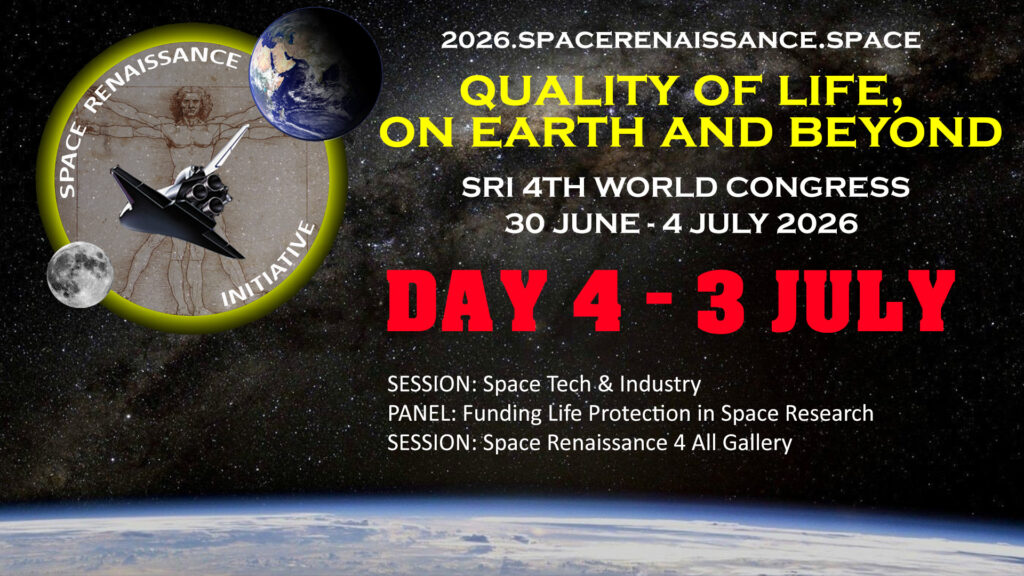
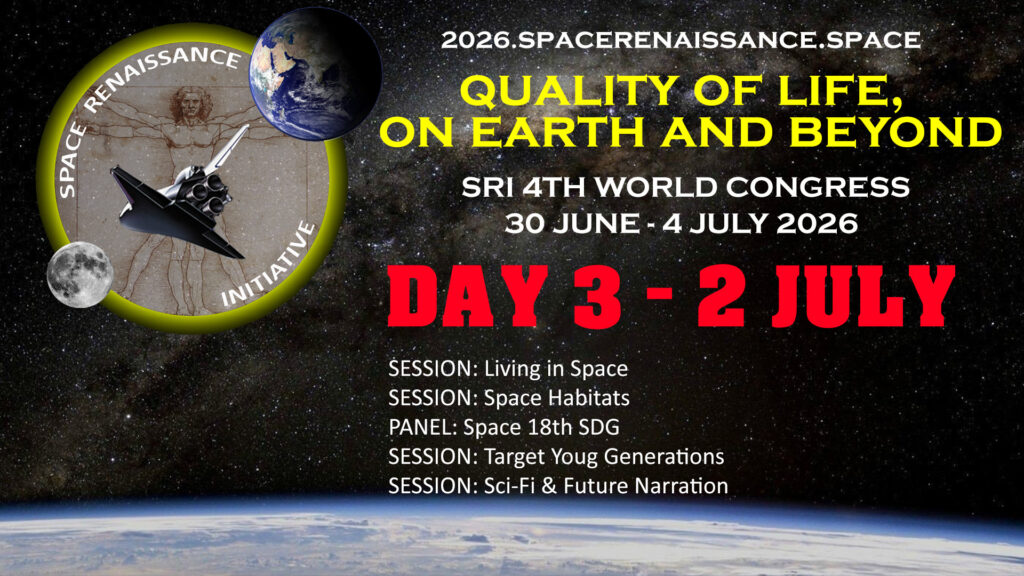
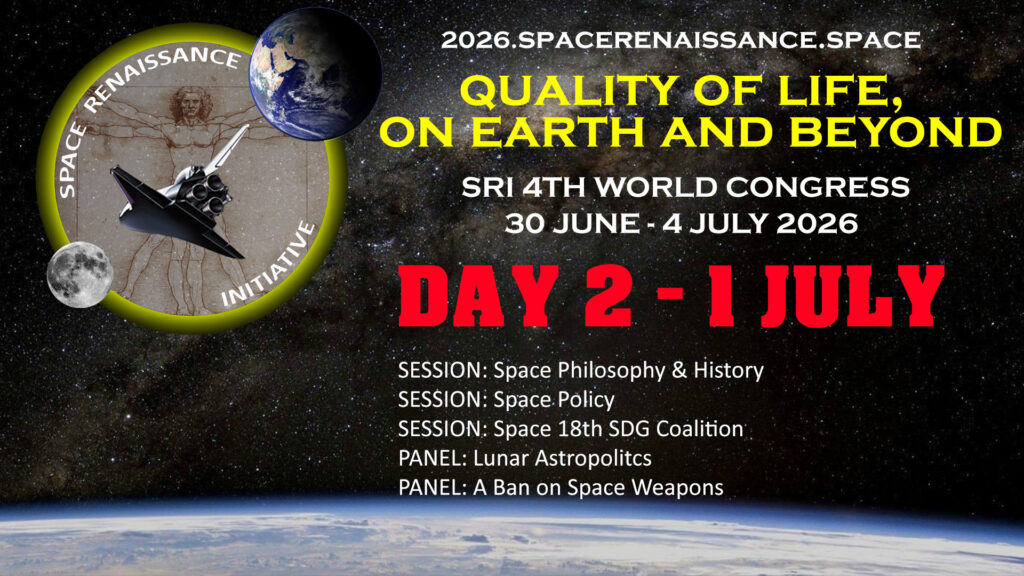
Today let me attract your attention to the SRI 4th World Congress, an online event held every five years. The 2026 session is titled “Quality of Life, on Earth and Beyond”, and will take place from 30 June to 4 July.

The Congress scope is the development of a space policy suitable to promote the acceleration of Civilian Space Development during next five years.

Among the key topics to be discussed:

  • Resources – The overshoot day and the unsustainable energy demand
  • Beautiful life in space – Quality of Life, ergonomics, beauty, greenery, flamboyance
  • Space Policy – Space 18th SDG, priority to geo-lunar industrialization and settlement, mining, fuel production in space, orbital debris recovery and reuse
  • Science & Tech – Human requirements for space habitats and vehicles, protection from cosmic and solar radiation, simulated gravity, redundant design
  • We speak for Space Settlers – Space resources property and utilization, the rights of the space settlers

And very much more!

Register to the congress here: https://spacerenaissance.space/sric4-registration/

And submit your abstract(s): https://spacerenaissance.space/sric4-abstract-submission/

Also see the keynote speakers participating to the opening session the 30 of June: https://2026.spacerenaissance.space/index.php/sric4-keynote-speakers/

The Congress website: https://spacerenaissance.space/

Looking forward to see you at the Congress.

Ad Astra!

Adriano V. Autino, SRI CEO & Founder

#space #spaceresources #civilianspacedevelopment #spacerenaissance #lifeinspace #quality #qualityoflife #18thsdg #spacesettlement #congress

Posted by Adriano in Blog, Newsletters, SRI IV WORLD CONGRESS

THE 4TH SPACE RENAISSANCE INTERNATIONAL WORLD CONGRESS June 30 – July 4, 2026

Welcome to the newsletter for SRI’s 4th World Congress, an online event held every five years. The Congress takes care of required business (e.g., the selection of directors) but is otherwise devoted to the development of policies and the practical steps needed to promote and implement them. We will also draft a Final Resolution and Congress Theses that will be submitted to the membership for approval and provide guidance for the next five years.
The discussion will be anchored by presentations during the Congress. To that end we have issued a Call for Abstracts. Please follow the link to see how sessions are being organized, then click “Submit an Abstract” to do so. You can also click on “SRIC4 Registration” to register for the Congress (or use links below). All sessions are free, but only members will vote on what we adopt as ongoing SRI policies.
There have already been some Congress-related presentations this year, part of SRI’s online Academy. The latest was by Dr. Marie-Luise Heuser on Space Romanticism. Our next presentation is February 17 (9pm CET), Data Centers in Space: An Update, by Alberto Cavallo. For a list of videos and links, please visit SRI’s YouTube channel.
We will also be discussing SRI’s work at the UN’s Committee on the Peaceful Use of Outer Space (COPUOS). SRI became an official Observer in 2024 and has been presenting technical reports during sessions of the Committee, the Scientific & Technical Subcommittee (we’re there now), and the Legal Subcommittee. Our focus has been on a critical review of the UN’s Space 2030 Agenda and SRI’s proposal for an 18th Sustainable Development Goal – Civilians Space Development. Please click on the link for more information about the 18th SDG Coalition (currently 116 organizations) and how your organization can join.
We will be sending updates as needed concerning the Congress and related work. Thank you for your interest in Space Renaissance International and the important issues facing humanity as we prepare to leave the home world.
– Prepared by Dennis O’Brien, Co-chair, SRI Space Policy Committee
Posted by Adriano in News, SRI IV WORLD CONGRESS
SRI NEWSLETTER – “WE SPEAK FOR THE SETTLERS!”

SRI NEWSLETTER – “WE SPEAK FOR THE SETTLERS!”

Space Renaissance International (SRI) is a Permanent Observer at the UN’s Committee on the Peaceful Uses of Outer Space (COPUOS). We are currently advocating for:

  1. Ownership of resources removed from in place (being considered by the COPUOS Working Group on the Legal Aspects of Space Resource Activity);
  2. Permanent advisory status for the private sector in any new consultation mechanism proposed by ATLAC (COPUOS Action Team on Lunar Activity Consultation);
  3. Recognition of the Right of Asylum in outer space, as guaranteed by the Universal Declaration of Human Rights and the Refugee Convention;
  4. Recognition of the Right to Develop as stated in the UN Declaration of the Right to Development, “an inalienable human right for every person and people to participate in, contribute to, and enjoy economic, social, cultural, and political progress, leading to improved well-being, freedom, and dignity.”

Jurisdiction and Control: Article VI of the Outer Space Treaty of 1967 states that “States Parties to the Treaty shall bear international responsibility for national activities in outer space . . . The activities of non-governmental entities in outer space, including the moon and other celestial bodies, shall require authorization and continuing supervision by the appropriate State Party to the Treaty.” Such jurisdiction and control can be shared by multiple states: “When activities are carried on in outer space, including the moon and other celestial bodies, by an international organization, responsibility for compliance with this Treaty shall be borne both by the international organization and by the States Parties to the Treaty participating in such organization.

Multiple states can also use an operating agreement to govern activities when working together, as with the International Space Station. States will retain jurisdiction of its nationals even when they are within space controlled by another state (OST Article VIII) unless the individual seeks asylum (above).

Many countries and organizations envision permanent settlements in outer space. Such settlements can seek to become autonomous regions, still within the jurisdiction of a state or states, but able to govern its own local affairs. A good example is American Samoa, where the United States federal government is responsible for foreign policy and defense, while the local Samoan legislature is responsible for almost everything else.

Ultimately, space settlements will likely seek independence, as dramatized by Robert Heinlein in The Moon Is A Harsh Mistress and by Isaac Asimov in The Martian Way. The Montevideo Convention of 1934 establishes four minimum requirements: (a) a permanent population; (b) a defined territory; (c) government; and (d) capacity to enter into relations with the other states. Recognition by other sovereign states, though not required, is certainly desired. When a settlement declares its independence, it will no longer be bound by the Outer Space Treaty but would likely seek to join on condition of recognition of its claimed territory.

SRI will continue producing papers and presentations on the Legal Aspects of Outer Space Settlers and Settlements in support of humanity’s efforts to expand into space. More at our SRI World Congress, June 30-July 4. https://2026.spacerenaissance.space/

Check the Call for Papers, and submit your abstract(s)!

Register here.

To understand more about the Congress symposia, sessions, and proposed topics, also watch the SRIC4 #00: “Announcing the 4th SRI World Congress”, on the Space Renaissance YouTube channel!

Let’s work together to make a great congress!

Join the Space Renaissance!

Watch and subscribe to the Space Renaissance YouTube channel.

You may discuss this article on the SRI Open Forum.

Also download a pdf version of this article.

Posted by Adriano in News, Newsletters

End of 2025, lost in fog for 2026 (my Christmas thoughts)

Dear SRI Friends and Supporters,

I don’t feel to wish you anything for the next year, since Wishes are obvious, when war drones are flying in the near skies, and too many times Wishes were unfulfilled.On the contrary, I am calling for help. Don’t be afraid, this time I am not asking for money, though money is always indispensable to NGOs, and my activist’s duty is to remember that you know how to do it, by the proper forms on the SRI website main menu (Funding and SRI Crew).

Straight to the point. You likely know that 2026 is the year of the SRI IV World Congress (30 June – 4 July). As you likely know from our past 3 World Congresses, since 2011, every 5 years, we inflicted on ourselves a very hard and ambitious task: to assess the status of civilization, and indicate our priority goals to solve the main global issues. Of course, if you follow SRI, our papers, our campaigns and activities at UN COPUOS, IAF, outreach and public events, you know what our analysis and proposed strategy are. We already described them in our 2021 thesis document. Those forecasts are now more than confirmed – civilization risks an irreversible implosion – and the strategy to avoid such a scary fate is only one: to kick off civilian space development before 2030, relaunching economic growth at 2 figures, and making Earthly resource wars obsolete.

But, comparing today’s situation with that of 2021, we see enormous changes and differences. Terrible wars and genocides have begun, and don’t promise to end, in the heart of or at the neighbors of the “advanced” world, and many other forgotten conflicts are killing thousands of unreplaceable human lives, a clear symptom that the implosion already started.

Terrific technological advances are developing, first of all, artificial intelligence, so full of promises and threats.

The space economy is going to lead the possible sustainable development. Yet, both the mentioned vectors, AI and Space Economy, can be sustainable and lead the global sustainable development, only if civilian space development really starts. Yes, of course, the Space+AI investors could even point once again only to automated orbital and Moon development: that would be just another illusion, destined to bring about further economic “bubbles” to explode, reiterating further stages of the global development crisis. Why? Because Planet Earth cannot tolerate the current and growing level of anthropogenic pressure. That should be clear nowadays, but it is not. So, our main task is to develop proper outreach and explain it in simple and understandable words.

The point is not that our home planet is now poor in resources, though this is also true. Yet we have already seen that new fossil reserves are being discovered, and new (terrestrial) energy sources are also discovered, like vegetal fuels, photovoltaic, etc. Yet we have already seen that the energy demand coming from supercomputers to support AI, electronic money, and electric mobility is not sustainable by terrestrial sources. And the main point is that, even if terrestrial sources were available, the needed large industrial extraction processes are not sustainable. That’s why we need to move outside, developing data centers in space, and the main industrial development, too. To produce what? For which customers? For Earthly markets only? That would not relieve the pressure; that would even increase it. Any growth limited within Earth’s boundaries is unsustainable. Let alone the wars… Wars are over any criteria of sustainability, and a global war as it is nearing is simply incredible, worthy of psychiatric treatment for its main dealers.

Coming to my today concerns and sleepless nights. Are we, at SRI, able to draw a realistic description of today’s civilization status? And, even more important, are we able to define an actualized strategy, the best priorities to be pursued, to help humanity pass the 2025-2030  “Eye of the Needle”?

For some weeks, the SRI Board and the Space Renaissance Academy have been tackling this terrific task. And I have the thankless duty to try assembling different contributions and drafting a coherent thesis paper.  I confess that any approach seems to me too poor, neglecting some important points, or giving too much relevance to some not really important ones.

Now, the Space Renaissance movement is larger than the SRI Board, Academy, and Membership. Very interesting discussions are raised each month in our SRI Open Forum. I have the very great pleasure and am proud to see that our Forum is also used by other sister organizations, such as AIAA, NSS, and other communities.

So I have decided to open this discussion and to ask all sincere space humanists to provide help on some key questions and issues.

We titled our Congress “The Quality of Life, on Earth and Beyond”. Clearly, we are talking about a 360° concept of quality of life, from the basic needs (food, clothes, shelter), to social and belonging needs, to the highest needs (self-realization and transcendent aims). What is your idea of the Quality of Life? Yes, my idea includes not only the acknowledged needs (physiological, social, and cultural). I might also refer to a famous slogan that says: “We don’t need only the bread, but also the roses!” Meaning that the superfluous is necessary. A hedonistic Western vision? Maybe, but nothing wrong, if we can provide a beautiful life for everybody… And that’s the concept that I had in mind, proposing the Quality of Life topic for our congress: space will make possible a beautiful life for everybody. Not just to survive, but to thrive, and to improve our quality of life.

Yes, I have proposed using Maslow’s criteria to try to read the reality, how the quality of life changed over the last 50 years. Some colleagues argumented that Maslow’s “pyramid of needs” suggests a hierarchical stratification of society, implying that one cannot achieve higher levels if one has not achieved the lower ones. Maslow never said that. He proposed his classification of human needs on a probabilistic statistical basis, not at all as a values classification. My personal opinion is that Maslow’s human needs classification is more complete than the Marxist one, which only focuses on the achievement of the basic needs (or maybe, being Marx’s literary production so large, let’s say that his epigones mainly focused on class differences, related to the basic needs).

However, it was said that there are many other philosophers and anthropologists who have provided tools to analyze and measure the progress or regress of civilization. Since I don’t aim to defend Maslow as our unique reference, I am first of all asking for some more references. Please provide concepts and useful tools for reading reality, not just authors. However, I’d like to point out that I consider Maslow’s philosophical and anthropological controbution relevant, though his studies were on psychology. And, however II, psychology is determinant for philosophy and human history (also think about Isaac Asdimov psychohistory).

It was also said that some excellent cases testify that reaching the highest self-realization goals is possible even in very poor conditions. Sure, in human history, we have saints, geniuses, and artists who were able to sublimate their poor living conditions and donate great philosophical concepts, beautiful artworks, or great cultural contributions. Yet, should we indicate those cases as a social model? Often, those great people deprived their families of the necessary things in order to pursue their ideals. I don’t want to denigrate their sacrifice, but neither would I like to suggest a model of society where people aiming high are constrained to renounce their basic needs to pursue their highest ideals. This is exactly the point where humanity’s expansion into space comes in, breaking the zero-sum game of a closed-world society!

When I proposed the Quality of Life as a title for our incoming congress, I had not Saints or Bohemians in my mind, but normal, average people. Normal, average people, at least in the so-called advanced societies, thanks to the industrial revolution and technological progress, were allowed to become aware of their cultural interests, and perhaps cultivate some cultural or artistic high-level objectives. That achievement, together with better housing, clothing, food, health systems, and the possibility to make their children study to achieve a higher social condition, improved their quality of life. Is such a process continuously going ahead in the present? Is it steady, or has it even inverted the march, heading now to social regression? I’d like to assess: has such improvement continued during the last, say, 20 years? Or has the progress in the closed world reached the bars of the cage? What are the main “key performance indicators” to assess the quality of life and social progress/regression? Number of graduates? Quality and availability of Health systems? Quality and availability of Education systems? Ease of establishment and access to the business environment for startups? Employment and opportunities for business?

Btw, my research evidenced a quite disappointing evaluation, made, not by us, but by the UN itself, about the achievement of the 17 SDGs, 10 years after the publication in 2025. 3 SDGs are showing clear regression (including the most worrying one, 16 Peace), 12 are steady, and only 2 show weak progress.

It was also observed that the sentiment of having no future, as described by some youth movements, e.g., “We don’t have planet B”, is prevailing in the western post-industrial world, while the emergent eastern Countries – India first – are quite different. Hope in the future and faith in progress are the most common feelings among the young generations in those Countries. Therefore, it seems that we need good contributions from the East of the world (of course, even to call it “East” is an Eurocentric geographic concept…), to get a really holistic view of the Civilization situation, and maybe different outreach strategies for different continents (not on the substance, but on the narrative style…).

However, it is very clear that the assessment of the status and perspective of Civilization is all but based on numbers and economic figures. Our future depends on the psychological perception of reality. The global data about the economy, ecology, climate change, progress, regression, and sustainability are the same at all latitudes, yet our perception is very different. We are facing a cusp in human history, but it is perceived differently in different parts of our world. How can we get in touch, discuss, and collaborate with all the sincere humanists of Planet Earth?

I know, my list of questions is largely incomplete! Please also suggest more criteria.

Answers are very welcome on our Forum (just ask to enter if you’re not already in): https://groups.google.com/g/sri-open-forum

Your paper abstracts for the Congress are very welcome too: https://2026.spacerenaissance.space/index.php/call-for-papers-abstract-submission/

Ad Astra! (hopefully)

Adriano V. Autino

Posted by Adriano in Blog, Open Letters, SRI IV WORLD CONGRESS
THE BRAVE AND THE COWARDS – SRI Newsletter December 2025

THE BRAVE AND THE COWARDS – SRI Newsletter December 2025

As the geopolitical climate shifts, we increasingly hear warmongering pronouncements that tend to resurrect popular sentiments we naïvely believed had been buried by history.Among these is the claim that Europe is weak and cowardly, unwilling to cross the threshold between adolescence and adulthood. Maturity, according to this narrative, demands rearmament and a head-on confrontation with the challenges of the present historical moment. Yet beneath this rhetoric lies a far more troubling transformation.

We are witnessing a blatant attempt to replace the prevailing moral framework—until recently ecumenically oriented toward a passive and often regressive environmentalism—with a value system founded on belligerence. This new morality defines itself against “enemies” of presumed interests, whether national, ethnic, or ideological.

Those who expected a different kind of shift—one that would abandon regressive policies in favor of an active, forward-looking environmentalism—have been rudely awakened. The self-proclaimed revolutionaries sing an old and worn-out song: war. These new “futurists” embrace a technocratic faith that goes far beyond a legitimate trust in science and technology—long maligned during the previous ideological era—and descends into open contempt for human beings themselves, now portrayed as redundant or even burdensome in the age of the supposedly unstoppable rise of artificial intelligence.

What we face is a dramatic ethical and cultural regression, from which some expect to profit greatly.

Why is this a cultural regression? Because it reintroduces fierce intraspecific competition as the proposed solution to our civilization’s challenges—or worse, without any concern for global challenges at all. The rearmament policies now spreading across the world almost entirely ignore environmental considerations, which until less than a year ago were presented as the dominant justification for largely regressive degrowth policies.

Why is this also an ethical regression? Because ethics, as lived and understood by societies, is neither fixed nor immutable. While profound ethical insights can indeed be found among ancient philosophers, humanity’s moral judgments regarding murder, massacre, genocide, exploitation, torture, ethnic cleansing, and war itself have undeniably evolved over centuries and millennia. Technological and social progress have steadily reduced the objective necessity of ruthless competition, opening the possibility of a world in which losers need not perish, but may still benefit from collective advancement—and perhaps find future opportunities for success.

Even within sacred traditions, this evolution is visible: from biblical narratives that recount massacres, divine favoritism toward specific ethnic groups, and concepts of women as property, to the evangelical message, which introduces a far more humanist vision—one that still resonates deeply today.

From both cultural and ethical perspectives—two dimensions that should never diverge—the realization, around the middle of the twentieth century, that humanity was consuming more resources than Earth could provide was itself a positive step forward. The responses to that realization, however, have been deeply flawed. Passive environmentalism and degrowth policies have paved the way for today’s grim prospect: the annihilation of much of humanity in a global war of all against all.

But here lies the central point.

Until little more than a century ago, space technologies did not exist. Human competition was confined within planetary boundaries, and the stakes were the control of Earth’s resources. Did this reality make war acceptable—or even virtuous? For centuries, poets and historians glorified heroes and conquests, embedding war deeply within educational systems that still emphasize victories, battles, and the demonization of the defeated.

Yet once humanity began to imagine expansion beyond Earth—and the possibility of accessing extraterrestrial resources—a different sensibility emerged. From the artistic movements of the twentieth century to the global upheaval symbolized by 1968, war increasingly came to be seen for what it truly is: an immense waste of lives and resources, an intolerable deviation from the path of civilized progress, and—almost always—a violent appropriation of land and wealth. An ethical and cultural wound that has become unbearable, especially now that a viable alternative exists.

Today, at the beginning of the second quarter of the twenty-first century, space technology—now closely and inextricably linked to the development of artificial intelligence—is on the verge of a true quantum leap. It is paving the way for the civilian development of space, beginning with the Moon and the cislunar domain.

It would seem logical to concentrate our collective efforts on this extraordinary goal. Humanity appears to stand at the threshold of a potential golden age, one in which all people—nations, cultures, ethnic communities, and peoples of Planet Earth—can contribute and share in the benefits. The resources of the solar system and the vast spaces available for industrial and residential development are so abundant that they naturally reduce greed and brutality, encouraging cooperation and fair competition instead. The development of global communication has progressively shown that all people of the world are really very similar in their daily life, hopes, concerns, projects, love for their children, struggle to get better life conditions… not easy for the warmongers to force Terrestrians to see monsters in foreign countries, and hate each other. We may be approaching a new romanticism: one in which looking down on Earth from orbit, and outward into the universe from the Moon and beyond, evokes a profound sense of shared destiny—what Frank White so aptly described as the “overview effect.”

This is not fantasy. It is a path of evolution firmly grounded in centuries of technological, cultural, and moral progress.

And yet, some of those to whom we have entrusted—by vote—the responsibility of leading our nations seem to believe that we must instead relish the prospect of death and destruction, and devote absurd quantities of public resources to this insanity.

In this surreal narrative, those who refuse rearmament are branded as weak and cowardly. In reality, the opposite is true. In today’s world, with the immense potential now within reach, it is precisely the weak and the fearful who turn to war. The brave and the generous do not resign themselves to killing their brothers over dwindling planetary resources. They aim higher. They look beyond Earth, toward new frontiers and new resources for all.

I am convinced that many of us—explorers and pioneers—already exist. What remains is for us to step forward and to begin replacing unsuitable political directions with others that are culturally sound, ethically mature, and worthy of humanity’s future.

The “Space for Peace” concept is at the core of the SRI IV World Congress preparation: “Quality of Life, on Earth and Beyond”. The Congress will take place, virtually, from 30 June to 4 July 2026. Some of the key tracks:

  • Status of civilization and quality of life
  • Civilian Space Development, a factor of Peace on Earth and Beyond
  • Space resources: who are the owners? We speak for Space Settlers!
  • Human rights in space
  • The permanent space revolution: 100% inclusivity
  • Protection of life and health in space
  • Beauty and ergonomics of habitats as an essential life requirement
  • Space to Space transport vehicles
  • Orbital Debris recovery and reuse
  • Cloud computing and big data centers in space
  • Producing fuel in space

Check the Call for Papers, and submit your abstract(s)!

Register here.

To understand more about the Congress symposia, sessions, and proposed topics, also watch the SRIC4 #00: “Announcing the 4th SRI World Congress”, on the Space Renaissance YouTube channel!

Let’s work together to make a great congress!

Join the Space Renaissance!

Watch and subscribe to the Space Renaissance YouTube channel.

Also download a pdf copy of this article.

Posted by Adriano in Newsletters, SRI IV WORLD CONGRESS
SUPPORT “HI” EVERYWHERE! – SRI Newsletter November 2025

SUPPORT “HI” EVERYWHERE! – SRI Newsletter November 2025

Artificial Intelligence and Civilian Space Development: A Call for Synergy, Not Substitution!

Artificial Intelligence (AI) is rising at an extraordinary speed, emerging as an entirely new industrial pillar. Leading corporations—NVIDIA, Apple, Microsoft, Alphabet—are achieving unprecedented revenue growth, reshaping global markets in just a few years. According to market analysts, the global AI market is likely to overtake the space market before 2030.

Today, the global space market is valued at roughly $512–613 billion (2025) and is projected to grow to $800–1,000 billion by 2030, with continued expansion expected through 2034. Growth drivers include next-generation satellites, launch services, and escalating commercial and governmental investments. Analysts from Grand View Research, the Space Foundation, and GlobalData forecast the space economy surpassing $1 trillion in the early 2030s.

Yet these projections are increasingly compared with the explosive ascent of the AI sector—a sector still in its infancy. This raises several important questions.

  • Is AI drawing investment away from the space industry?
  • Will AI accelerate or hinder humanity’s expansion into space?
  • Can AI sustain its current growth pace—or are we witnessing another bubble?
  • And, critically: can Earth-based energy and water resources support AI’s massive supercomputing demands?

Elon Musk recently voiced doubts about the sustainability of Earth-bound AI growth, pointing to limited terrestrial energy capacity and the enormous cooling-water requirements of data centers. He suggests that space may offer a more suitable environment for large-scale AI development, providing limitless solar energy and superior cooling potential.

There is no question that AI is an extraordinary tool for addressing human challenges. But confined within Earth’s physical limits, AI could also unintentionally slow the opening of the space frontier—much like previous technological revolutions (industrial automation, the internet, robotics) that gave humanity the illusion it could restart development indefinitely while remaining on a closed planet. Each time, the resurgence of global crises revealed the truth: no long-term progress is possible without expanding into the high frontier.

For the first time in history, we are aware that the new revolution—AI—cannot sustain itself within Earth’s resource limits, particularly energy and water. This presents a stark dilemma:

  1. Continue developing AI exclusively on Earth, risking the implosion of its economic potential as resource bottlenecks emerge.
  2. Shift main AI development into geo-lunar space, using AI to build the space infrastructure, and support civilian space settlement.

The warning has been raised. AI and space development are not adversaries; they can be profoundly synergistic. The question is whether political leaders will act in time. Space advocates have the responsibility to amplify this message before it is overlooked.

Meanwhile, the broader global crisis is hitting younger generations hardest. The COVID-19 pandemic confined them indoors, depriving them of essential social development. In many countries, students were directed to rely solely on remote schooling, undermining both learning and socialization. Today’s geopolitical climate—marked by nationalism, war, and international tension—further restricts opportunities for young people to explore the world and define their path. Increasingly, they are presented with a worldview where survival outweighs culture, and loyalty to narrow national or ethnic identities is valued above global human cooperation.

At SRI, we strongly reject this trajectory. We believe human intelligence exists everywhere—across all nations, cultures, and faiths—and that Human Intelligence (HI) shall remain ascendant over Artificial Intelligence (AI). Our goal is to find and support HI wherever it lives. Rather than attempting to build an artificial superhuman mind to replace our own, we choose to search for the real Einsteins and Mozarts of tomorrow. We know that genius may be found in a child living in a slum, playing football with a ball made of rags. We champion Human Intelligence—and we continue to use AI as a powerful tool, not a substitute for human insight, creativity, and vision.

The above concept is at the core of the SRI IV World Congress preparation: “Quality of Life, on Earth and Beyond”. The Congress will take place, virtually, from 30 June to 4 July 2026. Some of the key tracks:

  • Status of civilization and quality of life
  • Civilian Space Development and Artificial Intelligence
  • Space resources: who are the owners? We speak for Space Settlers!
  • Human rights in space
  • The permanent space revolution: 100% inclusivity
  • Protection of life and health in space
  • Beauty and ergonomics of habitats as an essential life requirement
  • Space to Space transport vehicles
  • Orbital Debris recovery and reuse
  • Cloud computing and big data centers in space
  • Producing fuel in space

Check the Call for Papers, and submit your abstract(s)!

Register here.

To understand more about the Congress symposia, sessions, and proposed topics, also watch the SRIC4 #00: “Announcing the 4th SRI World Congress”, on the Space Renaissance YouTube channel!

Let’s work together to make a great congress!

Join the Space Renaissance!

Watch and subscribe to the Space Renaissance YouTube channel.

Also download a pdf version of this article!

Want to discuss? You can do it on the SRI Open Forum!

Posted by Adriano in Blog, Newsletters, SRI IV WORLD CONGRESS