
- This event has passed.
SRIC4 #12: “Data Centers in Space: an update”
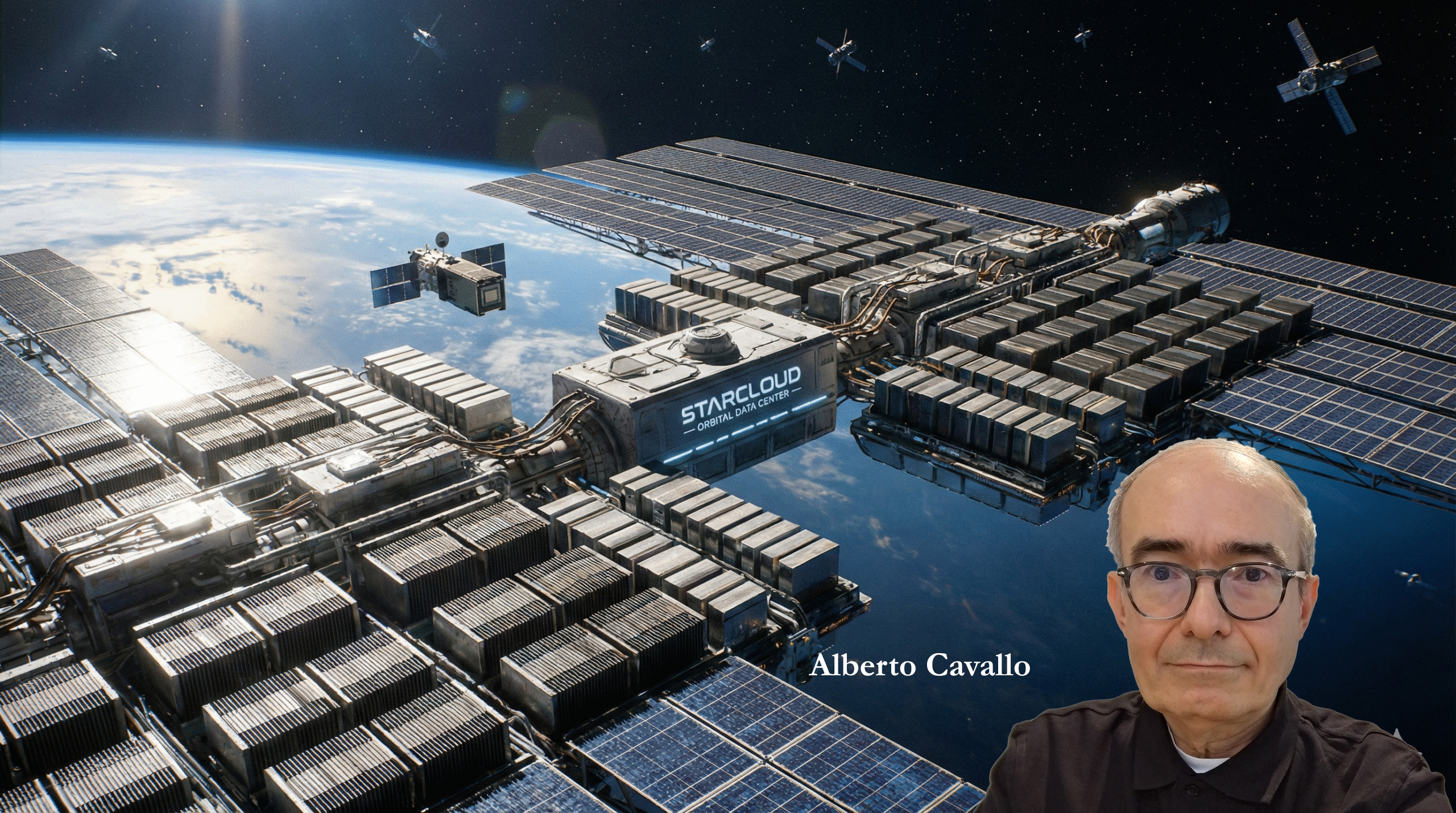
This is the preliminary webinar #12 of the IV SRI World Congress (SRIC4)
Abstract
By Alberto Cavallo – December 2, 2025
A central thesis which Space Renaissance International has enounced since the beginning is the opportunity of moving industrial and business activities to space: not “old space” activities like communications, Earth observation, and positioning services, but all industries that have a significant impact on Earth’s environment and can practically be transferred to space, specifically in the cislunar environment. There are several motivations to do that: 1. Reducing land occupation 2. Avoiding emissions of chemicals as well as waste heat on Earth, which affects the use of water, which is a precious resource 3. Reducing the load on energy systems, which in turn affects 1 and 2 4. Ensuring the possibility of unlimited scale-up, when space resources start to be used There is no doubt about the advantages, but in order to reach an industrial development off-Earth, several conditions must be met: 1. The activity must be feasible in space 2. The product or the service must be easy to deliver on Earth, because initially, the market will be there 3. The first activities should not require big technical advancements to be performed in space, allowing a reasonably quick deployment 4. Cost must be competitive Data centers are good candidates for the role of the first land-based activity that can be moved to space. The paper deals with the advantages and requirements connected to transferring data processing into space, showing how this operation can reach the goals and meet the conditions listed above. The main downside is, of course, cost, but the amazing progress being achieved in the reduction of launch cost can be decisive and can enable the initiatives that are, in fact, already starting, as described in the final section. Recently (November 2025), the Blue Origin New Glenn heavy launcher became fully operational with a flawless second launch, while SpaceX Starship has overcome some failures, succeeding in two consecutive test launches and is underway to reach operability, possibly within 2026. These launchers can reduce the cost to orbit enough to make space-based data processing competitive with land installations. This paper is an update of the one presented at IAC-2025 in Sidney, with the title: ”3xE: Energy, Economy, Environment. A space perspective case: Big Data Farms in Space.”
A short bio
Follow the Livestream on the Space Renaissance YouTube Channel: https://www.youtube.com/live/QuNDRuhdeMo
and click ‘going’ on the Facebook Event: https://www.facebook.com/events/25714492858148496/