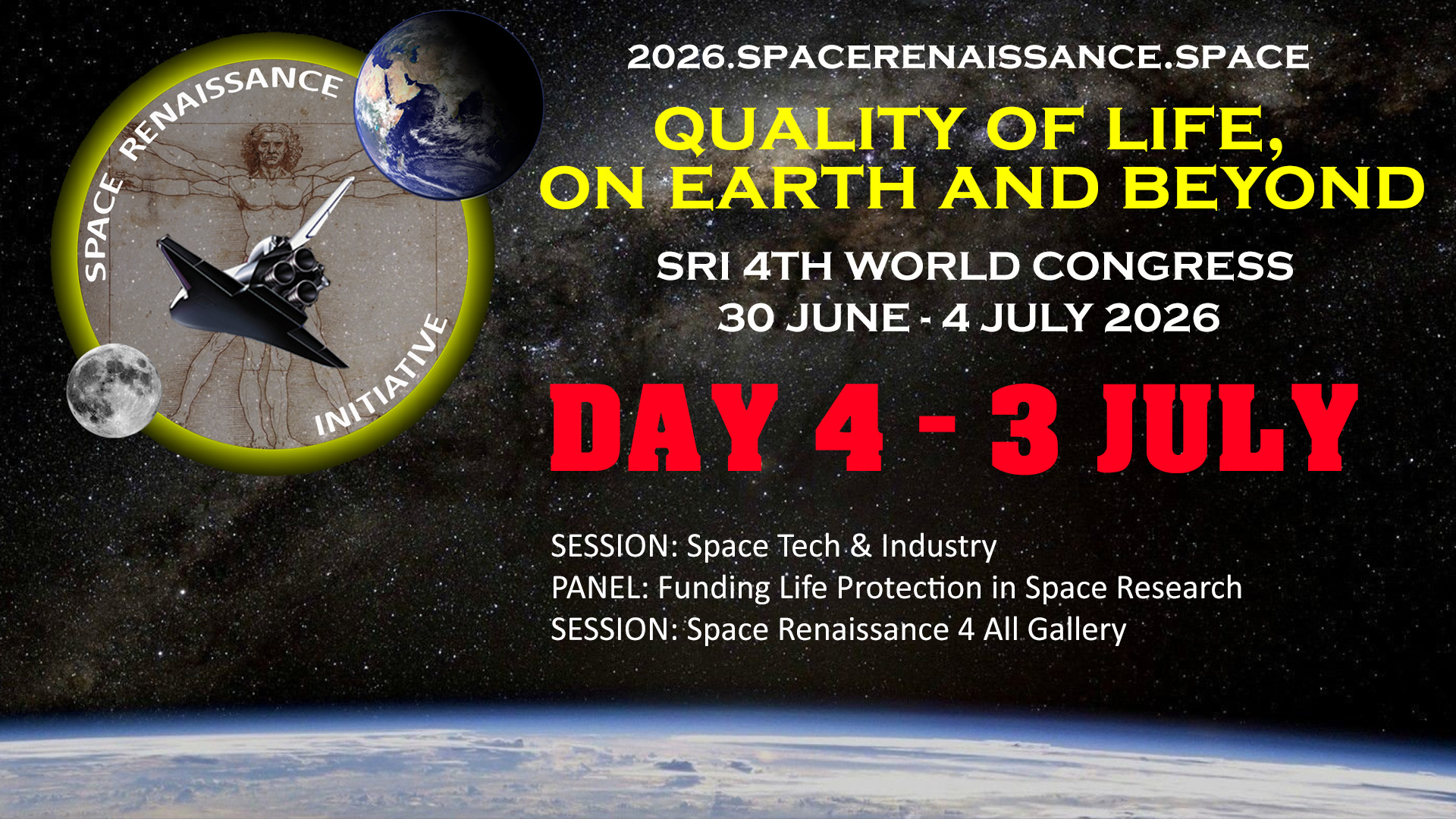
The fourth day of Space Renaissance International’s Fourth World Congress examined the technologies, infrastructure, health systems and cultural initiatives needed to transform space from a destination for short missions into a place where civilian communities could live, travel and create.
3 July 2026 — The Fourth Space Renaissance International World Congress continued on Friday with a wide-ranging programme focused on space technology, transportation, industry, human safety and the cultural use of outer space.
Day 4 brought together engineers, researchers, advocates and artists to explore subjects ranging from reusable launch systems and space elevators to rotating habitats, nuclear propulsion, lunar launch infrastructure, radiation protection and space art.
The day’s discussions reflected a common theme: becoming a spacefaring civilization will require an integrated system of transportation, construction, energy, health protection and culture. Participants argued that no individual technology will be sufficient. Civilian expansion will depend on how these systems are connected and made safe, sustainable and accessible.
Engineering the Foundations of Life in Free Space
The principal technology session was chaired by Werner Grandl and moderated by Alberto Cavallo.
Grandl opened the technical programme with an examination of the scientific and engineering requirements for living in free space.
His presentation covered artificial gravity, the construction of rotating habitats, in-situ resource utilisation, radiation shielding, protection against micrometeoroids and the creation of artificial biospheres.
Grandl argued that the ability to maintain long-term human health will influence the dimensions and architecture of future habitats. Although partial gravity may be sufficient during early experimentation, he suggested that environments approximating Earth-normal gravity may ultimately be required for permanent civilian communities.
The presentation also highlighted the importance of constructing large structures using materials obtained in space. Transporting every component from Earth would impose significant cost and logistical constraints, making extraterrestrial resources and orbital manufacturing central to long-term settlement.
The discussion established a framework that connected many of the day’s later contributions: safe human settlement will require artificial gravity, radiation protection, sustainable life-support systems and large-scale construction capabilities.
Reusable Launchers and the Transformation of Space Access
As moderator of the session, Alberto Cavallo also presented an overview of the development of reusable launch systems.
He examined the increasing launch activity of the United States and China and discussed the growing influence of commercial operators, particularly SpaceX, on global access to orbit.
Cavallo reviewed systems including Falcon 9, Blue Origin’s New Glenn and Rocket Lab’s Electron programme. He contrasted emerging reusable systems with more traditional expendable or partially reusable government programmes and questioned whether high-cost launch architectures can remain economically competitive.
The presentation argued that reusability is essential to reducing transportation costs and increasing launch frequency. However, reusable rockets were presented as one stage in a broader evolution rather than a complete solution to civilian space transportation.
For large-scale settlement to become possible, space transportation will eventually need to develop the reliability, safety, frequency and passenger orientation associated with mature terrestrial transport industries.
Space Elevators as Sustainable Transportation Infrastructure
Peter Swan presented the space elevator as a potential alternative or complement to rocket-based access to orbit.
He argued that conventional launch vehicles devote most of their initial mass to propellant and vehicle systems, while only a limited proportion reaches orbit as usable payload. A space elevator, by contrast, could move significantly larger quantities of cargo while requiring less propellant.
Swan described a Galactic Harbour architecture involving two major tether systems. Such infrastructure could support high-volume transportation, space-based solar power, planetary defence and construction throughout the Earth–Moon system.
The presentation also addressed risks from orbital debris and collisions. Swan noted that tethered systems have previously operated in orbit and argued that future elevators would require continuous monitoring, manoeuvring capability and integrated space-traffic-management procedures.
The space elevator was presented not merely as a transportation device, but as infrastructure capable of enabling an industrial economy beyond Earth.
Space Tourism as a Driver of Civilian Industry
Patrick Collins examined the economic and social role of space tourism.
He argued that the aerospace sector has historically depended heavily on government and military expenditure. Space tourism could help redirect the industry towards civilian passengers and commercially sustainable transportation services.
Collins compared the possible development of spaceflight with earlier revolutions in rail, maritime and air transportation. In each case, expanding passenger demand supported infrastructure, reduced costs and created industries extending far beyond the original transport service.
Space tourism was therefore framed as more than a leisure market. It could stimulate the production of safer vehicles, passenger facilities, accommodation, training services and orbital destinations.
Collins argued that a large civilian transportation economy could eventually grow into a major global industry and provide a peaceful alternative use for industrial and technological capacity currently directed towards military activity.
Advancing the Space-Elevator Roadmap
Dennis Wright presented the work of the International Space Elevator Consortium.
He reviewed the organization’s efforts over approximately two decades to advance research, education and public understanding concerning space-elevator systems.
The presentation addressed developments in carbon nanotubes, graphene and other high-strength materials. Wright explained that many individual components of a space elevator could already be engineered, while the production of a sufficiently strong and continuous tether remains one of the principal challenges.
He also discussed collision avoidance, risk assessment, tether dynamics and counterweight design.
Wright emphasized the role of knowledge curation and interdisciplinary coordination. Space elevators require expertise in materials science, orbital dynamics, transportation engineering, safety, policy and economics, making sustained cooperation among different research communities essential.
Space-Based Solar Power and the O’Neill Vision
Ghanim Alotaibi discussed space-based solar-power systems and their relationship to the space-settlement vision developed by Gerard K. O’Neill.
He compared current commercial proposals with O’Neill’s broader concept, in which solar-power satellites would form part of an industrial system supporting permanent settlements.
The presentation argued that scaling space-based solar power through materials launched entirely from Earth would be difficult. Lunar resources could eventually supply structural and industrial materials, allowing solar-power infrastructure to expand without an equivalent increase in launches from Earth.
This approach would connect energy generation, lunar resource use, orbital manufacturing and settlement development within a single economic system.
Space Cruisers for Cislunar and Interplanetary Travel
Werner Grandl later presented concepts for large spacecraft intended for travel within cislunar space and towards Mars.
The proposed vehicles would be assembled in low Earth orbit through modular construction rather than launched as complete systems from Earth.
Nuclear thermal propulsion was examined as an option because of its higher specific impulse compared with conventional chemical propulsion. The discussion also addressed technical concerns, including long-term hydrogen storage and propellant boil-off.
Walter Putnam contributed to the propulsion discussion, explaining the rationale for selecting nuclear thermal propulsion and considering whether advanced coatings, including graphene-based materials, could help address storage and thermal-management challenges.
The presentations reflected a shift away from mission-specific vehicles towards reusable space cruisers capable of supporting repeated journeys.
Looking Beyond the Solar System
Giancarlo Genta addressed the long-term possibility of interstellar travel.
He presented a concept for a large starship capable of transporting a substantial population to another stellar system over several centuries. Such a vessel would need to function as a self-contained community rather than a conventional spacecraft.
The presentation examined the mass, propulsion and population requirements of a generation ship and considered whether humanity could begin expanding beyond the Solar System within the coming centuries.
Niklas Järvstråt continued the interstellar theme by comparing possible strategies for long-term expansion through the galaxy.
He discussed routes directed towards the galactic centre and alternatives following the Orion Arm. Rather than minimising only average travel distance, he argued that route planning should reduce the most difficult individual stages of expansion.
His contribution addressed population growth, recycling, shielding, industrial capacity and communication delays between distant settlements.
Järvstråt also proposed the creation of a terrestrial generation-ship simulation in Sweden. The project would use a closed-loop environment incorporating habitation, agriculture, mining and manufacturing to test whether a small community could sustain itself over extended periods.
Launching Cargo from the Moon
Margarita Safanova examined the use of electromagnetic railgun systems for launching payloads from the lunar surface.
The Moon’s lower gravity and lack of a substantial atmosphere could allow cargo to be accelerated without the aerodynamic and energy constraints affecting similar systems on Earth.
The presentation considered how lunar launch systems could transport materials to orbit or other locations in cislunar space.
The discussion also addressed the need to circularize payload trajectories after launch. Safanova proposed further collaboration on strategies for orbital insertion and on a broader comparison of methods for leaving planetary surfaces.
Such a comparative study could assess rockets, mass drivers, railguns, elevators and other transportation concepts according to their energy requirements, payload capacity, safety and infrastructure needs.
A Proposed High-Thrust Electric Propulsion Concept
Gregory Harrison presented a proposed electric propulsion concept referred to as the H-drive.
The system was described as using sequenced electrical interactions and Coulomb forces to generate propulsion. Harrison presented highly ambitious theoretical performance estimates and outlined plans for a prototype operating with controlled electrode sequences.
Participants asked questions about the proposed physical mechanism, interaction with surrounding matter and the distinction between the concept and conventional reaction-mass propulsion.
As the technology remains at the prototype and theoretical stage, the performance claims discussed during the presentation require experimental validation and independent scientific assessment.
Making Human Risk Central to Exploration Architecture
The following session turned towards radiation protection and human safety.
Alessandro Bartoloni presented a strategic approach to space-radiation protection, arguing that research remains fragmented across separate disciplines and institutions.
He proposed a more integrated agenda encompassing:
- Moon-to-Mars radiation infrastructure;
- translational space radiobiology;
- validated digital human twins;
- autonomous monitoring and warning systems; and
- common standards for assessing exposure and health risk.
Bartoloni traced a complete protection pipeline beginning with galactic cosmic rays and solar-particle events, continuing through radiation transport and biological effects, and ending with operational decisions for crews and habitats.
Digital human twins could eventually combine environmental measurements with individual health data to support mission planning and real-time responses.
The central argument was that human-risk assessment should not be added after vehicles and habitats have already been designed. It should instead serve as an organising principle of exploration architecture from the beginning.
Artificial Magnetospheres and Planetary Protection
Jim Green discussed the possibility of creating an artificial magnetic field to protect Mars.
Mars lacks the strong global magnetosphere that protects Earth from solar particles and helps preserve its atmosphere. A sufficiently large artificial field could potentially reduce atmospheric loss and form part of a very long-term strategy for planetary protection or environmental transformation.
The proposal illustrated the scale of engineering that may eventually be considered for permanent planetary settlement.
It also reinforced the distinction between protecting individual astronauts and protecting entire inhabited environments. Long-term settlement may require defensive infrastructure operating at habitat, regional or even planetary scale.
Towards an Independent Space Safety Institute
Tommaso Sgobba addressed the need for stronger safety certification within the commercial space sector.
Although connectivity problems prevented parts of the presentation from being delivered as intended, the discussion introduced a proposal for an independent Space Safety Institute.
Such an organization could perform applied research, establish standards and provide certification services, functioning in a manner comparable to classification and safety bodies in aviation, maritime transport and other mature industries.
The proposal reflected the growing diversity of commercial space activities. As more private vehicles, habitats and services become operational, safety oversight cannot depend exclusively on mission-specific government procedures.
Participants discussed radiation protection, active magnetic shielding and the need for standards addressing the health and safety of civilians as well as professional astronauts.
Culture as Part of Space Settlement
The final major section of Day 4 shifted from engineering and health to the cultural utilisation of outer space.
The Space Renaissance 4 All Gallery & Culture Beyond Earth session was introduced and chaired by Bernard Foing.
Cheryl Gallagher, Minister of Culture of Asgardia and an SRI member, opened the cultural discussion with an examination of current trends in space art and the increasing use of artificial intelligence in creative practice.
She argued that AI should serve as a collaborative tool rather than replace human artistic intention. Responsible use will require transparency concerning how works are created, respect for artists’ contributions and continued emphasis on human imagination.
Gallagher also discussed her experience in sending artwork beyond Earth and expressed interest in future collaborations connecting art, science and space exploration.
Habitats as Cultural Environments
Guy Pignolet connected space-habitat development with the cultural history of human communities through his paper “Cooking-up APAS Cakes for a Peaceful Development of Space Habitat.”
As Pignolet reminded us through the Apollo–Soyuz example, space has already shown that former adversaries can meet, dock, cooperate and build together. The 1975 Apollo–Soyuz encounter, enabled by Vladimir Syromiatnikov’s APAS docking system, became a powerful symbol of peaceful cooperation beyond political division. His contribution drew attention to the role of food, cooking and shared practices in social development. These elements help transform an engineered shelter into a lived environment with identity and meaning.
The discussion suggested that future habitats must provide more than air, water and radiation shielding. Communities also require rituals, creativity, shared spaces and opportunities for cultural expression. This perspective linked the art session to the earlier engineering discussions. Technical habitability makes survival possible, but cultural life makes a settlement socially sustainable.
Developing the Space Renaissance for All Art Gallery
Bernard Foing presented an overview of the Space Renaissance for All Art Gallery and related projects developed over approximately two decades.
The initiatives have connected artists, educational institutions and space organisations through exhibitions, events and artworks sent beyond Earth.
Foing also discussed the Moon Gallery project and plans to display space-related art at future international events.
Dr. Gülin Dede presented “From Orbit to Exhibition: Developing the Space Renaissance for All Art Gallery as an Art Media and Outreach Platform.”
Speaking from the perspective of the SRI Art and Media Lab, she examined how the gallery could evolve from a collection of individual projects into a more coherent curatorial and public-engagement programme.
Recommendations included:
- developing thematic curatorial sequences;
- strengthening partnerships with museums and cultural institutions;
- improving documentation and interpretation;
- involving artists from different cultural backgrounds;
- establishing meaningful collaboration with Indigenous artists; and
- connecting exhibitions with education and public outreach.
The presentation positioned art as a way to communicate the social, cultural and human meaning of space development to wider audiences.
In the discussion, Aziz Alareedh also referred to archaeological and cultural artefacts from Kuwait that had been sent into space, underlining that human expansion beyond Earth can carry the histories and traditions of many societies rather than separating itself from Earth.
Gallagher also discussed opportunities to present the Space Renaissance gallery at forthcoming conferences and cultural venues, as well as future concepts including additional art missions and an “Art to Mars” initiative.
Technology and Culture Must Develop Together
Day 4 of SRI4C demonstrated the scale and diversity of the systems required for civilian life beyond Earth.
Reusable launchers may reduce the cost of initial access, while space elevators, lunar launch infrastructure and reusable cruisers could support higher transportation volumes. Orbital manufacturing and extraterrestrial resources may enable large habitats and energy systems that cannot be supplied solely from Earth.
At the same time, advances in transport and construction will have limited value unless human beings can live safely within the resulting environments. Radiation protection, artificial gravity, health monitoring, certification and independent safety standards must therefore develop alongside propulsion and infrastructure.
The cultural session added another layer to discussions. Permanent settlements will require art, heritage, shared practices and public narratives as much as engineering.
The main conclusion emerging from Day 4 was that a spacefaring civilization cannot be built through technology alone. It must combine engineering capability with human safety, economic access and cultural meaning.
See the recorded videos of SRIC4:
Follow the Congress last day, in less than two hours!
Here are the links to the YouTube livestream for each day: https://spacerenaissance.space/event/the-sri-4th-world-congress-30-june-4-july-2026/
ATTENTION PLEASE!!! All the new SRI Members registered during the Congress will get a special edition membership card! Join SRI now!
https://spacerenaissance.space/membership/international-membership-registration/

 The world has embarked on a path that can only lead to the suicide of civilization, if not of the human species tout-court. For years now, we have been facing epochal emergencies — climate, energy, and resource crises among them.





















 Space Renaissance France (French Chapter of SRI)
  Space Renaissance USA, Inc. (USA Chapter of SRI)
 Space Renaissance (Italian Chapter of SRI)
 Space Renaissance India (Indian Chapter of SRI)
 African Space Renaissance (African Chapter of SRI)
 Space Renaissance Academy
 Space Renaissance Initiative Group