

Space Renaissance International at the 33rd UN/IAF Workshop and IAC 2026 SRI Member Newsletter | October 2026 | Enes Beşli
Advancing Space for All: Scientific Contributions, Sustainable Development and International Cooperation in Antalya
Space Renaissance International (SRI) participated in the 33rd UN/IAF Workshop on Space Economy Opportunities for Emerging Nations (3–4 October) and the 77th International Astronautical Congress (IAC) 2026 (5–9 October) in Antalya, Türkiye.
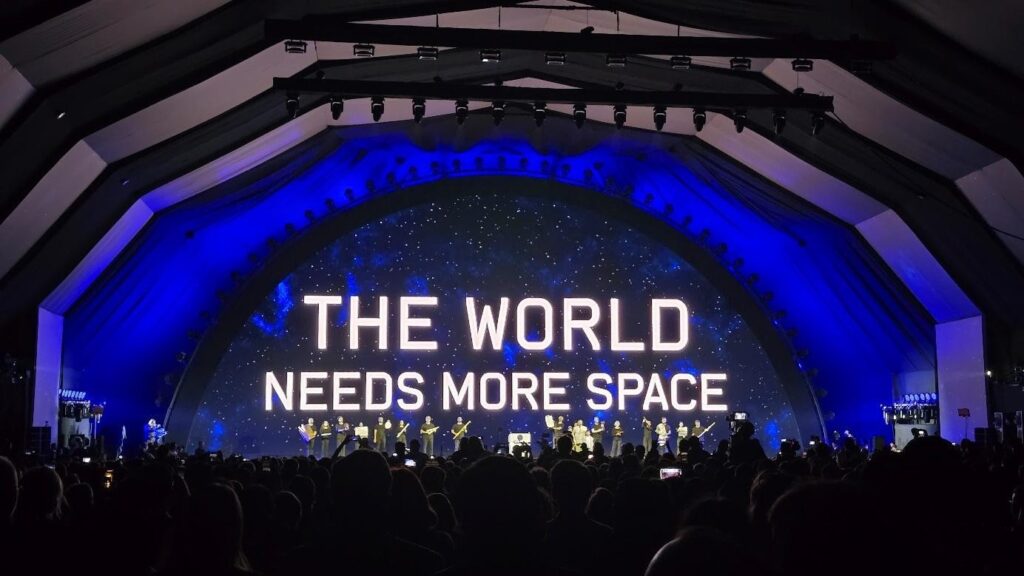
Under the theme The World Needs More Space, the Congress brought together the international space community to exchange scientific knowledge, address emerging challenges and explore new opportunities for cooperation.
SRI was represented by members of its Directorate and wider community, including Prof. Bernard Foing, President; Dr. Gülin Dede, Executive Director; Alberto Cavallo, Director of Intercultural Integration; and Enes Beşli, Public Outreach Coordinator, alongside other SRI members and collaborators.
Through scientific papers, interactive presentations, expert panels, workshops and institutional discussions, SRI contributed perspectives on civilian space development, lunar exploration, the proposed 18th Sustainable Development Goal (SDG) and the future of humanity beyond Earth.
Space for All: SRI’s research contributions
A central theme of SRI’s presence at IAC 2026 was the relationship between sustainable development on Earth and humanity’s expanding activities in space.
Three interactive presentations developed by SRI members addressed different dimensions of this challenge.
The 17 Sustainable Development Goals Status – Why the 18th SDG, Space for All on Earth and Beyond Is Needed
Presented by Enes Beşli | IAC-26,E3,IPB,18,x111169
This contribution assessed the progress and remaining challenges of the United Nations’ 17 Sustainable Development Goals, presenting SRI’s argument for recognising peaceful civilian space development as an additional dimension of the global sustainability agenda.
The paper examines the growing demands on Earth’s resources, the challenges associated with industrial expansion and emerging technologies, and the potential of space-based infrastructure to contribute to long-term sustainability. It further explores SRI’s proposed Space 18th SDG, its international coalition of supporting organisations and its role in encouraging cooperation on sustainable development.
Co-authored by Enes Beşli, Adriano V. Autino, Gülin Dede, Alberto Cavallo, Werner Grandl, Bernard Foing and Frank White, the paper reflects SRI’s interdisciplinary approach to connecting societal priorities with scientific and technological development.
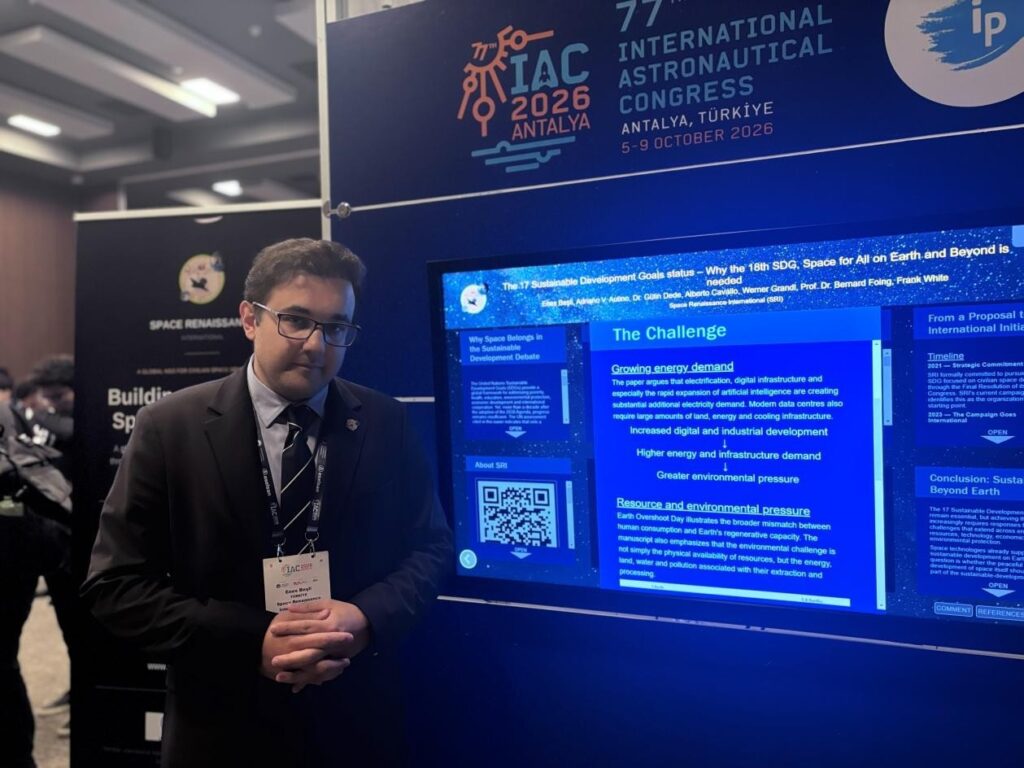
Photo by: Enes Beşli
Quality of Life, on Earth and Beyond – The Next Land of Freedom Is Free-Space Habitats!
Presented by Dr. Gülin Dede | IAC-26,E5,IP,4,x111191
Developed with Adriano V. Autino, Alberto Cavallo, Werner Grandl, Dennis O’Brien and Bernard Foing, this presentation explored the relationship between space settlement, human rights and quality of life.
Drawing on the legacy of Gerard K. O’Neill, the authors examined free-space habitats as environments capable of supporting long-term civilian life beyond Earth. The contribution placed particular emphasis on artificial gravity, radiation protection and reliable life-support infrastructure, arguing that technological design must also preserve human dignity, freedom and the ability of future settlers to return to Earth.
The 18th SDG – Space for All – A Non-Regulatory Framework for Interchange and Ethical Practice
Presented by Dr. Gülin Dede | IAC-26,E7,IP,11,x109396
This presentation approached the proposed 18th SDG from the perspective of international governance and space diplomacy.
It explored the potential of a voluntary, non-regulatory framework to encourage dialogue and cooperation among countries, research institutions and emerging space actors. The proposal connects existing terrestrial sustainability objectives with new questions arising from lunar development, cislunar industrialisation, orbital sustainability and future exploration.
Together, these contributions advanced SRI’s vision of Space for All, on Earth and Beyond, connecting the practical requirements of space development with ethical, social and institutional considerations.
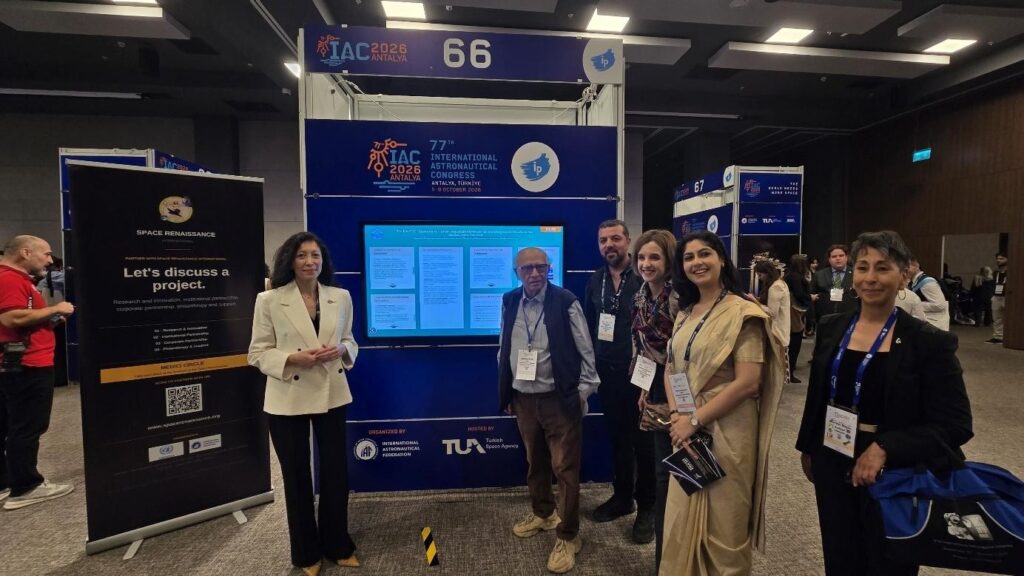
Photo by: Enes Beşli
Space policy and governance: A contribution to the 40th IAA/IISL Scientific-Legal Roundtable
On 8 October, Dr. Gülin Dede contributed as an invited technical speaker to the 40th IAA/IISL Scientific-Legal Roundtable: The Growing Roster of Space Countries.
Held jointly by the International Academy of Astronautics and the International Institute of Space Law, the roundtable examined how the increasing number of government and commercial space actors is reshaping international space governance.
With emerging nations developing new space capabilities and private-sector participation continuing to grow, the session addressed the need to reconsider how legal frameworks, scientific priorities and international cooperation can respond to the evolving space environment.
Dede’s participation brought SRI’s wider perspective on inclusive and sustainable space development into an interdisciplinary discussion among technical and legal experts.
The roundtable was co-chaired by Dr. Rainer Sandau and Prof. Larry Martinez.
Advancing lunar exploration and international scientific cooperation
Prof. Bernard Foing contributed to several scientific and technical activities throughout IAC 2026, particularly in lunar exploration, mission development and planetary research.
On 5 October, he joined the IAF Global Networking Forum panel Lunar Space Science: Priorities, Plans, Cooperation Perspectives, exploring the scientific priorities and cooperation opportunities associated with future lunar missions.
Later that day, Bernard Foing and Gülin Dede was also among the expert speakers for Designing for a Multi-Planet Future: Resilient Mission Architectures for Moon, Mars & Cislunar Operations, a special workshop organised by the American Institute of Aeronautics and Astronautics (AIAA). The workshop focused on the infrastructure, logistics, autonomy and human factors required to support long-term exploration beyond Earth.
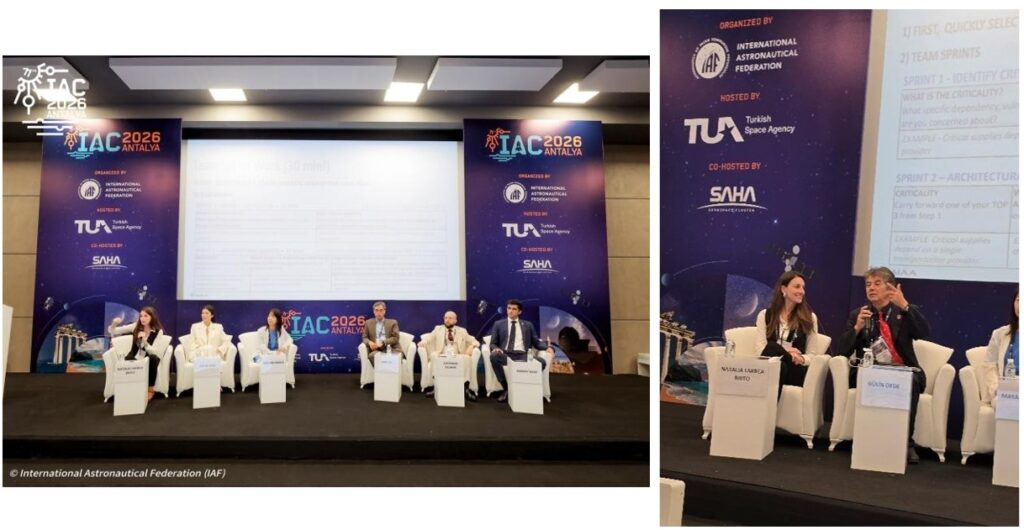
On 8 October, Bernard Foing was among the speakers for Lunar Sites of Special Scientific Interest (SSSI): Challenges and Opportunities, discussing the scientific importance of particular lunar locations and the need for appropriate stewardship as exploration activities expand.
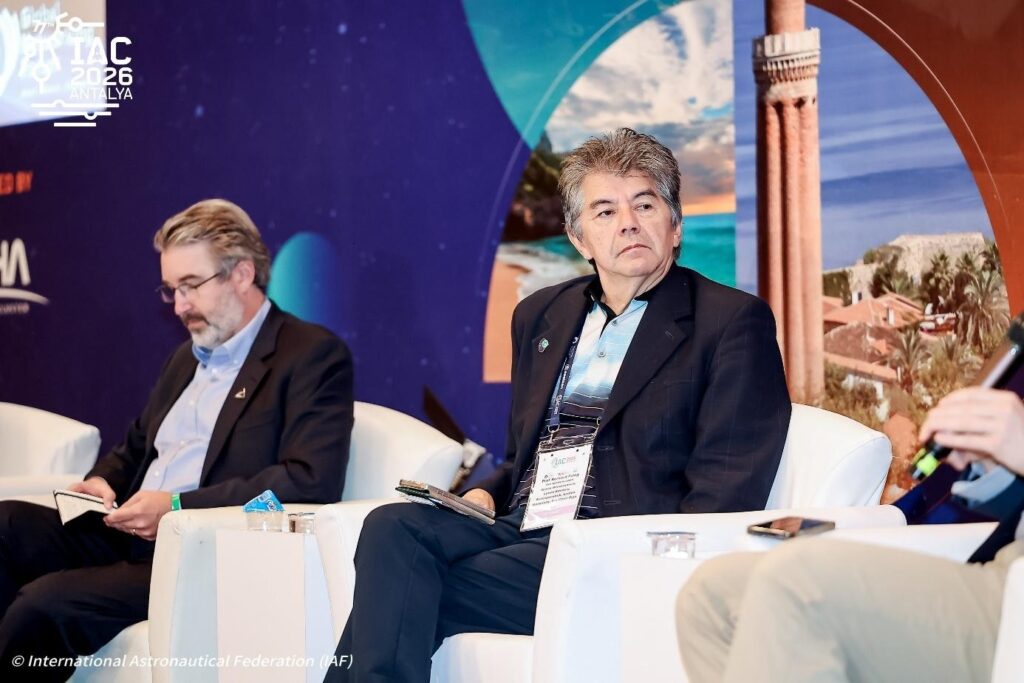
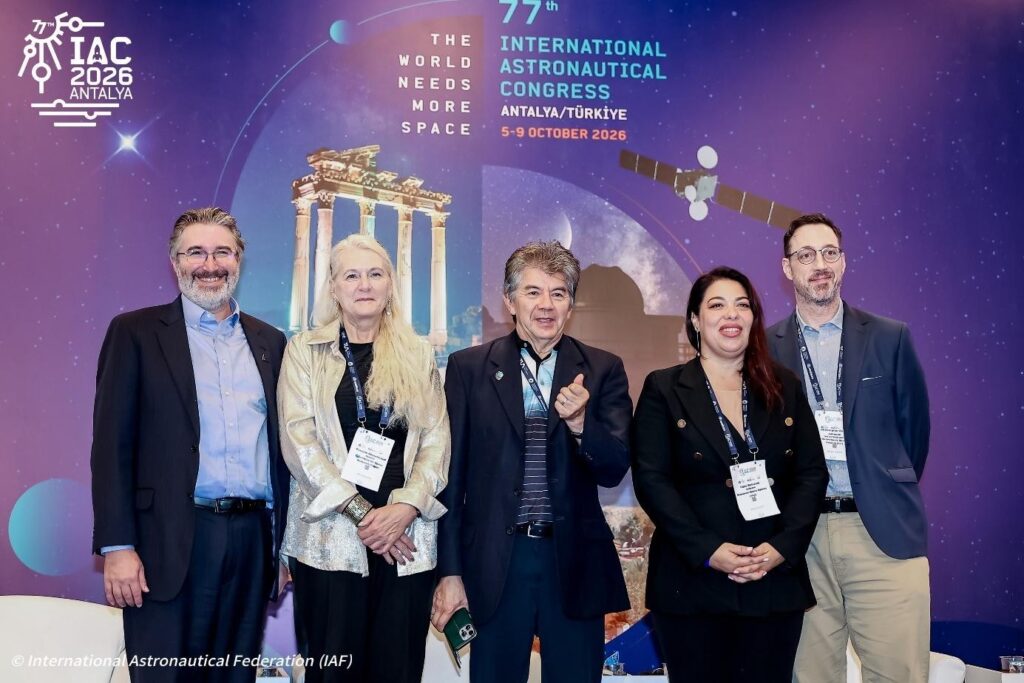
His scientific contributions were further reflected in an extensive programme of co-authored research covering lunar mineralogy, scientific instrumentation, exploration technologies and analogue missions. These included:
- Connecting Meteorite Spectra to Lunar Surface Composition Using Hyperspectral Imaging and Machine Learning (IAC-26,A3,2A,6,x110561), investigating lunar mineralogical mapping through spectroscopy and machine-learning techniques.
- ILEWG LUNEX EuroMoonMars Science & Exploration Report 2026: Data Analysis, Instruments, Payload, Missions & Field Tests (IAC-26,A3,2B,3,x116522), jointly authored with an international research team including SRI founder Adriano V. Autino.
- Lessons Learned from LUNEX EuroMoonMars Analog 2025 (IAC-26,A3,2C,6,x105706), addressing experience gained through analogue exploration activities.
- Trust with a Humanoid Robot during Analog (IAC-26,E5,6,12,x105707), examining human–robot interaction in simulated exploration environments.
These activities demonstrate the breadth of the international scientific networks in which SRI members participate, connecting fundamental research, mission development and education with the wider objectives of civilian space exploration.
Beyond scientific presentations and panel discussions, SRI representatives contributed to the institutional, technical and professional activities of the International Astronautical Federation (IAF) throughout IAC 2026.
SRI’s engagement extended to participation in the IAF General Assembly, attended by Dr. Gülin Dede and Alberto Cavallo, as well as involvement in IAF technical committees and their activities, supporting dialogue and cooperation across the international space community.
Prof. Bernard Foing maintained an active role in the Federation’s scientific and technical activities, chairing several technical sessions and contributing to discussions on lunar exploration, scientific cooperation and future exploration programmes. Dr. Gülin Dede, as a member of the IAF Space Communications and Navigation (SCAN) Committee, also contributed to the Congress technical programme, including co-chairing the technical session on Advanced Antenna & RF Technologies for Space Communications.
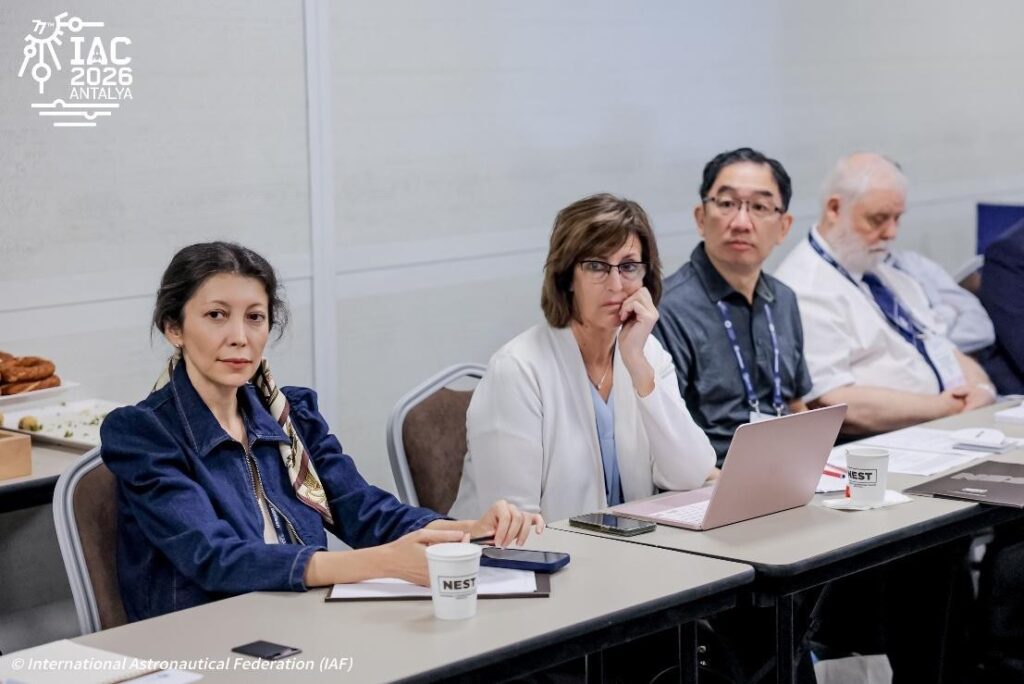
SRI representatives also engaged in professional networking and capacity-building initiatives. Dr. Dede participated as Mentor in the IAF Young Professionals Speed Mentoring activities, exchanging experiences and perspectives with emerging space professionals and supporting intergenerational knowledge sharing. Engagement with the Space Generation Advisory Council (SGAC) provided further opportunities to strengthen connections with the next generation of space leaders.
Together, these activities reflect SRI’s continued involvement in the IAF, extending beyond scientific contributions to technical programme development, institutional participation, professional cooperation and the advancement of the international space community.
IAC 2026 also provided an opportunity to share the outcomes of SRI’s recent work with the international community.
During IAC week, the collected proceedings of SRI’s Fourth World Congress became available in print, edited by SRI founder and President Emeritus Adriano V. Autino.
The volume brings together the Congress Theses, Final Resolution and papers associated with SRI4C, held from 30 June to 4 July 2026.
These proceedings preserve the Congress’s interdisciplinary discussions and provide a foundation for advancing SRI’s priorities in the coming years, including peaceful civilian space development, human-centred space infrastructure and the proposed Space 18th SDG.
Explore the SRI4C Congress website and materials
Space Law and Policy: A New Contribution by Dr. Gülin Dede
Dr. Dede also contributed the chapter Türkiye’s Place in Global Space Governance to the new volume International Space Law and Policy: Current Developments and Türkiye (original Turkish title: Uluslararası Uzay Hukuku ve Politikası: Güncel Gelişmeler ve Türkiye).
The book, published in September 2026, was presented to the international space-law community during IAC in Antalya. It examines contemporary developments in space law and policy through perspectives including emerging space nations, international governance and Türkiye’s evolving position in the global space sector.
International engagement and emerging partnerships
Alongside the scientific programme, IAC 2026 offered opportunities to strengthen relationships with institutions and organisations working across the global space sector.
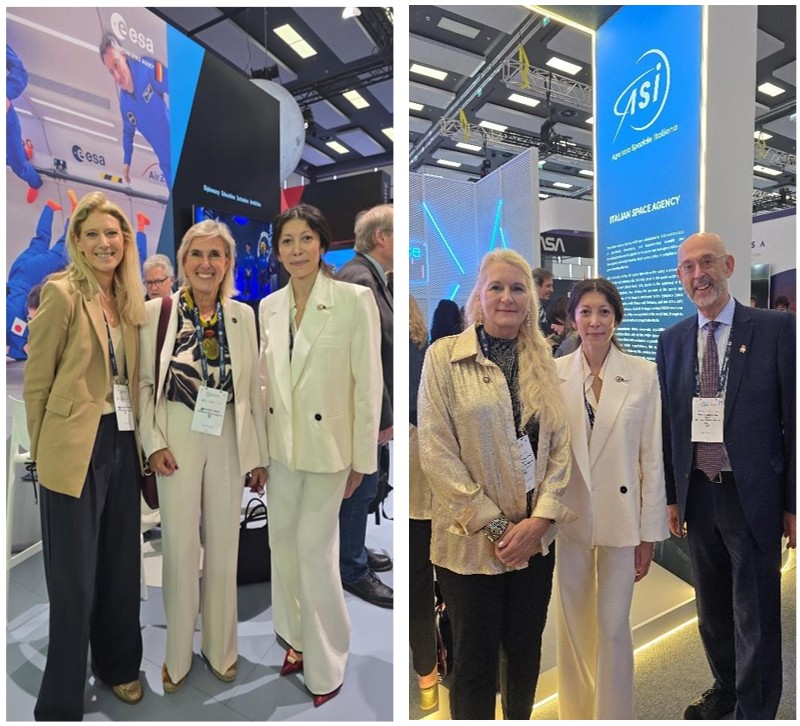
Photo by: Enes Beşli
SRI representatives held discussions with members of the European Space Agency (ESA), the Italian Space Agency (ASI) and the Space Generation Advisory Council’s Space Law & Policy Project Group (SGAC SLP PG) regarding potential areas for future cooperation.
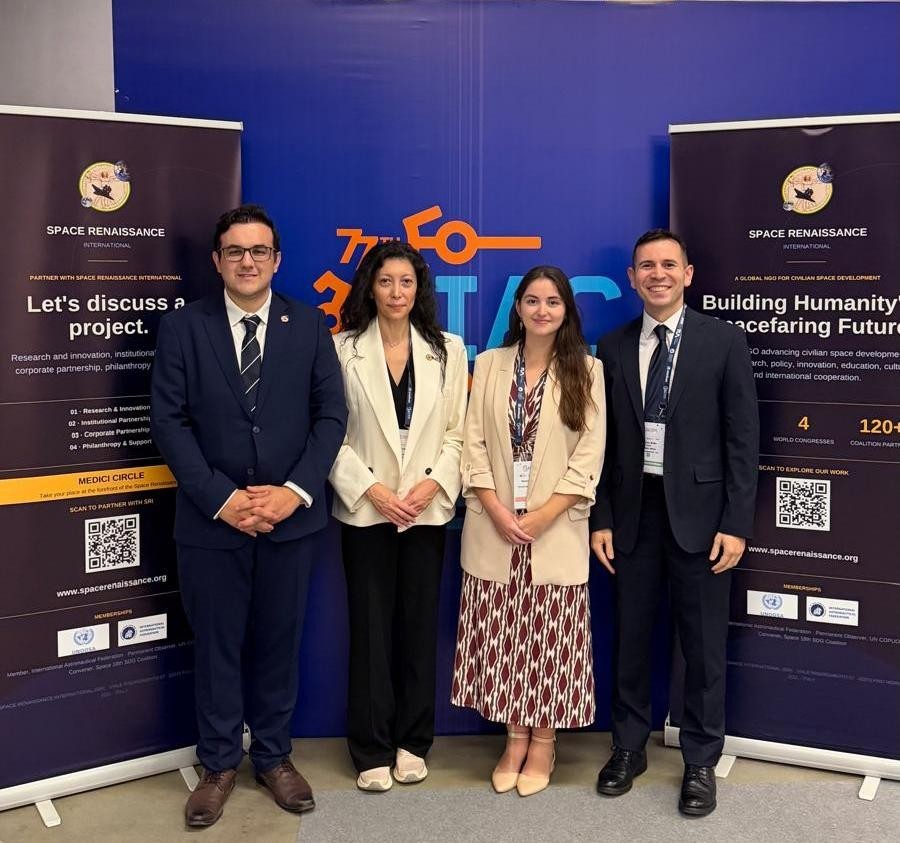
The delegation also exchanged perspectives with Isabelle Mierau, Founder of Cosmic Guardian, on responsible space development, sustainability and orbital governance.
These discussions provided opportunities to identify shared interests, explore prospective activities and strengthen SRI’s connections with established institutions and emerging international networks.
The 33rd UN/IAF Workshop: Opportunities for emerging space nations
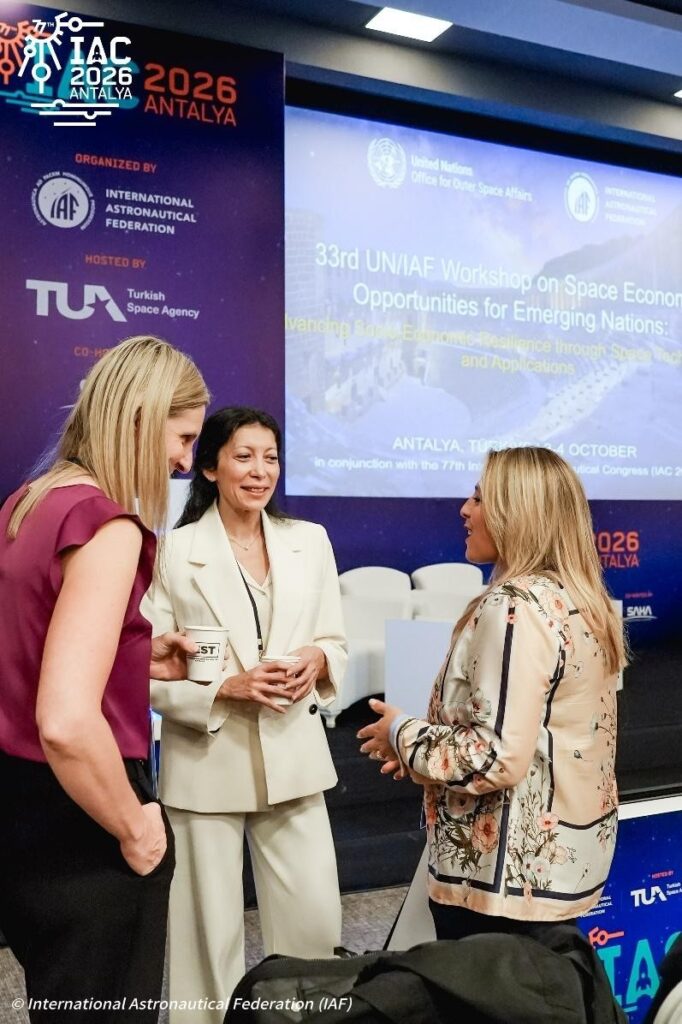
SRI’s participation in the 33rd UN/IAF Workshop on Space Economy Opportunities for Emerging Nations: Advancing Socio-Economic Resilience through Space Technologies and Applications complemented its activities during IAC 2026.
Organised by the United Nations Office for Outer Space Affairs (UNOOSA) and the International Astronautical Federation (IAF), the workshop addressed how space technologies, capacity building and international partnerships can support socioeconomic resilience and sustainable growth in emerging space economies.
The workshop’s focus on widening participation in the global space economy closely reflects SRI’s advocacy for accessible civilian space development and its ongoing work to connect space exploration with broader societal needs.
Looking towards IAC 2027
The 33rd UN/IAF Workshop and IAC 2026 marked an important opportunity for SRI to share its perspectives, contribute research and strengthen its international relationships.
The scientific and policy contributions of our members demonstrate how SRI’s vision can be developed through research, interdisciplinary dialogue and cooperation with the wider space community.
We extend our appreciation to UNOOSA, the IAF, the Turkish Space Agency, SAHA İstanbul Aerospace Cluster, the IAC organisers and all participating institutions, partners and collaborators. We also thank our delegation members and the many volunteers whose continued dedication makes SRI’s work possible.
As we look towards , we will continue advancing the priorities of our Fourth World Congress and building meaningful partnerships to support peaceful, sustainable and inclusive civilian space development.
Ad Astra!
Space Renaissance International