

The mission of SRI has always been to promote and foster the peaceful expansion of humanity into space, going beyond exploration and science to get humanity out of its cradle, the planet Earth, to become a truly universal species. This implies not just working in space, not just to produce services for those who live on our mother planet, but to dwell there and do whatever humans do here on Earth.
A first, essential step toward this goal consists in industrializing the cislunar space, which necessarily includes using the resources of the Moon to support a full industrial development. Moon materials shall allow building structures on the Moon itself as well as space factories and habitats, since lifting materials from there to space is much easier and can be done even without rockets.
The idea of going again to the Moon to create permanent structures there is now well established, as the USA and China are competing to create bases in the areas of the Moon that are deemed to be richer of interesting resources—mainly water ice.
But the first announcements of long-term industrial developments, going further towards creating a true industrial base on the Moon, come from Japan.
In November 2024 [1], JAXA (the Japanese space agency) assigned to JGC Corporation the preliminary design and breadboard development, testing, and other tasks for a terrestrial pilot plant for a future lunar ISRU plant.
At the International Astronautical Conference IAC 2026 in Antalya, Türkiye (5th – 9th October), JGC gave a general presentation of the project titled “Lunar Infrastructure System Architecture Enabled by Water-Based ISRU Plant” [2].
The general concept of the plant includes the production of oxygen and hydrogen from the electrolysis of moon water from ice deposits. The two gases will be used as fuel for rockets (in liquefied form), as well as fuel for fuel cells, but hydrogen will also be used for the chemical reduction of minerals to produce construction materials. Among the elements that can be extracted from minerals are iron, magnesium, titanium, silicon, aluminum, and calcium. All these elements are present in the minerals in an oxidized form: the reduction reaction removes the oxygen from the other element as hydrogen combines with the same oxygen, producing water, which can be recycled.
In this way, the plant will use local resources to produce liquid water and oxygen for human use, fuel for rockets and power cells, and construction materials for all uses.
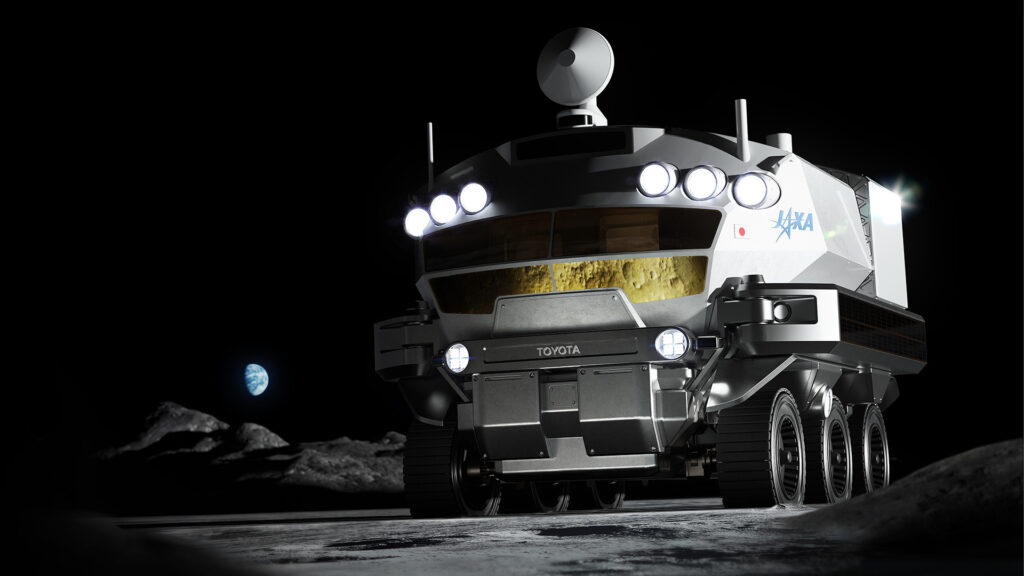
During the same session (Moon exploration 3), two more technical presentations were given by Japan, both by Toyota Motor Corporation: “Conceptual Design of an Integrated Lunar Surface Communication System for the Pressurized Rover ‘Lunar Cruiser'” [3] and “Project Management and Systems Engineering Challenges in the Early Development of the Pressurized Rover” [4].
Toyota is developing for JAXA a pressurized crewed rover capable of carrying two persons for up to one month on the Moon surface. Its expected life on the Moon’s surface is 10 years.
This vehicle is part of the cooperation between JAXA and the NASA Artemis program.
More than the technical details of these projects, it is very important that both are being developed not by aerospace industries but by the same companies that regularly do the job on Earth.
JGC is the largest EPC (Engineering, Procurement, Construction) company in Japan in oil and gas and ranks 14th in the world [5]. The author of this note was involved, some years ago, in the Habshan 5 project, UAE, a large gas treatment plant where JGC was the main contractor in partnership with the company he was working with at the time.
Toyota does not need a presentation: it is just the largest carmaker in the world with over 10,000,000 cars/year [6].
This is a real paradigm change: space is not just for aerospace industries, as industrialization is starting for real; mainstream industries of each business area are entering the scene. At IAC someone objected to the lack of experience of these companies in space, but the point is the opposite: as space becomes everyday business, large companies become interested. The aerospace sector was specialized in small numbers and high costs, while industrialization means preparing for large production numbers and lowering costs even on the Moon!
Large industries can easily acquire the missing expertise by having specialized companies as sub-suppliers or by taking them over. Their financial and organizational strength will allow them to be successful out of the planet as well as on Earth. Of course, some space companies are growing or have already grown enough to be global actors: first of all, SpaceX. Large companies of other areas will join the field, while some special competencies will always be there with smaller entities. But this is industrial business as usual—exactly what is expected if space becomes part of the general economy, well beyond traditional space business.
Some space corporate giants of the past may not be ready for this and risk being sidelined if they do not adapt to the new reality, while startups with no past history may become the giants of tomorrow. Large companies that operate in other businesses now have the opportunity to keep their positions by entering the space business or may become obsolete even in their traditional field as others take advantage of their new space sectors to improve their capability in all areas.
This seems to be the beginning of what SRI has been promoting: space as a place for development in the widest possible meaning, and industrial development moving to space as the place where growth is possible, without increasing the pressure on our native planet.
- See the Final Resolution of the Space Renaissance International 4th World Congress: https://2026.spacerenaissance.space/wp-content/uploads/2026/07/SRIC4-Final-Resolution.pdf
- Join the Space Renaissance: https://spacerenaissance.space/membership/international-membership-registration/
- Donate to Space Renaissance: https://spacerenaissance.space/donate-to-space-renaissance/
References
[[1]] https://www.jgc.com/en/news/2025/20250702_11.html
[[2]] https://iafastro.directory/iac/paper/id/109767/abstract-pdf/IAC-26,A3,2C,13,x109767.brief.pdf
[[3]] https://iafastro.directory/iac/paper/id/108826/abstract-pdf/IAC-26,A3,2C,9,x108826.brief.pdf
[[4]] https://iafastro.directory/iac/paper/id/110338/abstract-pdf/IAC-26,A3,2C,15,x110338.brief.pdf
[[5]] https://blog.projectmaterials.com/epc-projects/top-epc-contractors-oil-gas-2026/
[[6]] https://statranker.org/economy/leading-global-car-manufacturers-by-production-volume-in-2025/