by Adriano V. Autino
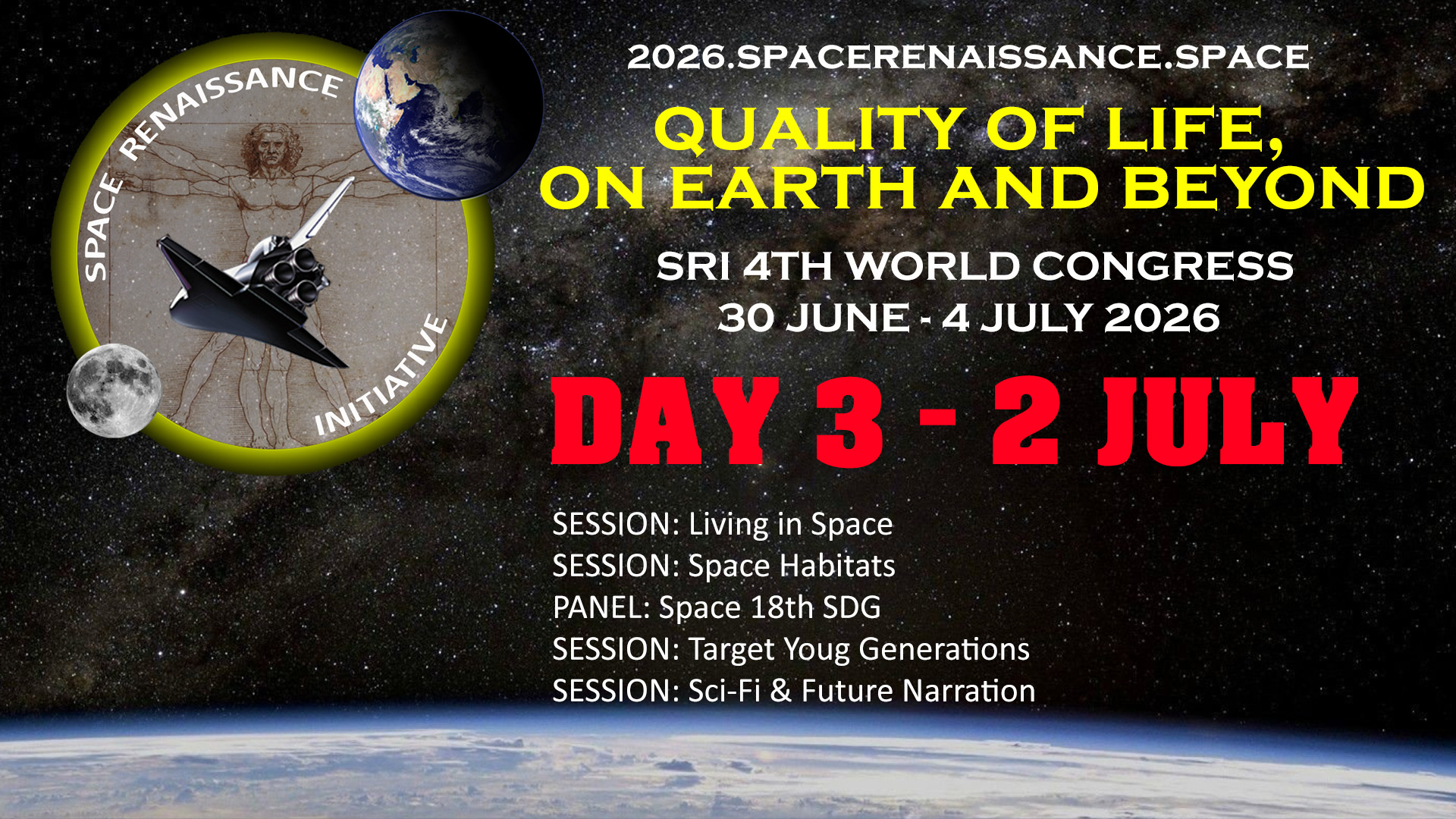
This was the third day of the Space and NASA’s International Support for Congress, with multiple panel sessions and presentations. The meeting began with Robert Katz welcoming attendees to Day 3 on July 2, 2026.
The Living in Space Session
The session began with Adriano Autino presenting on the importance of simulated gravity for long-term space habitation, emphasizing the need for 1G environments to support human health, well-being, and freedom of bi-directional migration and tourism. Brooke Mills then discussed her company’s development of technology to profile radiation degradation in pharmaceuticals for long-duration space missions, presenting their HERO Lab payload design. Colin Lennox presented on reintroducing wetlands into habitat systems as a natural solution for environmental needs, avoiding high-energy requirements for processing. David Brody discussed bioethical and socio-political frameworks for child-rearing in space, highlighting challenges such as gravity, radiation, and the ethical considerations of reproducing off-planet. Joseph Pelton explored the concept of terraforming Mars and the Moon, focusing on the challenges of creating artificial magnetic fields to retain atmospheres and the massive amounts of mass required for atmospheric generation. Peter Swan discussed the modern space elevator concept, explaining how graphene-based materials could enable a 100,000 kilometer tether system that would deliver 170,000 tons of mass annually to space with 70% efficiency, allowing routine Mars missions and assembly at the geosynchronous anchor point. Dr. Susan Jewell addressed neurological and neurobehavioral health challenges in space, proposing policy recommendations including behavioral health monitoring standards and human-centered AI governance, and outlined plans to test AI integration in upcoming analog missions. Madhu Thangavelu discussed the potential for commercially sustainable space missions using the International Space Station as a staging point for lunar exploration, proposing a 14-day mission profile using existing SpaceX technology. Dr. Claire Nelson introduced the concept of Lunaria, a citizen-owned lunar conservancy cooperative that would enable 150 people to live permanently on the Moon by 2050, focusing on research, heritage preservation, and collaborative governance rather than competing national interests. Mike Helton presented a solution for managing dangerous asteroid orbits using artificial intelligence robots and thruster systems that could gradually move asteroids out of Earth’s vicinity into the asteroid belt, requiring minimal budget and involving a phased approach from human crews to fully autonomous robotic systems. Joe Pelton closed the session, recalling the publication of a book collecting several article written by some of the partners of the Living in Space initiative, carried on by ACES Worldwide and SRI since 2 years.
The Space Habitats Session
Jerry Stone presented a comprehensive history of space station and habitat design concepts, tracing ideas from early 20th century proposals by Hermann Nudnung and Arthur C. Clarke to modern concepts like Gerard O’Neill’s large-scale space habitats. He discussed the challenges of planetary surfaces for long-term human habitation, particularly the issues with gravity on the moon and Mars, and proposed a small scale O’Neill habitat demonstrator called Island Zero, which would provide simulated gravity through rotation while being more cost-effective, for an initial experimentation. Jerry Stone also presented his Island Zero project, which proposes a space habitat designed for medical research on different gravity levels, with potential for income generation through leasing modules to commercial organizations. Bernard Foing and his team demonstrated their exospacer habitat, which has been used in various locations for astronaut training and lunar mission simulation, including testing rovers and conducting scientific experiments. Silvia Schmalzl presented a compelling argument for incorporating living systems, particularly moss, into space infrastructure to support long-term human habitation beyond Earth. She emphasized that current space habitats rely heavily on mechanical systems with limited biological redundancy, arguing that pioneer organisms like moss could serve as “biological hardware” for life support, psychological well-being, and creating habitable environments that feel like homes rather than machines. Joe was scheduled to present on rotating LEEO resorts but experienced technical difficulties with screen sharing, preventing him from delivering his planned discussion about artificial gravity requirements for multi-planetary settlement. Joseph Carroll presented his paper on Rotating LEO Resorts as Training Wheels for Space Settlements.
The Space 18th SDG Panel
The meeting transitioned to a panel led by Dr. Gülin Dede on the proposed 18th Sustainable Development Goal (SDG) focused on space sustainability. Dr. Dede presented SRI’s efforts to advocate for space sustainability within the UN framework, highlighting their side event at the legal subcommittee meetings and the need for structured engagement moving forward. Frank White emphasized that incorporating space into the 18th SDG is a “no-brainer” as space activities increasingly affect life on Earth, and he called for greater awareness and education about this connection. Gary Barnhard discussed the importance of providing opportunities for engagement rather than entitlement in space, highlighting the need to help nations develop capacity to utilize space technology and data effectively. The discussion included insights about creating a “snowball effect” by helping people understand how to become effective actors in space-related initiatives. Adriano Autino also recalled earlier campaign efforts at the UN in New York, where Dr. Claire Nelson contributed to the exchange in support of the 18th SDG, and linked them to the success of these earlier initiatives. The meeting focused on discussing the organization’s progress and initiatives related to the 18 SDG and space sustainability. The panel discussed the importance of combining brain, heart, and gut perspectives in their work, with participants sharing insights on living in harmony with nature and the challenges of presenting visionary ideas. Alberto Cavallo described the Space 18th SDG as currently the most important initiative within SRI. On the margins of the panel, the group also addressed the concept of arcology and the development of space habitats, with Frank L’Italien referring to his work on a 3D-printing asset library for high-density ecosystems. Frank White offered a thoughtful closing reflection, drawing on his experience with the Space Studies Institute and praising SRI for carrying forward its “heart,” while expressing renewed optimism about the future of space exploration. The discussion included updates on the 18th SDG initiative, with Ammar Jafri providing information about potential formal presentation at the UN General Assembly involving over 40 countries advocating for SDG 18.
The Target Young Generations session
Ghanim Alotaibi introduced the Young Generation Committee’s activities, including a student competition and scholarship opportunities, followed by Enes Beşli‘s message about integrating younger generations into space missions and advocacy work. Miracle Kuchibusa-Masel presented the Pan-African Citizen Science Laboratory, a non-profit organization using astronomy and space science to support STEM learning across Africa since 2020. The organization has engaged over 5,000 learners from 50+ countries in various citizen science projects including asteroid hunting, exoplanet research, and amateur radio programs connecting students with astronauts. Ghanim Alotaibi announced that SRI will soon launch an essay competition for young generations. Adriano Autino invited organizations to join the 18th SDG coalition, noting they currently have 121 member organizations. Poojan Sanyara then presented his work on “Beyond Survival,” a governance framework for cultural continuity and political autonomy of space settlers, discussing how power structures might evolve in isolated settlements and the importance of self-correction mechanisms.
The Sci-Fi and Future Narrative session
The Sci-Fi and Future Narrative session, chaired by Adriano Autino and moderated by Enes Beşli, featured Adriano Autino’s presentation on the “Universal Dark Forest” hypothesis, arguing against the paranoid theory that the universe is filled with hostile civilizations. He analyzed 42 prominent science fiction authors, finding that 50% were cosmic optimists who reject zero-sum fatalism, while 35% were pessimists and 50% represented cosmic realism. The discussion included comments from Madhu Thangavelu about cultural mythologies and human values, and Gary Barnhard‘s observation about the suspension of disbelief in science fiction, with participants expressing interest in exploring mythology and storytelling aspects further. Cheryl Gallagher presented on the global cultural implications of potential extraterrestrial disclosure, discussing how humanity should prepare for such a transformative discovery through scientific verification protocols, international coordination mechanisms, and public communication strategies. Victoria Ustimenko then explored how modern science fiction plays a crucial role in accelerating civilian space development by inspiring public desire and recruiting engineers, investors, and supporters before technical feasibility is achieved. Adriano Autino wrapped up the session pointing out that Science Fiction literature is covering a missing key cultural part in philosophical history: futurology. Also, the research going on in the SRI Academy framework is evidencing the persisting fracture between scientific and humanistic research, and the very need of connecting rationalism with intuition in all future human activities.
See the recorded videos of SRIC4:
- Day 3: https://www.youtube.com/live/MFDcRiJo8Bg
- Day 2: https://www.youtube.com/live/Z0eZOV_MC9c
- Day 1: https://www.youtube.com/live/7r80QYrcHwQ
Follow the Congress the next days!
Here are the links to the YouTube livestream for each day: https://spacerenaissance.space/event/the-sri-4th-world-congress-30-june-4-july-2026/
ATTENTION PLEASE!!! All the new SRI Members registered during the Congress will get a special edition membership card! Join SRI now!
https://spacerenaissance.space/membership/international-membership-registration/


















 Space Renaissance France (French Chapter of SRI)
  Space Renaissance USA, Inc. (USA Chapter of SRI)
 Space Renaissance (Italian Chapter of SRI)
 Space Renaissance India (Indian Chapter of SRI)
 African Space Renaissance (African Chapter of SRI)
 Space Renaissance Academy
 Space Renaissance Initiative Group