News

SRI News

SRI 4th World Congress: some key topics

Dear Space Friends,

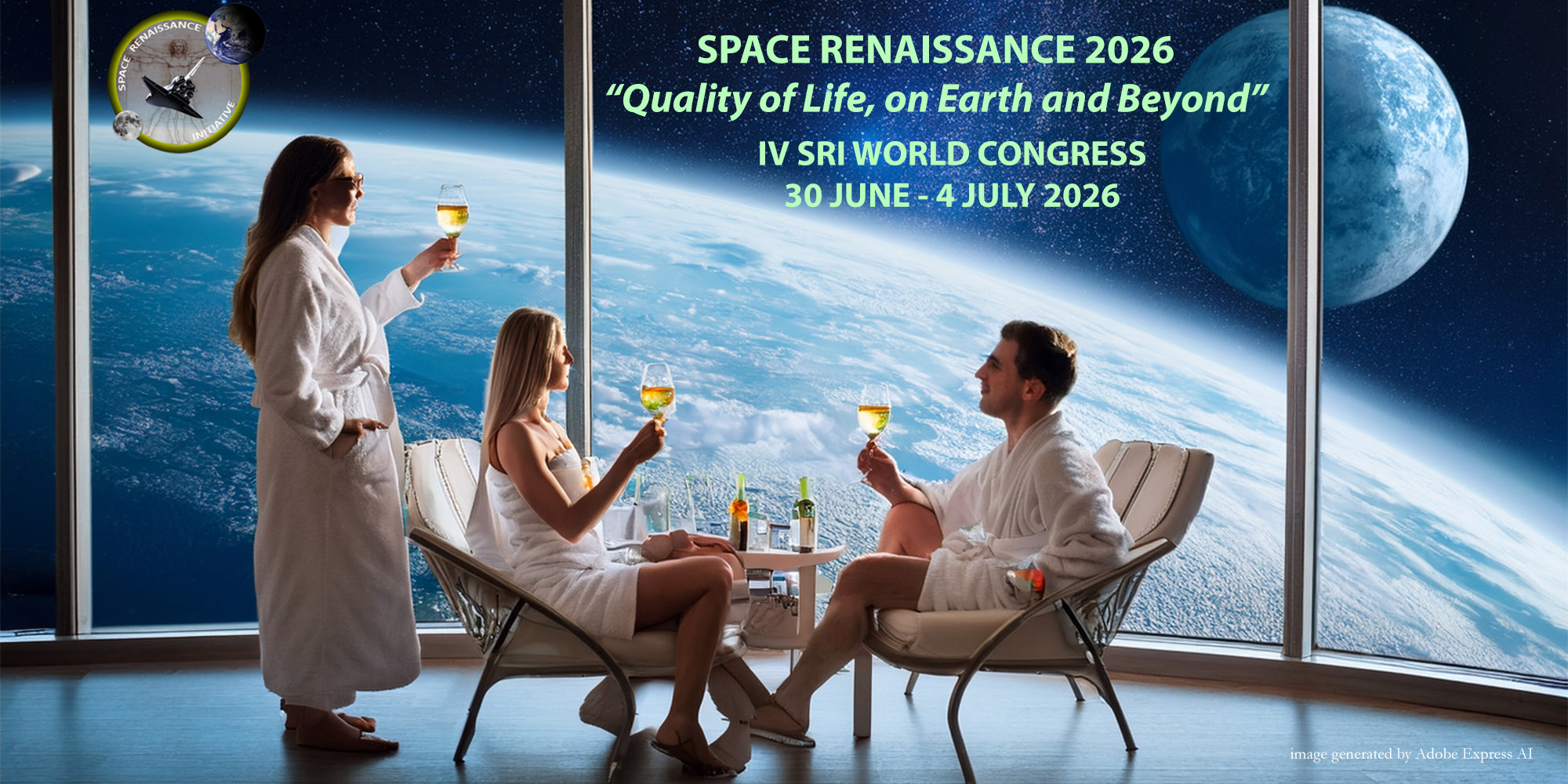
Today let me attract your attention to the SRI 4th World Congress, an online event held every five years. The 2026 session is titled “Quality of Life, on Earth and Beyond”, and will take place from 30 June to 4 July.

The Congress scope is the development of a space policy suitable to promote the acceleration of Civilian Space Development during next five years.

Among the key topics to be discussed:

  • Resources – The overshoot day and the unsustainable energy demand
  • Beautiful life in space – Quality of Life, ergonomics, beauty, greenery, flamboyance
  • Space Policy – Space 18th SDG, priority to geo-lunar industrialization and settlement, mining, fuel production in space, orbital debris recovery and reuse
  • Science & Tech – Human requirements for space habitats and vehicles, protection from cosmic and solar radiation, simulated gravity, redundant design
  • We speak for Space Settlers – Space resources property and utilization, the rights of the space settlers

And very much more!

Register to the congress here: https://spacerenaissance.space/sric4-registration/

And submit your abstract(s): https://spacerenaissance.space/sric4-abstract-submission/

Also see the keynote speakers participating to the opening session the 30 of June: https://2026.spacerenaissance.space/index.php/sric4-keynote-speakers/

The Congress website: https://spacerenaissance.space/

Looking forward to see you at the Congress.

Ad Astra!

Adriano V. Autino, SRI CEO & Founder

#space #spaceresources #civilianspacedevelopment #spacerenaissance #lifeinspace #quality #qualityoflife #18thsdg #spacesettlement #congress

Posted by Adriano in Blog, Newsletters, SRI IV WORLD CONGRESS

THE 4TH SPACE RENAISSANCE INTERNATIONAL WORLD CONGRESS June 30 – July 4, 2026

Welcome to the newsletter for SRI’s 4th World Congress, an online event held every five years. The Congress takes care of required business (e.g., the selection of directors) but is otherwise devoted to the development of policies and the practical steps needed to promote and implement them. We will also draft a Final Resolution and Congress Theses that will be submitted to the membership for approval and provide guidance for the next five years.
The discussion will be anchored by presentations during the Congress. To that end we have issued a Call for Abstracts. Please follow the link to see how sessions are being organized, then click “Submit an Abstract” to do so. You can also click on “SRIC4 Registration” to register for the Congress (or use links below). All sessions are free, but only members will vote on what we adopt as ongoing SRI policies.
There have already been some Congress-related presentations this year, part of SRI’s online Academy. The latest was by Dr. Marie-Luise Heuser on Space Romanticism. Our next presentation is February 17 (9pm CET), Data Centers in Space: An Update, by Alberto Cavallo. For a list of videos and links, please visit SRI’s YouTube channel.
We will also be discussing SRI’s work at the UN’s Committee on the Peaceful Use of Outer Space (COPUOS). SRI became an official Observer in 2024 and has been presenting technical reports during sessions of the Committee, the Scientific & Technical Subcommittee (we’re there now), and the Legal Subcommittee. Our focus has been on a critical review of the UN’s Space 2030 Agenda and SRI’s proposal for an 18th Sustainable Development Goal – Civilians Space Development. Please click on the link for more information about the 18th SDG Coalition (currently 116 organizations) and how your organization can join.
We will be sending updates as needed concerning the Congress and related work. Thank you for your interest in Space Renaissance International and the important issues facing humanity as we prepare to leave the home world.
– Prepared by Dennis O’Brien, Co-chair, SRI Space Policy Committee
Posted by Adriano in News, SRI IV WORLD CONGRESS
SRI NEWSLETTER – “WE SPEAK FOR THE SETTLERS!”

SRI NEWSLETTER – “WE SPEAK FOR THE SETTLERS!”

Space Renaissance International (SRI) is a Permanent Observer at the UN’s Committee on the Peaceful Uses of Outer Space (COPUOS). We are currently advocating for:

  1. Ownership of resources removed from in place (being considered by the COPUOS Working Group on the Legal Aspects of Space Resource Activity);
  2. Permanent advisory status for the private sector in any new consultation mechanism proposed by ATLAC (COPUOS Action Team on Lunar Activity Consultation);
  3. Recognition of the Right of Asylum in outer space, as guaranteed by the Universal Declaration of Human Rights and the Refugee Convention;
  4. Recognition of the Right to Develop as stated in the UN Declaration of the Right to Development, “an inalienable human right for every person and people to participate in, contribute to, and enjoy economic, social, cultural, and political progress, leading to improved well-being, freedom, and dignity.”

Jurisdiction and Control: Article VI of the Outer Space Treaty of 1967 states that “States Parties to the Treaty shall bear international responsibility for national activities in outer space . . . The activities of non-governmental entities in outer space, including the moon and other celestial bodies, shall require authorization and continuing supervision by the appropriate State Party to the Treaty.” Such jurisdiction and control can be shared by multiple states: “When activities are carried on in outer space, including the moon and other celestial bodies, by an international organization, responsibility for compliance with this Treaty shall be borne both by the international organization and by the States Parties to the Treaty participating in such organization.

Multiple states can also use an operating agreement to govern activities when working together, as with the International Space Station. States will retain jurisdiction of its nationals even when they are within space controlled by another state (OST Article VIII) unless the individual seeks asylum (above).

Many countries and organizations envision permanent settlements in outer space. Such settlements can seek to become autonomous regions, still within the jurisdiction of a state or states, but able to govern its own local affairs. A good example is American Samoa, where the United States federal government is responsible for foreign policy and defense, while the local Samoan legislature is responsible for almost everything else.

Ultimately, space settlements will likely seek independence, as dramatized by Robert Heinlein in The Moon Is A Harsh Mistress and by Isaac Asimov in The Martian Way. The Montevideo Convention of 1934 establishes four minimum requirements: (a) a permanent population; (b) a defined territory; (c) government; and (d) capacity to enter into relations with the other states. Recognition by other sovereign states, though not required, is certainly desired. When a settlement declares its independence, it will no longer be bound by the Outer Space Treaty but would likely seek to join on condition of recognition of its claimed territory.

SRI will continue producing papers and presentations on the Legal Aspects of Outer Space Settlers and Settlements in support of humanity’s efforts to expand into space. More at our SRI World Congress, June 30-July 4. https://2026.spacerenaissance.space/

Check the Call for Papers, and submit your abstract(s)!

Register here.

To understand more about the Congress symposia, sessions, and proposed topics, also watch the SRIC4 #00: “Announcing the 4th SRI World Congress”, on the Space Renaissance YouTube channel!

Let’s work together to make a great congress!

Join the Space Renaissance!

Watch and subscribe to the Space Renaissance YouTube channel.

You may discuss this article on the SRI Open Forum.

Also download a pdf version of this article.

Posted by Adriano in News, Newsletters
THE BRAVE AND THE COWARDS – SRI Newsletter December 2025

THE BRAVE AND THE COWARDS – SRI Newsletter December 2025

As the geopolitical climate shifts, we increasingly hear warmongering pronouncements that tend to resurrect popular sentiments we naïvely believed had been buried by history.Among these is the claim that Europe is weak and cowardly, unwilling to cross the threshold between adolescence and adulthood. Maturity, according to this narrative, demands rearmament and a head-on confrontation with the challenges of the present historical moment. Yet beneath this rhetoric lies a far more troubling transformation.

We are witnessing a blatant attempt to replace the prevailing moral framework—until recently ecumenically oriented toward a passive and often regressive environmentalism—with a value system founded on belligerence. This new morality defines itself against “enemies” of presumed interests, whether national, ethnic, or ideological.

Those who expected a different kind of shift—one that would abandon regressive policies in favor of an active, forward-looking environmentalism—have been rudely awakened. The self-proclaimed revolutionaries sing an old and worn-out song: war. These new “futurists” embrace a technocratic faith that goes far beyond a legitimate trust in science and technology—long maligned during the previous ideological era—and descends into open contempt for human beings themselves, now portrayed as redundant or even burdensome in the age of the supposedly unstoppable rise of artificial intelligence.

What we face is a dramatic ethical and cultural regression, from which some expect to profit greatly.

Why is this a cultural regression? Because it reintroduces fierce intraspecific competition as the proposed solution to our civilization’s challenges—or worse, without any concern for global challenges at all. The rearmament policies now spreading across the world almost entirely ignore environmental considerations, which until less than a year ago were presented as the dominant justification for largely regressive degrowth policies.

Why is this also an ethical regression? Because ethics, as lived and understood by societies, is neither fixed nor immutable. While profound ethical insights can indeed be found among ancient philosophers, humanity’s moral judgments regarding murder, massacre, genocide, exploitation, torture, ethnic cleansing, and war itself have undeniably evolved over centuries and millennia. Technological and social progress have steadily reduced the objective necessity of ruthless competition, opening the possibility of a world in which losers need not perish, but may still benefit from collective advancement—and perhaps find future opportunities for success.

Even within sacred traditions, this evolution is visible: from biblical narratives that recount massacres, divine favoritism toward specific ethnic groups, and concepts of women as property, to the evangelical message, which introduces a far more humanist vision—one that still resonates deeply today.

From both cultural and ethical perspectives—two dimensions that should never diverge—the realization, around the middle of the twentieth century, that humanity was consuming more resources than Earth could provide was itself a positive step forward. The responses to that realization, however, have been deeply flawed. Passive environmentalism and degrowth policies have paved the way for today’s grim prospect: the annihilation of much of humanity in a global war of all against all.

But here lies the central point.

Until little more than a century ago, space technologies did not exist. Human competition was confined within planetary boundaries, and the stakes were the control of Earth’s resources. Did this reality make war acceptable—or even virtuous? For centuries, poets and historians glorified heroes and conquests, embedding war deeply within educational systems that still emphasize victories, battles, and the demonization of the defeated.

Yet once humanity began to imagine expansion beyond Earth—and the possibility of accessing extraterrestrial resources—a different sensibility emerged. From the artistic movements of the twentieth century to the global upheaval symbolized by 1968, war increasingly came to be seen for what it truly is: an immense waste of lives and resources, an intolerable deviation from the path of civilized progress, and—almost always—a violent appropriation of land and wealth. An ethical and cultural wound that has become unbearable, especially now that a viable alternative exists.

Today, at the beginning of the second quarter of the twenty-first century, space technology—now closely and inextricably linked to the development of artificial intelligence—is on the verge of a true quantum leap. It is paving the way for the civilian development of space, beginning with the Moon and the cislunar domain.

It would seem logical to concentrate our collective efforts on this extraordinary goal. Humanity appears to stand at the threshold of a potential golden age, one in which all people—nations, cultures, ethnic communities, and peoples of Planet Earth—can contribute and share in the benefits. The resources of the solar system and the vast spaces available for industrial and residential development are so abundant that they naturally reduce greed and brutality, encouraging cooperation and fair competition instead. The development of global communication has progressively shown that all people of the world are really very similar in their daily life, hopes, concerns, projects, love for their children, struggle to get better life conditions… not easy for the warmongers to force Terrestrians to see monsters in foreign countries, and hate each other. We may be approaching a new romanticism: one in which looking down on Earth from orbit, and outward into the universe from the Moon and beyond, evokes a profound sense of shared destiny—what Frank White so aptly described as the “overview effect.”

This is not fantasy. It is a path of evolution firmly grounded in centuries of technological, cultural, and moral progress.

And yet, some of those to whom we have entrusted—by vote—the responsibility of leading our nations seem to believe that we must instead relish the prospect of death and destruction, and devote absurd quantities of public resources to this insanity.

In this surreal narrative, those who refuse rearmament are branded as weak and cowardly. In reality, the opposite is true. In today’s world, with the immense potential now within reach, it is precisely the weak and the fearful who turn to war. The brave and the generous do not resign themselves to killing their brothers over dwindling planetary resources. They aim higher. They look beyond Earth, toward new frontiers and new resources for all.

I am convinced that many of us—explorers and pioneers—already exist. What remains is for us to step forward and to begin replacing unsuitable political directions with others that are culturally sound, ethically mature, and worthy of humanity’s future.

The “Space for Peace” concept is at the core of the SRI IV World Congress preparation: “Quality of Life, on Earth and Beyond”. The Congress will take place, virtually, from 30 June to 4 July 2026. Some of the key tracks:

  • Status of civilization and quality of life
  • Civilian Space Development, a factor of Peace on Earth and Beyond
  • Space resources: who are the owners? We speak for Space Settlers!
  • Human rights in space
  • The permanent space revolution: 100% inclusivity
  • Protection of life and health in space
  • Beauty and ergonomics of habitats as an essential life requirement
  • Space to Space transport vehicles
  • Orbital Debris recovery and reuse
  • Cloud computing and big data centers in space
  • Producing fuel in space

Check the Call for Papers, and submit your abstract(s)!

Register here.

To understand more about the Congress symposia, sessions, and proposed topics, also watch the SRIC4 #00: “Announcing the 4th SRI World Congress”, on the Space Renaissance YouTube channel!

Let’s work together to make a great congress!

Join the Space Renaissance!

Watch and subscribe to the Space Renaissance YouTube channel.

Also download a pdf copy of this article.

Posted by Adriano in Newsletters, SRI IV WORLD CONGRESS
SUPPORT “HI” EVERYWHERE! – SRI Newsletter November 2025

SUPPORT “HI” EVERYWHERE! – SRI Newsletter November 2025

Artificial Intelligence and Civilian Space Development: A Call for Synergy, Not Substitution!

Artificial Intelligence (AI) is rising at an extraordinary speed, emerging as an entirely new industrial pillar. Leading corporations—NVIDIA, Apple, Microsoft, Alphabet—are achieving unprecedented revenue growth, reshaping global markets in just a few years. According to market analysts, the global AI market is likely to overtake the space market before 2030.

Today, the global space market is valued at roughly $512–613 billion (2025) and is projected to grow to $800–1,000 billion by 2030, with continued expansion expected through 2034. Growth drivers include next-generation satellites, launch services, and escalating commercial and governmental investments. Analysts from Grand View Research, the Space Foundation, and GlobalData forecast the space economy surpassing $1 trillion in the early 2030s.

Yet these projections are increasingly compared with the explosive ascent of the AI sector—a sector still in its infancy. This raises several important questions.

  • Is AI drawing investment away from the space industry?
  • Will AI accelerate or hinder humanity’s expansion into space?
  • Can AI sustain its current growth pace—or are we witnessing another bubble?
  • And, critically: can Earth-based energy and water resources support AI’s massive supercomputing demands?

Elon Musk recently voiced doubts about the sustainability of Earth-bound AI growth, pointing to limited terrestrial energy capacity and the enormous cooling-water requirements of data centers. He suggests that space may offer a more suitable environment for large-scale AI development, providing limitless solar energy and superior cooling potential.

There is no question that AI is an extraordinary tool for addressing human challenges. But confined within Earth’s physical limits, AI could also unintentionally slow the opening of the space frontier—much like previous technological revolutions (industrial automation, the internet, robotics) that gave humanity the illusion it could restart development indefinitely while remaining on a closed planet. Each time, the resurgence of global crises revealed the truth: no long-term progress is possible without expanding into the high frontier.

For the first time in history, we are aware that the new revolution—AI—cannot sustain itself within Earth’s resource limits, particularly energy and water. This presents a stark dilemma:

  1. Continue developing AI exclusively on Earth, risking the implosion of its economic potential as resource bottlenecks emerge.
  2. Shift main AI development into geo-lunar space, using AI to build the space infrastructure, and support civilian space settlement.

The warning has been raised. AI and space development are not adversaries; they can be profoundly synergistic. The question is whether political leaders will act in time. Space advocates have the responsibility to amplify this message before it is overlooked.

Meanwhile, the broader global crisis is hitting younger generations hardest. The COVID-19 pandemic confined them indoors, depriving them of essential social development. In many countries, students were directed to rely solely on remote schooling, undermining both learning and socialization. Today’s geopolitical climate—marked by nationalism, war, and international tension—further restricts opportunities for young people to explore the world and define their path. Increasingly, they are presented with a worldview where survival outweighs culture, and loyalty to narrow national or ethnic identities is valued above global human cooperation.

At SRI, we strongly reject this trajectory. We believe human intelligence exists everywhere—across all nations, cultures, and faiths—and that Human Intelligence (HI) shall remain ascendant over Artificial Intelligence (AI). Our goal is to find and support HI wherever it lives. Rather than attempting to build an artificial superhuman mind to replace our own, we choose to search for the real Einsteins and Mozarts of tomorrow. We know that genius may be found in a child living in a slum, playing football with a ball made of rags. We champion Human Intelligence—and we continue to use AI as a powerful tool, not a substitute for human insight, creativity, and vision.

The above concept is at the core of the SRI IV World Congress preparation: “Quality of Life, on Earth and Beyond”. The Congress will take place, virtually, from 30 June to 4 July 2026. Some of the key tracks:

  • Status of civilization and quality of life
  • Civilian Space Development and Artificial Intelligence
  • Space resources: who are the owners? We speak for Space Settlers!
  • Human rights in space
  • The permanent space revolution: 100% inclusivity
  • Protection of life and health in space
  • Beauty and ergonomics of habitats as an essential life requirement
  • Space to Space transport vehicles
  • Orbital Debris recovery and reuse
  • Cloud computing and big data centers in space
  • Producing fuel in space

Check the Call for Papers, and submit your abstract(s)!

Register here.

To understand more about the Congress symposia, sessions, and proposed topics, also watch the SRIC4 #00: “Announcing the 4th SRI World Congress”, on the Space Renaissance YouTube channel!

Let’s work together to make a great congress!

Join the Space Renaissance!

Watch and subscribe to the Space Renaissance YouTube channel.

Also download a pdf version of this article!

Want to discuss? You can do it on the SRI Open Forum!

Posted by Adriano in Blog, Newsletters, SRI IV WORLD CONGRESS
SHALL WE DANCE IN FREE-SPACE? A CHOICE OF FREEDOM!

SHALL WE DANCE IN FREE-SPACE? A CHOICE OF FREEDOM!

Humanity stands at a crossroads. Our beautiful Earth, cradle of all we know, is straining under the weight of nearly 8.5 billion people. Environmental degradation, social inequity, and resource scarcity deepen by the day. We are reaching the limits of a single-planet civilization. We can face this challenge in two ways. Some will cling to the old patterns—fighting over dwindling resources and defending narrow borders. Others will rise above, expanding into space not to escape Earth, but to renew and sustain it. These pioneers—the Space Settlers—will carry the next chapter of civilization beyond our home planet.

The Humanist Path: Living in Free Space. When people imagine living beyond Earth, they often picture Lunar or Martian colonies. Yet, from a humanist perspective, a better path exists: rotating free space habitats, as envisioned by Gerard K. O’Neill. These are vast, spinning structures orbiting Earth or the Moon, or standing at Lagrange Libration Points, designed to simulate Earth’s gravity and sustain full, flourishing communities. Unlike planetary colonies bound to weak gravity, dust, or darkness, O’Neill habitats offer: 1g simulated gravity to preserve human health; continuous sunlight and abundant solar energy; freedom of movement, as habitats can orbit safely or relocate if needed. More than technical achievements, these habitats embody the Enlightenment spirit—the belief that reason, ethics, and creativity can design environments of dignity, beauty, and freedom.

Freedom and Human Dignity in Space. Freedom is at the heart of humanity’s destiny. Consider a lunar settler who finds his bones too fragile to withstand Earth’s gravity—trapped by biology, after a few years living on the Moon. In contrast, inhabitants of a rotating habitat retain the freedom to return on Earth, at will. Simulated gravity safeguards their health, ensuring that space settlement remains reversible and voluntary. Freedom of movement leads naturally to freedom of culture. In a habitat like “New Gaia”, thousands of people from all nations live together: Russians celebrating Maslenitsa, Indians lighting Diwali lamps, and space-born storytellers sharing ancient myths. New traditions also emerge—festivals, music, and art inspired by life between worlds. These habitats can become beacons of a new Renaissance—a rebirth of cultural and creative freedom beyond the constraints of geography and politics.

Beauty, Ergonomics, and the Art of Living. To truly live in space, we must go beyond survival. Beauty, comfort, and joy are as essential as oxygen and water. Studies on Earth already show that nature, light, and art nurture well-being. In space, they become indispensable. Imagine habitats filled with gardens, flowing water, and sunlight filtered through vast windows, or mirroring structures. Paths wind among trees, homes open to panoramic star views, and art fills public halls. Ergonomics ensures comfort and health: sports areas for vitality, meditation spaces for balance, and theaters where shared culture thrives. Art and aesthetics are not luxuries—they are tools of civilization. They transform cold outposts into luminous homes and keep the human spirit alive amid the stars.

Safety, Redundancy, and Joyful Abundance. Safety in space depends on redundancy—multiple systems for life support, energy, and food. Yet redundancy need not be austere. It can be elegant: rainwater fountains that double as recycling systems, green belts concealing power generators, transparent tubes carrying life-sustaining water. From such abundance arises what Howard Bloom has called flamboyance[1]—abundance, redundancy, splendour and joyful expression. With solar power and space resources at hand, communities can build colorful, diverse habitats rich in gardens, art, and leisure. Flamboyance transforms survival into celebration, proving that life in space can exceed Earth’s limitations in quality and beauty.

Building the Geo-Lunar Economy. A thriving human presence in space must rest on a strong industrial base. The geo-lunar space—the region between Earth and the Moon—is becoming the new frontier of industrialization. Four key sectors will drive this transformation. 1) Satellite Servicing and Manufacturing: extending satellite lifetimes through on-orbit refueling, repair, and assembly saves billions and reduces waste. Companies like Northrop Grumman, Astroscale, and OrbitFab already lead this revolution. 2) Orbital Debris Recovery and Reuse (ODRR): recovering defunct satellites and rocket parts removes hazards while recycling valuable materials. By 2035, orbital recycling will supply raw materials for new satellites and habitats—foundations of a circular space economy. 3) In-Space Propellant Production: launching fuel from Earth is costly. Producing it in space—from lunar ice or asteroid water—will revolutionize logistics. Water can be split into hydrogen and oxygen, stored in orbital depots, and used to refuel spacecraft traveling throughout the Earth-Moon system. 4) Lunar and Asteroid Mining and Refining: extracting water, metals, and oxygen directly from space bodies enables construction and manufacturing without dependence on Earth. By the 2040s, automated facilities will deliver refined materials to orbital hubs, supporting habitats and spacecraft. Together, these industries form a synergistic ecosystem—a self-sustaining economic loop that turns the vastness between Earth and Moon into humanity’s new industrial heartland. This industrial base will enable the creation of large habitats and ensure their autonomy.

Partnership and Sustainability, toward a Future of Hope and Renewal. The road ahead requires cooperation. Governments, private companies, and investors must join forces under transparent, ethical frameworks that promote peace and sustainability. Shared infrastructure, open standards, and mutual accountability will accelerate progress and prevent conflicts. Such cooperation is not only pragmatic—it’s moral. The resources of the solar system should benefit all humankind, avoiding new forms of exploitation or exclusion. Rotating space habitats will not be sterile fortresses or escape pods. They will be living worlds—green, luminous, and free—where billions may one day thrive. They will draw power from the Sun and resources from asteroids, easing Earth’s burdens while protecting its ecosystems. Space is not a void—it is the stage of humanity’s next Renaissance. By combining art, science, and ethics, we can build a civilization that reflects the best of what we are and what we aspire to become. Earth will always be our first home. But the stars call us to maturity—to expand our circle of life, protect our planet, and embrace the cosmos with courage and grace.

The time is now. The choice is ours.

The IV SRI World Congress “Quality of Life, on Earth and Beyond” will discuss this and other key themes, to define the positions and goals that SRI will promote during the next 5 years. The Congress will take place virtually from 30 June to 4 July 2026. But the final dates might still be adjusted, around that time.

REGISTER TO THE CONGRESS!

The call for papers can be seen in home page at https://spacerenaissance.space/

SUBMIT YOUR ABSTRACT! 

To understand more about the Congress symposia, sessions, and proposed topics, also watch the SRIC4 #00: “Announcing the 4th SRI World Congress”, the launch webinar, on the Space Renaissance YouTube channel: https://www.youtube.com/live/duwFQHbsXWs

Let’s work together, to make a great congress!

Join the Space Renaissance! https://spacerenaissance.space/membership/international-membership-registration/

Watch and subscribe the Space Renaissance YouTube channel: https://www.youtube.com/@spacerenaissance

[1] Howard Bloom – “The Case of the Sexual Cosmos” https://www.youtube.com/live/8PvjfKg2JZQ

Posted by Adriano in Blog, Newsletters
“QUALITY OF LIFE, ON EARTH AND BEYOND”  THE IV SRI WORLD CONGRESS HAS BEEN LAUNCHED!

“QUALITY OF LIFE, ON EARTH AND BEYOND” THE IV SRI WORLD CONGRESS HAS BEEN LAUNCHED!

Human civilization stands at a critical juncture. Global crises—wars, nationalism, cultural decline, and environmental degradation—are worsening our quality of life and blocking pathways for progress, particularly for younger generations. If unchecked, this trajectory could lead to collapse.

Civilian Space Development offers a viable alternative. By expanding into outer space, humanity can open new frontiers for sustainable growth. Space resources and habitats, as envisioned by Gerard K. O’Neill, can provide clean energy, vast living space, and abundant raw materials while protecting Earth’s biosphere. Moving industry off-planet and gradually establishing self-sufficient colonies on and around the Moon, Mars, and asteroids can help preventing resource wars, foster cooperation, and ensure the survival and flourishing of human civilization.The SRI 2026 IV World Congress will bring together thinkers, innovators, and space humanists to:

  • Raise awareness of current risks to civilization and culture
  • Promote accelerated civilian space development
  • Debate priorities in space policy, philosophy, and strategy
  • Build coalitions to advance industrialization and settlement beyond Earth

Call for Papers: We invite contributions that address how humanity can transcend present limits and grow into outer space. While technical and business proposals are welcome, emphasis will be on political, cultural, and philosophical frameworks that can inspire action.

The time has come to shift focus from mere survival to expansion, progress, and a renaissance of human civilization in space.

The Congress will take place, virtually, from 30 June to 4 July 2026. But the final dates might still be adjusted, around that time.

The registration is already open. You can register here:

https://spacerenaissance.space/sric4-registration/

And the abstracts submission is open too:

https://2026.spacerenaissance.space/index.php/call-for-papers-abstract-submission/

The Call for Papers can be seen in home page at https://2026.spacerenaissance.space/

To understand more about the Congress symposia, sessions, and proposed topics, also watch the SRIC4 #00: “Announcing the 4th SRI World Congress”, the launch webinar, on the Space Renaissance YouTube channel: https://www.youtube.com/live/duwFQHbsXWs

Let’s work together, to make a great congress!

Join the Space Renaissance! https://spacerenaissance.space/membership/international-membership-registration/

Watch and subscribe the Space Renaissance YouTube channel: https://www.youtube.com/@spacerenaissance

Also dowmload a pdf version of this article.

Posted by Adriano in Blog, Newsletters

PRESS RELEASE: “Space Renaissance for All Gallery” aboard The Exploration Company’s Nyx capsule: Launch of “Mission Possible”

Press and Public Infonote For immediate Release (22 June)

–o– rescheduled 23 June same time –o– 

The Space Renaissance 4 All Gallery (www.sr4allgallery.com) is an international initiative, to carry a Science-Technology-Art-Partnerships payload into lowEarth orbit, where it will circle the planet before returning for scientific study and public engagement. The Gallery is inside Nyx capsule of The Exploration Company that is scheduled to launch aboard a SpaceX Falcon 9 from Vandenberg Base, California on 23 June 2025 23:15 CEST, orbit Earth, reenter the atmosphere and return intact — making its payload available for scientific and technical evaluation, museum exhibitions, and public outreach.It was initiated by LUNEX CEO and SRI President Prof. Bernard Foing  (former ESA Chief Scientist and lead of first ESA lunar mission SMART1) .  “This is not just a technological mission. It is a Space Renaissance for All statement,” said Prof. Bernard Foing. “Together with MoonMars and our partners, we are creating a human-centric space future that carries our stories, our knowledge, and our spirit.”

“We have developed a space payload to celebrate the values and goals of SRI Space Renaissance, LUNEX and partners. It is using spare from ISS Expose astrobiology tray own 2009-2010” says Bernard Foing. “The gallery contains: Science samples from NASA Ames and Universities (astrobiology, soils and rocks from Earth, meteorites from Moon, Mars, asteroids); Artscience pieces from ArtMoonMars, MoonGallery, MoonMars Museum, SRI; a Digital library of documents, images and music; a Tribute to 40 partners of Space SDG18 and LUNEX.”

“It is really exciting, for us of Space Renaissance International, to see this beautiful program coming to its goal: reaching orbit and re-entering to Earth on a critical test mission! Space Renaissance 4 All was of great inspiration also during the 3rd National Congress of Space Renaissance Italia, that we celebrated a few days ago in Catanzaro, at the Magna Graecia University!! Thanks to all participants, to the Exploration Company and all the Sponsors of this fantastic venture into space! Long live to Space Renaissance, long live to Space Art and Space Artists!“ says Adriano V. Autino, SRI CEO and Founder.

Each sample fits within a cylinder slot of 10 mm diameter by 8 mm depth. The Space Renaissance for All Gallery carries samples from partners that collaborated with EuroMoonMars, also science, cultural and artefacts supporting space4All SDG18 initiative. The SR4AG was assembled in LUNEX/SRI NL, delivered in Dec 2024 to The Exploration Company and in Nyx capsule for ”Mission Possible” launch planned on 22 June 2025 with SpaceX from VandenBerg Base in California. This is a precursor step of an approach to go to space , and then to  the surface of the Moon with future Moon landers.

Science and Astrobiology Experiments

The science experiments included as part of the Space Renaissance 4 All science payload represents a collection as diverse as the space sector.  Some samples soils and rocks were from extreme places of Earth. It also contains meteorites coming from Moon, Mars, asteroids that will experience space for another time !

“The Space Renaissance for all mission plants the seeds for broader access to space, be it for art or science;  a new era of access to space has begun—an era open to anyone, from traditional space faring nations to nascent start-ups” says Dr. Heather Smith,  Space Renaissance 4 all Science lead.

This flight test will determine the feasibility of using aerogel as structure for housing electronics. If successful, aerogel as a light-weight, thermal insulator, would expand our ability to support electronics in highly thermal variable environments, such as the Moon. This portion of the payload was developed through a collaboration between NASA Glenn Research Center and NASA Ames Research Center. The Arabidopsis Thaliana seeds, have decades of flight experience as the model organism, data from these seeds form the foundation for plant space science.   Raphanus Sativus, radishes, are a fast-growing root vegetable high in anti-oxidants.  Pumpkin seeds were chosen because they are large edible seeds high in vitamin C.  Hibiscus Syriacus was chosen as the payload for the COSPAR Panel On Exploration (PEX). The Hibiscus Syriacus- the Rose of Sharon, represents “the eternal blossom that never fades , similar to humankinds’ innate curiosity to explore.  The Hibiscus Syriacus has been carried and cared for by people traveling and establishing communities through-out migration for centuries.  Our humankinds’ migration path continues we journey from Earth to establish communities on the Moon. The Hibiscus Syriacus is the National Plant of South Korea- the home of the newest space agency formed- KASA (Korea AeroSpace Administration).

Space Renaissance ArtScience Samples

ArtMoonMars programme of cultural and artistic activities was started in 2010 in collaboration with ESA ESTEC and number of partner institutions, with more than 55 events (workshops, space artscience classes, public events, sessions at international conferences) and exhibitions. Previous artscience work have been displayed in galleries on Earth, as well as in space (Moon Gallery test flight to ISS in 2022, MoonMars Museum on Firefly Blueghost lunar lander in 2024.

The Space Renaissance for All Gallery contains some 20 Artscience pieces from ArtMoonMars, MoonMars Museum, Space Renaissance Art chapter, ArtEO, MoonGallery and a Digital library of documents, images and music.

Artscientists contributors to gallery include Eva Petric, Eanna Doyle, Brigitte Havan Odum, Jun Sato & Ruta Stankeviciute, Mary Kuiper, Sabine Heinz, Danielle Futselaar, Ghanim Alotaibi, Caroline Gueye, Jean-Marie Havan, Ravi Kapur and Fransisca Tan (coordinators/curators) with  Anica Huck, Daniel Rosero, Sock Redding for ArtEO, and MoonMars Museum by Marieke Feenstra and Johanna Nyqvist with VAVortex, Ali Sabet, Marieke Feenstra, Francis & Odile Crick, Johanna Nyqvist, Shira Pugatch, Hesling Reidinga, Montreal.ai, Gordon Benjamin, Ruben Hale, Mary Kuiper, Micha Klein, Rainbow Mosho, Visheh, The Fabricant, Melissa Marcello, Joep Swagemakers, Frank NFT, Milana Juventa, MidiPunkz, Houston Vandergriff, Aloha Humanz, Paladin Punks, Sketchlight, Neuropila, Bernard Foing, IrishNFTgal, 3d Philisopher, FAmused, Naastaaraan, Lucia PV, Secret Proyect, Moma Postcard, Nata Erdem, Choen Lee, Ramadzo, Mitochondralorian, Vanessa Camacaro, 0xWolfgang, Shlomovaart, Klaw Machine, Filip Persson, 500k, Mustafa Aydin, Paul van Hoeydonck, VAVortex AI Art Community; Web Horizon, Token Pecock, Roberto Oz, Pop AI, CryptoL3mon, Maurice, Marcus Feather, Nuwan Shilpa, Martha/Urban Dragons, Anna/ Mixed AI Art, Iban Broker, Andrea Blacker, Shadowbean, Nancy Kilmer, Carmen van Horn, Mumzels, Mike E Angelo, Johnny MEMonic, Lucid Jordan, Lady Leah, Kassi, Feather Frogs, Collina Cleo, Ilkes Orbit, Curly P, Sinisa Koprivjnak, Kira Risugawa, Ethereal Fairie, NFT Portal, Felix Thelen, Chazz Gold, Nexus 8, Avia Mommy, Kar 1212m2, Collection Tazi, Adriano V. Autino and the Moon Walkers Jazz Band, Benedetta Cattani Ecosmic.

As part of the Space Renaissance 4 All Gallery (www.sr4allgallery.com), the MoonMars Museum contributes four dedicated payload slots featuring cutting-edge, miniaturized art-science artefacts. “These are developed in close collaboration with advanced technology partners  NanoFiche, sPhotonix, and Printoptix, making it possible for cultural storytelling in a very small form factor with high-precision optics, data preservation, and microfabrication” says Marieke Feenstra, founder of MoonMars Museum. “We wanted keeping the footprint of the MoonMars Museum small and at the same time creating a big impact for future generations to come.” “Each of our four payload slots are bridging the original moonlanding on March 2, 2025 on a NanoFiche inside the lifeship payload on the Firefly Blue Ghost moonlander to future endeavors of the MoonMars Museum. Together with our technical partners, we are forging a poetic and scientific bridge between Earth and orbit.”

Public engagement & Space Renaissance Tribute to 40 partners of Space SDG18 and LUNEX

One plate of the gallery carries 20 slots with polished glass disks coated recto-verso with 40 logos as tributes to partner institutions, universities, movements and societies:

  • Organisations: Space Renaissance International, Space4All, LUNEX, ILEWG, EuroMoonmars, UN, IAA, ESA , SBIC, NASA Ames, NASA,  COSPAR
  • Foundations: EuroSpaceHub, Space SDG18, AATC, Mars society, NSS, IAF, Space Campus NL, NVR, ICEE Space, MoonMars,IMA, ArtEO, Imperative Space, SpaceLand, MoonVillage Association
  • Universities: Leiden U, LiS Leiden Instrument Makers , ISU, TU Delft, InHolland, Latvia U, Fotonika LV, CSUG Grenoble, Padova U, IPSA FR, U Iberoamericana Mexico
  • Companies: SpaceX, Blue Origin, Nanofiche, SPhotonics, Void&Visual, PrintOptix

Background information and Links

LUNEX is a society and research foundation created in 2001 to promote space research and exploration.  EuroMoonMars is an ILEWG LUNEX programme in collaboration with space agencies, academia, universities and research institutions and industries. The programme includes research activities supporting Moon and Mars Missions for data analysis, instruments tests and development, field tests in MoonMars analogue, pilot projects, training and hands-on workshops, technical visits and outreach activities. The ILEWG LUNEX

https://www.hou.usra.edu/meetings/leag2024/pdf/5005.pdf https://euromoonmars.space/

Space Renaissance International (SRI) is an international non-profit organization based in Europe, with members and supporters all around the globe, dedicated to getting humanity off-world, not just astronauts engaged in pioneering exploration, but humanity, en masse: because it is a natural progression in our development as a species.

Space Renaissance – Space Renaissance – Civilian Space Development https://spacerenaissance.space/

Launch event on 23  June  and public engagement

The Spare of the Gallery was shown at many events around the world since December 2024 when the flight payload was delivered to The Exploration Company. Many friends and public could hold it to celebrate Space 4 All.

The Exploration Company is organizing launch events in Munich, Paris, Bordeaux , Turin, Houstonon 22 June  from 21h CEST for a launch window starting 23h15 CEST

Space Renaissance is organizing on 23 Jun from 23h00 CEST a YouTube livestream link: https://youtu.be/xp1AwpEniU0 During the live, we will re-broadcast the launch from the launch web facility. https://www.facebook.com/events/699436863008279/

Contact: Bernard Foing (SRI/LUNEX, foing@strw.leidenuniv.nl), Marieke Feenstra (marieke@MoonMars.com), Riccardo Puglia (The Exploration Company)
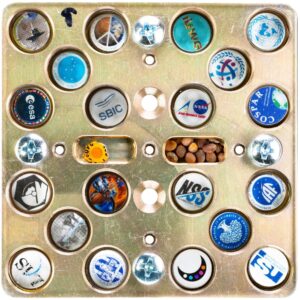
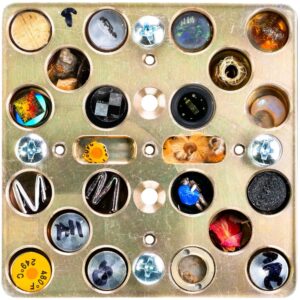
Space Renaissance for All Gallery: Science and Artscience (top), Tribute Space4All (bottom)

Credits: LUNEX Space Renaissance (Marieke Feenstra & Bernard Foing)

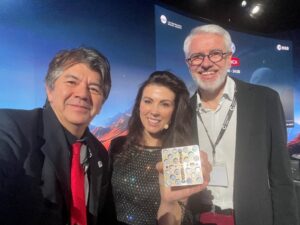
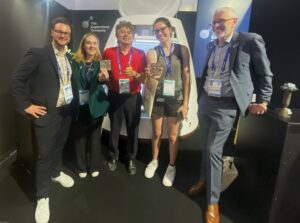
SR4All Integration in Holland, Delivery to TEC in Dec 24, TEC booth Salon du Bourget June 25

Credits: Space Renaissance LUNEX (Bernard Foing)

Quotes and informations from contributors to “ Space Renaissance for All Gallery”:

“A unique feature of the Space Renaissance 4 all payload is that it is equal parts art and science. Both areas equally contribute to our lives on Earth.  It is refreshing that they equally contribute to this flight project.”  says Dr. Heather Smith, US,   Space Renaissance 4 all Science lead.

“Meeting NASA’s critical deadline was a proud moment for our team. From design to delivery in under 24 hours, we proved that our high-velocity mass customization can make spaceflight-ready hardware possible on demand—helping turn this international multi-faceted space experiment into reality.” – Dr. Doug Milburn, ProtoSpace Mfg Vice-President and Co-Founder

“Ageha Petit, a tiny swallowtail with a mass of 0.1g, composed of deployable wings and a pillow-shaped transparent body, represents a module composed of photovoltaic tarps and an inflatable habitation capsule, providing hope for human presence on the moon and Mars among young generations across the globe” say creators Jun Sato & Ruta Stankeviciute (Japan)

“We are thrilled to see rocks from Failaka Island — a place rich in history and culture — journeying into space as part of the Space 4 All gallery. This extraordinary project is a celebration of global creativity, unity, and the boundless potential of human imagination. As these stones travel beyond our planet and return, they carry with them a message of hope, connection, and a future where art knows no limits.” says Ghanim Alotaibi, Advance Space Civilization Initiative – ASCI, SRI board member from Kuwait.

“The inclusion of artists from ArtEO.earth (the data arts initiative from Imperative Space) onboard Space4All, marks a milestone where creative vision meets space technology and data, uniting art and discovery for everyone.” says Ravi Kapur, UK, Director of ArtEO & Managing Director, Imperative Space. https://www.arteo.earth/

MoonMars Museum Sends 4 Cultural-Scientific Payloads with Space Renaissance for All Gallery into Orbit on “Mission Possible” with The Exploration Company

The 4 MoonMars Museum Payloads Include:

  1. MoonMars NanoFiche Layer – Developed using NanoFiche ultra-dense data storage technology, this 9mm disc contains a nanoscale archive of high-resolution imagery and texts from the Mare Crisium Collection. The same archive was sent to the Moon aboard the Firefly Blue Ghost Moonlander on March 2, 2025 as part of the Lifeship payload, marking a major milestone in digital cultural preservation on the lunar surface. This Earth-orbiting version enables parallel access and research, while a digital twin remains permanently accessible to the public inside the MoonMars Museum Metaverse.
  2. sPhotonix Crystal Glass: 5D Digital Archive – In collaboration with sPhotonix, this unique artefact stores five-dimensiona laser-etched data within a 9mm glass disc. The content: digital documentation of the Chauvet Cave paintings — some of the earliest known human artworks — preserved for eternity in crystalline form. This payload inaugurates a new theme for the MoonMars Museum: documenting the deep past of human creativity as we look toward the future. It also serves as the artistic prelude to a planned future lunar mission themed around artforms throughout the ages.
  3. Lunar Legacy MicroSculpture – Designed with Printoptix, this optical 3D micro-sculpture celebrates the MoonMars Museum’s distinction as the first museum to place artwork on the

Moon, via the Firefly Blue Ghost mission. At the center is a miniature version of “The Fallen Astronaut”, originally placed on the Moon in 1971 by artist Paul van Hoeydonck — making this a historic return and tribute.

Surrounding the central piece are six additional nanoprinted artworks:

  • “Pillman” by Micha Klein
  • A gold-toned MoonMars Museum “symbolic reliquary”
  • “The Nest” by Mary Kuiper  “This Cocoon shaped Nest made of hair from different hors breeds for the SRI4All Gallery, is to remind future generations about the human urge to leave the nest and expand their horizon into the universe.” says Mary Kuiper, NL, ArtMoonMars and MoonGallery artist

Bruce Ha, Nanofiche founder, says: “Nanofiche was created to transcend time. With this mission, it continues to transcend space.  Proven on previous lunar missions, NanoFiche technology permanently preserves art, memories and knowledge, engineered to endure extreme conditions in space. Tasked with protecting civilization’s memories, we strive forward with purpose, precision, and preservation beyond Earth.”

Ilya Kazansky, sPhotonix CEO & Founder, says: “This is the first space mission for Paleolithic Stone Age cave paintings as they orbit the earth in our durable 5D Memory Crystal. We can only imagine how our forebearers would look into the night sky and wonder. Now, through our world breaking nanotechnology, their paintings are not only preserved forever, they are preserved in outer space too.”

Nils Fahrbach, Printoptix CEO & Founder,  says: “At Printoptix, we’ve invested years of focused innovation and determination to push the boundaries of what’s possible with micro-optics. Seeing our 3D‑printed micro-sculptures find a place in the MoonMars Museum and the SR4ALL gallery is a powerful tribute to our craft. These intricate structures, crafted with nanometer-scale precision, are not just 3D-printed optics and structures – they’re reflections of the curiosity and dedication of everyone who made them possible. Out in space, they hint at what’s next for art, technology, and exploration.”

Eva Petric, ArtMoonMars artist from Austria, Slovenia and New York, says: “The EARTHLING Tattoo SEAL is a 3D embodiment of my artwork Stem Cell Potential — a form translated into a lace-like structure that visualizes the deep interconnectedness within and between us. It serves as a symbolic blueprint of our emotional Earthling existence.” Come to our event

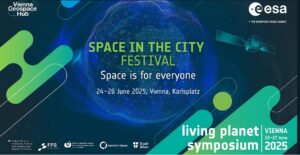
Space Everywhere: “Space in the City” Festival in Vienna next week June 24, Vienna’s Karlsplatz , From orbit to Vienna’s Karlsplatz: a journey through space, art, and connection.

“The story of Stem Cell Potential began in 2015, when I was invited to participate in a Moon simulation mission organized by ESA (European Space Agency). There, I experienced first-hand the profound sense of isolation that can occur in space — an emotion that inspired me to propose two artistic projects aimed at preserving human connection during long-duration space missions. One of these was the lace figure Stem Cell Potential, envisioned as a tattoo — a constant, intimate companion for astronauts. Like a contemporary Earthling emoji, this tattoo would serve as a quiet reminder of their identity as Earthlings, reinforcing their bond with Earth even while far from it. I extend my heartfelt thanks to the visionary Dr. Bernard Foing, and to all the fellow artists and scientists who continue to explore the unknown with courage and creativity.”

Additional info

  • Who is sending out the press release? Prof B Foing, to be reported by SR4All partners
  • When will it be sent out?  21 June 4 pm
  • Who will it go to?  To distribution list, and media
  • What is the social media plan? Started since delivery of Gallery and events worldwide
  • How can everyone view the launch, the public etc.?  launch webcast, 5 events in Munich, Paris, Bordeaux, Houston, Turin
  • What # and @ are being used for social media? Lunex, Space Renaissance, MoonMars
  • Who else is being invited to see the launch?  Open invitations at 5 sites
  • What videos/images are being taken and recorded for use? in www.sr4allgallery.com
  • Can we provide our tags etc.?  please send tags to Bernard Foing  and Marieke
  • Which persons of influence will Bernard and The Exploration Company send this information to? Many, agencies, organisations, academia , your network
  • What is Bernard doing with the papers ? Who is it going to?  IAC SR4AG abstract will be presented at Sydney on 30 sept-2 Oct , also as part of Keynote talk by B Foing

Follow the livestream of the launch, Sunday 23 June 2025, from 22:30 CEST,  on the Space Renaissance YouTube channel: https://youtu.be/xp1AwpEniU0

Posted by Adriano in Newsletters, Press Releases
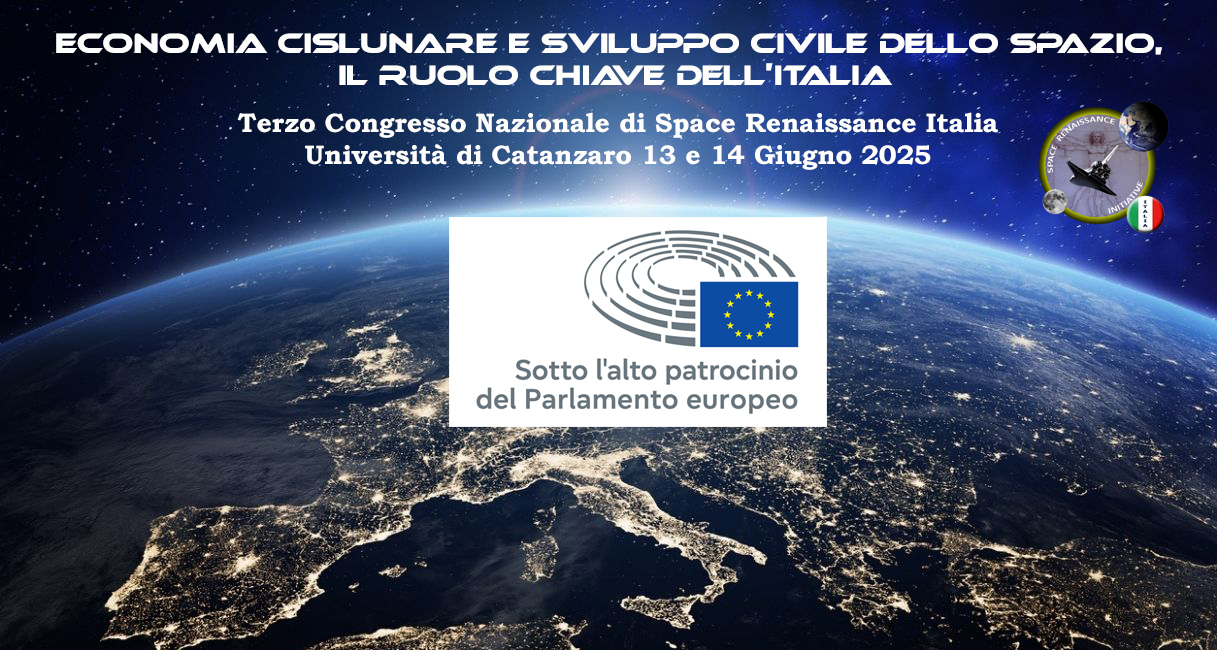
Space Renaissance Italia announces its third National Congress, “Cislunar economy and civil space development, the key role of Italy”

Space Renaissance Italia announces its third National Congress, “Cislunar economy and civil space development, the key role of Italy”

FOR IMMEDIATE RELEASE

Catanzaro, 26 May 2025

After the 2014 congress at Politecnico, Milano and the 2018 congress at INAF, Bologna, Space Renaissance Italia announces its third National Congress, “Cislunar economy and civil space development, the key role of Italy”, which will take place under the High Patronage of the European Parliament on 13-14 June 2025 at the “Magna Græcia” University, Catanzaro.

In a world marked by economic and environmental crises and horrible wars, the civilian space development is a fundamental strategy to relaunch the evolution and really sustainable development of civilization. Reusable launchers, now a reality for a decade, have drastically reduced the costs of space missions, opening the market to new opportunities and new entrepreneurial initiatives.

Italy, historically a protagonist in space research, contributes with advanced technologies at 360°, from the ISS to the Lunar Gateway, up to the development of safe human space habitats.

This Congress will address key issues such as: sustainable terrestrial and space energy supply, orbital data centers, human rights in space, orbital debris, and the role of civilian space development as a tool for peace.

In its capacity as observer at COPUOS (Committee for the Peaceful Uses of Outer Space, United Nations, Vienna) Space Renaissance proposes an 18th Sustainable Development Goal: “Space for All, on Earth and Beyond”, to be integrated into the UN 2030 agenda. The ARTEMIS Consortium and the International Lunar Research Station are also proposed to plant a UN flag on the Moon, during the next lunar missions, next to the national flags.

Link:

Contacts:

Posted by Adriano in Blog, News, Press Releases

Space Renaissance International at COPUOS SciTech SubCommittee, February 2025

Space Renaissance International (SRI) has participated, as an observer, in the 62nd session of the COPUOS Scientific & Technical SubCommittee, in Vienna, from 3 to 14 February 2025

Our delegation was composed of Adriano V. Autino, Bernard Foing, Marie-Luise Heuser, and Werner Grandl.

Autino has given a technical presentation, on February 7th: 3xE Energy Economy Environment. The presentation discusses the issue of the skyrocketing global energy demand, due to emerging technologies such as artificial intelligence, web communication, electronic money, and electrical mobility. Both fossil and renewable sources, together, are not sufficient to pair the demand. The proposal advanced by SRI – to relocate big data farms in space – was very well received, and some promising partnerships are now going to be initiated.

Prof. Foing has given a Technical Presentation as well, on February 11th, providing a detailed panoramic of the SRI mission and activities, a comprehensive illustration of the rationales and expected outcomes of the Space 18th SDG, to be added to the U.N. 2030 17 SDGs. The Space Renaissance Art Gallery – a collection of miniaturized artworks that will fly into orbit in June 2025 – was illustrated. Last, information was given about LUNEX Analog Training programs, which are going on in many countries.

Grandl presented, on February 12th, his concept of an industrial plant to be built in L5 Lagrange Point of the Earth-Moon system. The case has been discussed in detail, illustrating the lunar and asteroid materials that may be processed in a Lagrange Space Factory. Orbital Debris might be reprocessed as well, to get new raw materials for industrial production.

SRI, also in the name of the Space 18th SDG Coalition, marked a meaningful presence at this important meeting of the UNOOSA/COPUOS Scientific Technical Subcommittee.

The three presentations are visible on the UNOOSA TV website [1], and on the Space Renaissance YouTube channel too:

  • Adriano V. Autino – 3xE Energy Economy Environment [2]
  • Bernard Foing – Space Renaissance, Space 18th SDG, Space Renaissance 4 All Art Gallery, LUNEX [3]
  • Werner Grandl – Building a Lagrange Space Factory in L5 [4]

 Released on Planet Earth – 13 February 2025


About Space Renaissance International:

Space Renaissance International (SRI) is a global non-profit organization dedicated to promoting the peaceful civilian development and further exploration of outer space for the benefit of all humanity. SRI advocates for space philosophy and sustainable space development as key factors in addressing global challenges and securing a prosperous future on Earth and Beyond. For more information about Space Renaissance International and its initiatives, please visit https://spacerenaissance.space.


[1] https://www.unoosa.org/oosa/en/ourwork/copuos/stsc/2025/index.html

[2] https://youtu.be/7DDCFVrn6sA

[3] https://youtu.be/un0NxvZK8qo

[4] https://youtu.be/idNaBmz2zyU


Contacts:

International: Adriano V. Autino – adriano.autino(at)spacerenaissance.org
USA: Robert Katz – rsk(at)win.ngo
Posted by Adriano in Blog, Press Releases