News

SRI News

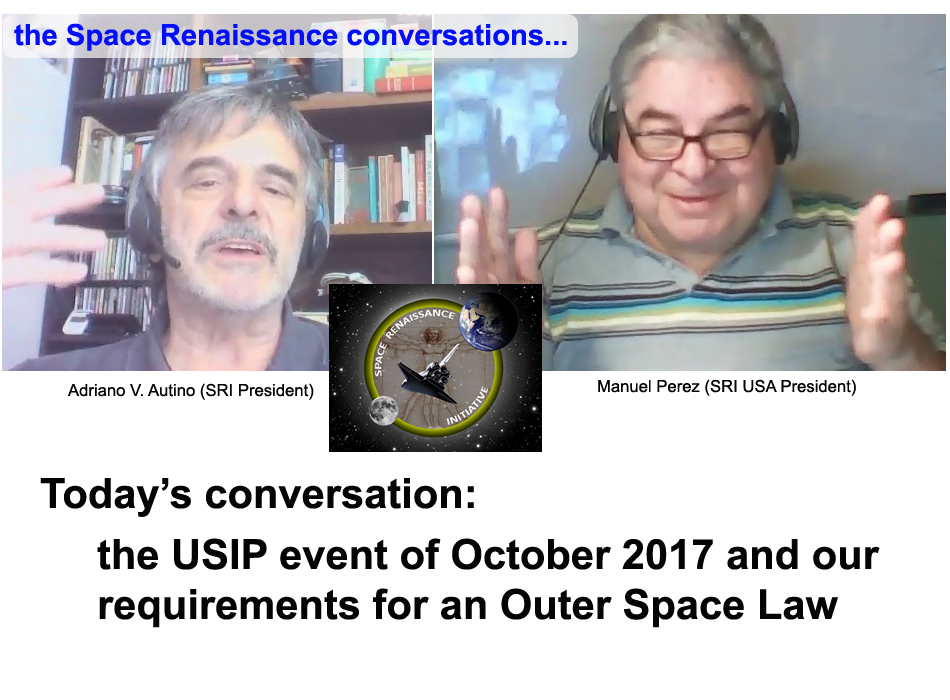
Manuel Perez and Adriano Autino talk about the USIP event and requirements for an Outer Space Law

Manuel Perez and Adriano Autino talk about the USIP event and requirements for an Outer Space Law

Space Renaissance USA, together with Lifeboat Foundation, will held an event, next October 10th 2017, at the United States Institute of Peace (USIP) in Washington.

The event will celebrate the 50th Anniversary of the “Treaty on Principles Governing the Activities of States in the Exploration and Use of Outer Space, including the Moon and Other Celestial Bodies” (Outer Space Treaty http://www.unoosa.org/oosa/en/ourwork/spacelaw/treaties/introouterspacetreaty.html), proposed in 1967, by the United States of America, the United Kingdom and the Soviet Union. Later it was signed by 106 Countries, and other 24 Countries are going through the process for signing it.

The Treaty was never updated, and it only provides rules for national governments operations in outer space, for the peaceful use of space environment.

In our last international congress (October 2016), SRI approved a short list of requirements, for the quick implementation of an Outer Space Law, to provide rules for civilian activities, expanding human rights into the Outer Space.

Also read:

Posted by Adriano
World wide call: support the Space Renaissance!

World wide call: support the Space Renaissance!

Dear SRI Friends and Supporters,

2017 is a wonderful opportunity, being the 50th anniversary of the Outer Space Treaty, to bring to the public attention the theme of the expansion of civilian activities and expanding civilian rights into the Outer Space.

Trying to be coherent with the commitments we took in our last congress, a few months ago, we are developing several projects, in different countries, naming just some of these initiatives:
– a primary Space Renaissance Tour in Nigeria, next October
– an event at USIP, in the USA, to celebrate the 50th anniversary of the Outer Space Treaty, and solicit a revision and further implementation of it
– a similar event in Italy, in collaboration with ASI and ESA
– conferences in the UK, with universities in Glasgow and Edinbourgh
– developing Space Renaissance Academy, an high profile Institute for education and outreach.

Besides, the SR International is strongly committed to sustain our supporters in all countries where they are working to create a Space Renaissance Chapter: India, Nigeria, UK, and other ones.

In this respect, i’d like to communicate here what is our spirit and setup, promoting local chapters of SR International.
Local chapters are very important, for us: without local chapters no international organization would exist.
Only local chapters allow people to work together in the real life, and not only on the web. To see each other face to face, and not only via electronic means. A real solidarity and practical sharing of goals and activities can ve developed only by human direct contact. The network is important, of course: just think about how it was hard, for international organizations to develop, 50 years ago, without the world wide web…
The network is a necessary but not sufficient condition, for an international to develop, national groups of activists need to meet, to agree their agendas, to work in their own country reality, political environment, people’s cultural perception level…

SR International is not a political party, we don’t claim to create a world wide political leadership.
The aims of the International are to develop the philosophy, to understand the current status of civilization, by means of our social analysis, and this is what we make in our international congresses.
We give general indications, about priority industrial developments.
We suggest equally cooperation and fair competition, among nations, for the opening of the space frontier, for the extension of civilian rights in outer space. In this respect the International acts like FIFA (Fédération Internationale de Football Association).
So we encourage peaceful and fair competition, and the generous sharing of know how and experience, achieved by the already space-faring Countries, with the Countries that are initiating their journey into space.

Should a SRI local chapter publically work for the primacy of its Country, for the leadership in the conquer of space? Yes, of course! Any real progress in the human expansion in outer space will be however for the benefit of the whole humanity!
Yes, history will always remember who was first in Earth Orbit, who was first on the Moon, who will be first on Mars, who will be the first capturing and asteroid and transforming it in a geo-lunar habitat…
But noting will prevent others, after the first, to do the same! And the acquired know how will be precious.

So, dear friends and supporters, be patriots, and be earthling citizen, at the same time, and give birth to Space Renaissance local Chapters!

However, i am here today also to ask you for money, to support all what we do.
Your contribute is precious: without your registration fees, we could sustain our websites, our newsletters, our tax duties, nor provide a small support for kicking-off new chapters.

Please register as a member.

If you register to a local chapter, you will be however also a member of the International.
Please also consider a donation.

    Also, you can donate to our crowdfunding campaign for the Space Renaissance Tour, if you like so.

    If you live in the UK, you might like to contact Ryan J. Curtis, to help him creating the SRI UK chapter.
    And, if you live in India, you could write to Sourav Karmakar.

    Choose your preferred way, but please support the Space Renaissance!

    Ad Astra!

    Posted by Adriano
    Elon Musk, Leonardo da Vinci and Wernher Von Braun

    Elon Musk, Leonardo da Vinci and Wernher Von Braun

    It’s been over three months since our last newsletter, and we won’t deny that this break was mainly due to a necessary reflection. Renaissance years are never easy, as history teaches us, and this historical phase is manifesting more and more hectic and contradictory, if not chaotic, events. Political turmoil and movements came about centuries ago, and are doing so again, dividing countries, and offering simplistic answers to complex problems, pushing for change. In fact, today our world looks like a bubbling cauldron, where the global communication network allows the diffusion in real time of information on everything that happens. But the true cultural contribution of the network is a general awareness of the great similarity of all peoples in the world: we share feelings, expectations, aims and desires while simultaneously chasing vastly different goals. This is what the 21st Century Renaissance looks like, and what we assume the 15th Century Renaissance was like to the people of that era, with a big difference: thanks to the global network, now we know that all of us humans have the same hopes and fears.

    Space Renaissance is both a goal and an astronautical humanist association (and not a political party). Our mission is to accelerate the kickoff of the expansion of civilization into space. Sadly, history tells us that undesirable violence and injustice seem to inevitably accompany all advances the renaissance might bring to humanity, but that does not mean we must stand quietly by when this happens. The first rocket to fly in space, V2, was developed by the Von Braun team at the German Peenemunde base, Hitler’s space research center. The first man to fly in orbit was Yuri Gagarin, in 1961, during the Stalinist dictatorship. Leonardo Da Vinci designed war engines while simultaneously promoting human scientific development. We do not agree with the violence and so promote peaceful, collaborative civilian space development as an alternative to military interests.

    What does militarism in space development mean? Is our civilization still so immature that we need to promote control and centralized power in order to rediscover a healthy boost to development? We cannot think (only) this way: humanity has demonstrated maturity in other areas of development and we trust will continue to do so in those that are still devoted to violence. The Renaissance we see is composed of progress-oriented vectors in technology, politics, economics, culture, education, civil rights, etc.

    In this turmoil, believing the promises of one politician or another is a mistake: Renaissance is a historical process that goes beyond any individual speech. Actions speak louder than words. Elon Musk, for example, is a leader in space technology development and other innovations, but he is not alone. As we see it, Musk sums up the attitude of astronautical humanists: our priority, our imperative, is to open the outer space to civil activities, expanding human rights over there, and considering outer space an arena where human rights can develop very much further.

    The dream of Von Braun was to fly the first rockets in space: should he have spurned the Nazi funds, and faced a firing squad? Wasn’t it better, for all of us, that he chose to pursue his astronautic dream, while pretending to develop a weapon? Historians report the poor combat effectiveness of v2, just because it was too technologically advanced, and was constructed of hard to get metals.

    It makes sense, to ask ourselves another question: will land conflicts extend to outer space? Even this is possible. We believe that the opening of the space frontier, and the expansion of civil activities in outer space, can put an end to the global crisis and create a new long Renaissance age, gradually mitigating all social problems, conflicts, making resource wars obsolet, bringing peace and ethical evolution everywhere. It will be a long and complex process, but we think that the symptoms of strong economic recovery will be seen soon, and will be of enormous encouragement, even if, quite hypothetical, some spark of war were initially spread into Earth orbit.

    In summary, if our priority is the opening of the space frontier, why should we refuse to work with anyone willing to allocate funds, facilities and patronage in support of this great epoch-making process? If we can even give a positive opinion on the decision taken by Von Braun, and later by the Soviet scientists, working under Hitler and Stalin, why shouldn’t we allow modern innovators to do the same? Should we change our mission, and to strive for a progressive enlightened democracy to be affirmed worldwide before resuming the journey into space? We believe not, because such a goal could never be reached without opening the space frontier. Collaborative efforts involve everyone, just as democratic processes do. Good, bad, friendly or offensive, this is a process for all humanity to participate in. That’s the foundation on which our ideological priorities have been built. This does not change the criticisms that, as humanists, we must make on Hitler, Stalin, and any other promoter of murders and genocide. Therefore we are waiting, but not passively, for the first decisive moves of Earth’s political leaders, for moving forward with the civilian expansion of humanity into outer space.

    In 2017 Space Renaissance will develop, or contribute to, several initiatives as part of the Space Renaissance Tour:

    Nigeria, 18-21 October 2017 – Lead City University, Ibadan, hosts the first event of the Space Renaissance Tour:

    USA, USIP, October 10th, Outer Space Treaty, 50 Years Anniversary, – news will be given on:

    Italia, Outer Space Treaty, 50 Years Anniversary, an opportunity to boost the adoption of a true space law system, to rule and support civil activities in space – news will be given on:

    UK, Space Renaissance Tour events will take place in Glasgow and Edinbourgh, stay tuned on:

    Please also don’t forget, to develop all of the above, and more, we do need money… donate to the Space Renaissance Tour Crowdfunding campaign.

    And join us, registering as a member of the Space Renaissance.

    Posted by Adriano in News, Newsletters
    A survey on space tourism

    A survey on space tourism

    In the near future it may be possible to buy a ticket and travel into space. Indeed, several people have already done so. We would like to know how much you are willing to pay for a trip into space, what kind of trip you might like to take, and how much risk you are willing to accept.

    We will ask you two questions about each of three kinds of space trips one might take. There are no right or wrong answers. Please answer exactly what you really think and feel. After these questions there are some optional questions about you. Fee free to ignore these if you prefer. Here’s the first trip:

    Trip 1 lasts three to five hours with five other tourists and one staff member in a small capsule. You are rocketed into orbit hundreds of miles above the Earth, jammed into your seat by the acceleration in an adrenaline-pumping experience like no other. You will go around the world two or three times, each orbit taking about 90 minutes. Through small individual windows you will see the heavens and almost the entire Earth from your vantage point far above the clouds. You will experience continuous weightlessness as you move about the cabin in a whole new way. Amenities will be minimal: bottled water, cold finger food, no toilet but a way to urinate. There will be no privacy.

    Please reply to all questions here.

    The questionnaire was prepared by Al Globus, supported by the ELEO group.

    Posted by Adriano in News, United States
    The SRI Board announced a position paper on civilian space development

    The SRI Board announced a position paper on civilian space development

    Planet Earth, December 21st 2016
    The SRI Board announced a position paper on civilian space development
    At their meeting on Saturday December 17th, the Board of Space Renaissance International (SRI) approved a position paper on civilian space development, refined during the two months since the 2nd SRI World Congress, and kicked-off the organization of the “Space Renaissance Tour
    (https://spacerenaissance.space/wp-content/uploads/2016/12/SRI_Position_Paper_December_2016.pdf)
    The position paper focuses the priorities of the international space advocacy association for the next four years, in response to the current global situation, as the Space Renaissance continues to unfold – led by the test-flying of fully reusable sub-orbital launch systems. Such epochal achievement will eventually lead to the dramatic reduction of the cost of traveling to orbit, making commercial civilian and industrial activities in space feasible.
    The paper identifies three essential developments, which SRI will support with immediate outreach actions:
    1. Developing Low Cost Access to Earth Orbit
    2. Addressing the issues of the protection of civilian life and health in space, and
    3. Consolidating a suitable set of laws for the global governance of activities in outer space, i.e. to collate and extend international civilian rights in space.
    This aspect has particular relevance in view of the coming celebration of the 50th anniversary of the Outer Space Treaty, signed in 1967.
    Some key technological advances, including fully reusable rockets and additive manufacturing, will allow the rapid growth of a wide range of manned activities in Earth orbit and provide the first steps towards industrial growth in the region of “near-space” around the Earth and Moon.
    SRI will promote and support this ongoing process – encouraging the cultural paradigm shift from quasi-military space exploration to civilian expansion into outer space, which is now overdue in order to create new opportunities and relieve the stresses of a world becoming more crowded and jobless.
    Following the recent SRI World Congress resolution, the Board has invited the SRI Executive, in which all the national groups and chapters are represented, to take initiatives in the frame of the Space Renaissance Tour, a broad outreach program aimed at bringing popular awareness of the Space Renaissance, and the urgent need to promote it, to as large a part as possible of the general public world wide.
    Also download this press release in pdf format.


    Posted by Adriano in News, Press Releases, SRI Announcements
    Crowdfunding for a Space Renaissance Tour, to  support the Renaissance vs. new Middle Ages

    Crowdfunding for a Space Renaissance Tour, to support the Renaissance vs. new Middle Ages

    Dear friends,

    we are living in a very critical age. The Renaissance, which began more than 500 years ago, has developed through several scientific and industrial revolutions, and is now aiming directly towards outer space. Should this step be misunderstood, misinterpreted or set-aside, the Renaissance will be defeated and mankind may enter into yet another dark age. The risks are real, should the current global crisis win over the Renaissance, or if continuing global conflicts emerge with unpredictable consequences. Our duty is to support the Renaissance everywhere, with all of our pacific and positive means.

    Two months ago, the Space Renaissance International (SRI) 2nd World Congress updated its analysis of the status of civilization, and defined our program for the next four years, working towards 2020. We have identified three essential developments, which SRI will support with outreach actions: establishing Low Cost Access to Earth Orbit, addressing the issues of the Protection of Civilian Life and Health in Space, and advocating for a suitable set of Laws for the global governance of activities in Outer Space, i.e. to collate, and extend international civilian rights in space.

    Some key technological advances, including fully reusable rockets and additive manufacturing, will allow the inception of comprehensive manned activities in Earth orbit, and the first steps for industrialization of the space surrounding the Earth and Moon region.

    SRI will promote and support such an ongoing process. Nothing will be easy or discounted. We have a wonderful opportunity, next year, to focus public attention on the civilian space development: the 50th anniversary of the Outer Space Treaty, signed in 1967. While, in 2018, the UN will convene the fourth International Conference on the peaceful uses of outer space UNISPACE+50 which will define outer space development for the 50 years which lie ahead. It is paramount that the public at large fully understands what is at stake within this few years: extending civilian rights in outer space, in order to allow civilian passengers and settlers to travel, live and work in space. Something that, so far, has been definitely missing, within any space program. Travel in space, for the few private astronauts who have visited the International Space Station, was obtained under military rules: very low protection for human life and health, no warranties, no responsibility from the agencies for possible injuries or health damages, and a long military training needed. Within the perspective of the geo-lunar space civilian development and industrialization, we need a full commitment, both by the scientific community and by governments worldwide, to solve the main life protection issues — cosmic radiations and zero or low gravity — and to define a proper outer space law system.

    Our congress approved a very effective program for next four years, including a world wide Space Renaissance Tour, prizes for young artists and scientists, and to develop the Space Renaissance Academy, a wide philosophical, scientific and cultural education project.

    But then not make long turns of phrase: we need funds.

    In 2016 we made several meaningful steps forward. SRI is now present in almost twenty countries world-wide. In two countries — USA and Italy — we have formally incorporated local non-profit chapters. In two countries — UK and India – chapters will be incorporated in few months. In many other countries our members are working to aggregate supporters for local chapter activities. Everywhere we’ll take public initiatives.

    Even so everything we plan to do, basing on volunteer effort, also implies hiring specialized services: web marketing and events management, just to name two. So the very first very urgent step is to create a seed fund, enough to hire the needed services for at least one year.

    We have started a crowdfunding campaign, and we are asking you very seriously to help us, in one or both of two ways:

    Ad Astra!

    Adriano V. Autino, SRI, President

    donate-button-5

    also download the pdf version of this article

    Posted by Adriano in News, Newsletters, Press Releases, SRI Announcements
    Moritz Bierling (Exosphere) interview to Adriano Autino, President of Space Renaissance International

    Moritz Bierling (Exosphere) interview to Adriano Autino, President of Space Renaissance International


    Moritz Bierling (Exosphere) interviewed Adriano Autino, President of Space Renaissance International, in the frame of the Exosphere show called “The Creative Economy Interviews”. Autino talks about the Renaissance, begun 500 years ago, now aiming to outer space.

    Your work with Space Renaissance, what is it about and what do you plan for it?

    To make the meaningful steps of civilian expansion into outer space during next ten years is very urgent: low cost access to orbit, protection of life and human health for civilians passengers and settlers, a coherent space law system, to rule the commercial civilian activities in outer space.
    The change of paradigm, now feasible, from military space exploration to civilization expansion into outer space. This is our presentist vision: the future shall be now! Traditional futurism, that used to promise a brilliant and distant future, is now obsolete. Humanity needs that brilliant future, now.
    We recently had a very good methodology lesson by Elon Musk, CEO of SpaceX: let’s do what we can with the technologies we have, which demonstrated that we can certainly achieve immediate results.
    A Columbus egg, a brilliant yet logical idea after all, if we cannot yet build a single stage transportation directly to orbit , let’s take both stages back down to Earth surface for reuse. Such a simple strategy is already downsizing the cost to orbit, making the old monopoly of expendable rockets obsolete.
    So we have some urgent priorities, as we discussed during the recent Space Renaissance 2nd World Congress:
    – to accelerate the development of technologies for Low Cost Access to Earth Orbit,
    – to resolve the issues of protection of civilian life and health in space,
    – to develop a suitable set of laws, to rule the activities in Outer Space, i.e. to code the civilian rights in space
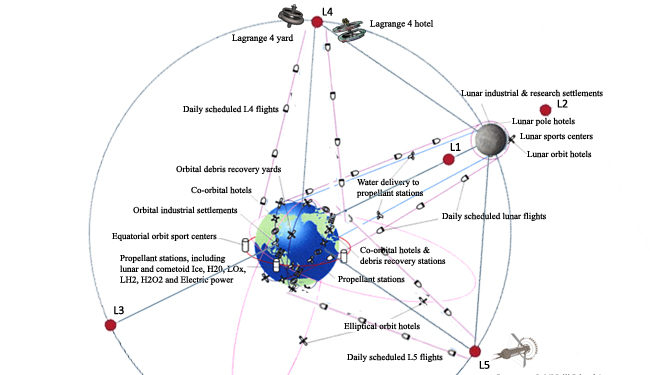
    – to build the geo-lunar space infrastructures, from Earth orbit to Lagrange Points, developing habitats, manned workshops, industrial settlements, asteroids mining, hotels, advanced research settlements
    This is a complete change of paradigm: from (military) space exploration to civilian space development.
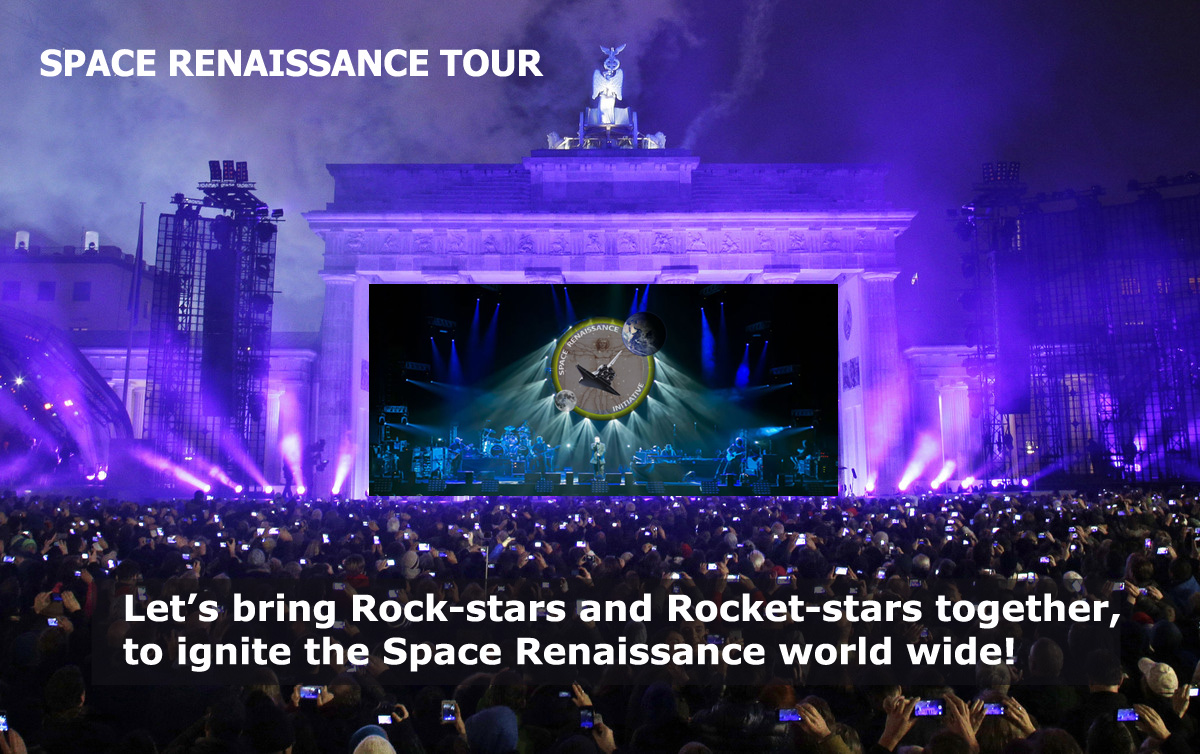
    In this perspective, priorities change: protecting life and health assumes great relevance, since people will live and work in space for long periods or undetermined time. In the space exploration paradigm, we had mission requirements, for round trips, or lingering few months in space. In the space settlement paradigm, we have humanist anthropologic requirements. The exploration time didn’t need a space law system, since astronauts were subject to military rules, with no warranties, nor the space agencies were responsible for their life. The space settlement urgently needs space law, to be evolved from the Outer Space Treaty (1967), and the marittime law. During next four years, SRI will develop the Space Renaissance Tour, bringing our proposals to the five continents, with big events involving rocket stars, and rock stars… we are negotiating, i cannot make any name, so far.

    And your advice to young people just starting out and wanting to get into cool work, what do you recommend the young people of Italy and the world to do in order to get started with their careers?

    Everything we are doing is done for young people.
    The birth of civilian space development will create millions new jobs, on Earth and in space, as it was done during the past century, by the aeronautic industry, the automotive industry and other industrial vectors, now obsolete.
    My first suggestion would address more to the education and entertainment dealers.
    Our young people are shamefully kept in the ignorance of the ongoing renaissance, and the extreme need to support it.
    The Space Renaissance Academy is trying to fill such a big gap, providing knowledge about history of astronautics, history of the renaissance, our present and our future.

    Initiatives like Exosphere are very opportune and useful too, since they allow many young people to join together, sharing meaningful contents.
    But i take this chance to extend a call to all journalists and medialists: come to us, take our urgent message and spread it to the young generations, the Renaissance needs them, and they need the Renaissance!
    There are many works that can be made in Earth orbit, today, with high return, in terms of costs saving, in the frame of the current space market.
    Talking about satellites, it would be very much convenient to mount, them in orbit, by manned orbit workshops. The satellites could then be placed in the required orbit, and periodically maintained, by such orbital workshops.
    The recovery and possible reuse of the space debris is another topic that will gain momentum in the immediate future.
    But we should start to think to a context in which many earthling jobs will have their counterpart in space: restaurants, shops, arts, sports, entertainment, tourism, hotels…
    The civilian space travelers and inhabitants will not be “astronauts”, in the meaning we know today…
    And the geo-lunar civilization will not need only scientific and technological skills… there will be need of philosophers, writers, psychologists, cultural operators, and many other humanistic skills.
    So, a pragmatic suggestion to young people:
    give to your studies another direction, whatever your preferred field: to the high!

    Posted by Adriano in News, Philosophy
    The space frontier is opening! The outcomes of the SRI 2nd World Congress

    The space frontier is opening! The outcomes of the SRI 2nd World Congress

    news7-title

    The Space Renaissance International 2nd World Congress took place on Skype, from September 30th until October 2nd, 2016, and it was a great event, with participants from all continents. During the three days, five thesis documents and a final resolution were discussed, amended and voted upon. The SRI Board was renewed, to represent the active and collaborative international team that is now leading SRI, and that signed important results. These include, the incorporation of the Space Renaissance USA chapter, in April 2016, the more than doubled SRI presence on social networks and the application to the MacArthur 100&CHANGE prize (link at the bottom of this page).

    The SRI first World Congress was held five years ago, in 2011. Since then, many things have changed and finally the space frontier has initiated the opening process. Fully reusable rockets have had their first successful experimentation this year and the obsolete monopoly of expendable rockets is now finally broken. This is also a good time for assessing SRI’s capabilities to understand and foresee the social processes, since this is one of the conditions that justify the existence of an organization like ours. The result is the Final Resolution of our recent Congress that we agreed to. Below is a large excerpt from the resolution. The complete acta of the Congress will be available soon.

    Fully reusable rockets are now a reality thanks to a collaboration between the NewSpace industry — Elon Musk’s SpaceX — and NASA. Space tourism is a growing and meaningful part of the Newspace segment, endowed with a high capability to develop on its own capital: Virgin Galactic, Blue Origin, Sierra Nevada, Skylon, XCOR, and many other space companies are working hard to initiate commercial flights. The paradigm change has finally arrived: reusable rockets reduce the cost of launching into Earth Orbit. So we were right, when we said that the NewSpace industry, in order to meet this unprecedented evolutionary challenge, needed, and still needs, the support of public money as well as a positive public opinion. If this awareness was more largely shared, maybe the history would have been different. However we are working restlessly for the space frontier to be opened in time.

    The experience of SpaceX demonstrates that private industry, working with government agencies contracts, can in fact reach the goal of lowering the cost of the Earth-Orbit transportation by several magnitudes. As such, many other objectives can now be targeted, including a substantial industrialization of the geo-lunar region. Space tourism and other civilian space activities, such as orbital manned services, asteroid mining, advanced research settlement and space based solar power will all benefit from the reduction of the Earth-Orbit launch costs. That’s why our main commitment, during next four years, will be to work towards a general extension of such a method: a broad collaboration among the government agencies and the NewSpace private industry.

    If most people continue thinking that the world is closed, it will remain so. Instead of this, if we are able to build on these recent achievements and extend these into a meaningful vanguard, then the space-enabled future can become a reality. The first essential step on such road is to accelerate the development and the marketing of technologies that enable low cost civilian passenger transportation into space.

    We are not working for a revolution, but for a renaissance of civilization. A revolution is violent, while a renaissance is fundamentally joyous and peaceful. The true conflict nowadays is between those who aspire to growth and change (the Renaissance), and those who want de-growth, de-industrialization, cultural involution, which will eventually lead to the implosion of civilization. The global crisis of the closed world has worsened, but the renaissance is going ahead and aiming to reach space. We do not fear robots: humans do it better, are more efficient and more cost effective in the space environment.

    The next 10 or 15 years will see the technical and social opportunities brought about by the renaissance of the last 500 years to balance the threats, the conflicts, the huge risk of a World War III, that could be the last global war that humanity wages, since the next wars will be fought with sticks. A peaceful expansion of civilization into outer space via a peaceful development of civilian space activities, will be the core of our celebration of the 1967 Outer Space Treaty which will have its 50th anniversary in 2017. We will bring our proposals of principles for a space law, which development is urgent, to the United Nations in order to provide democratic rules for commercial and industrial activities to be conducted by private entities in outer space.

    SRI will develop a narrative of our near future, of our possible present civilian life in space, requiring artists to represent what cannot yet be photographed because it doesn’t exist, yet. Elon Musk announced his Interplanetary Transport System, to carry passengers to Mars for a relatively modest ticket price in few years. Jeff Bezos announced his plan to start migrating heavy industries into outer space, making of Earth a beautiful garden. Jeff Greason is working to develop manned activities in Earth orbit. All of these great space programs are not very well known by the general public. They are not yet part of educational programs in schools and colleges. SRI wants to raise such awareness and push the urgent narrative in throughout society.

    SRI entered its 2.0 phase, going over the mere “propaganda”, toward a concrete engagement in the social reality. We will be open and collaborative in order to be able to listen to all of the voices which can be available to work for the renaissance. We shall reach out to many renaissance persons, creative minds which can contribute to the renaissance, if given the proper tools and channels.

    During next four years, towards 2020, we shall bring the awareness of the extreme urgency to open the space frontier to civilian and industrial activities to the broad general public. We will support the quick development of low cost launch vehicles, promote public support for the NewSpace industry, promote a space industrial political platform, promote space based solar power, contribute to space law and promote a “presentist” vision and narrative of our immediate future life in space. We begin by lobbying governments, space agencies and international institutions. We will try to create collaborations with all the renaissance initiatives, which are not limited to the Space Renaissance’s ones. In order to realize such an ambitious program, SRI will initiate a major world-wide program:

    The Space Renaissance Tour

    We want to bring the space renaissance message to all five continents in the next 2 to 3 years. This will be achieved with public conferences having their focus on few key themes, namely: accelerating the development of low cost Earth-Orbit passenger and cargo transport vehicles, promoting civilian space development as an alternative to conflicts and the risk of a World War III; celebrating the 50th anniversary of the 1967 Outer Space Treaty and to reaffirm the Human Right to Development as stated by United Nations in 1986. To lead such a grand tour which we will call the true renaissance vanguard of our time: we salute all of the NewSpace industries making the Space Renaissance happen!

    Now, to realize all of the above we must rely upon the help of all the renaissance persons in the world. By registering as a member of SRI, you will help us by creating a seed fund, by which we can hire proper services and build up our very ambitious but urgently needed program. We need your financial contribution as well as your ideas and your projects, but mostly we need your activist volunteer commitment.

    please join us, join the renaissance,

    JOIN THE SPACE RENAISSANCE INTERNATIONAL!

    The SRI participation to the MacArthur 100&CHANGE prize 

    Also download the pdf version of this article.

    Posted by spacere in News, Newsletters, Press Releases, SRI Announcements
    DEVELOPMENT IS A HUMAN RIGHT – AN OPEN LETTER TO UNITED NATIONS

    DEVELOPMENT IS A HUMAN RIGHT – AN OPEN LETTER TO UNITED NATIONS

    [mp_row]

    [mp_span col=”12″]

    DEVELOPMENT IS A HUMAN RIGHT – AN OPEN LETTER TO UNITED NATIONS

    dhr-590

    SRI News #05.2016 – September 17th 2016, by A. V. Autino, with contributes by M. Perez, A. Sinclair, A. Woods

    In our incoming Congress we will discuss the program for next four years, including initiatives towards United Nations, concerning the Human Right to Development and the 50th Anniversary of the 1967 Outer Space Treaty.
    On the above subjects we sent an open letter to UN, while they are meeting in New York. Our analysis says that only expanding our industrial and commercial activities in space the human right to development can have a chance.
    We think that a broad international collaboration is needed.

    What is your opinion? Share it with us, during the Space Renaissance congress:

    “FROM SPACE EXPLORATION TO SPACE SETTLEMENT”
    The Space Renaissance International 2nd World Congress will be held from September 30th to October 2nd,

    on skype chat, three hours per day, starting at 15.00pm, GMT

    REGISTER TO PARTICIPATE TO THE CONGRESS!
    (participation is free)
    see the Congress Theses

    In the framework of the 2nd Space Renaissance International World Congress
    September 20 – October 2, 2016

    OPEN LETTER TO THE UNITED NATIONS

    Distinguished Participants to the 71st Session of the UN General Assembly (UNGA 71),
    Distinguished Participants to the High-level segment of the General Assembly to commemorate the thirtieth anniversary of the Declaration on the Right to Development[1],

    please accept our greetings and sincere wishes for a successful and productive conference!

    Thirty years after the Declaration on the Right to Development[2], we have to acknowledge that many analysts paint a dismal picture of the status of civilization in spite of meaningful advances in education, longevity, civil rights, malnourishment, poverty and in other critical societal areas.

    Though there are places and situations that world’s media highlight as examples of worsening conditions and inequalities and obstacles to development, UN statistics show clear and gradual improvements. Yet, there exists new threats to human development that must be dealt with, such as serious environmental issues, increasing scarcity of material and energy sources, that are becoming more and more evident and serve to enhance conflicts, terrorism and migration fluxes.

    We identify the problem of a growing human population within the closed system of planet Earth as the main cause for the worsening of all the well-known global problems which concern the UN and national governments across the world. There will soon be 8 billion humans on our home planet who are facing resource shortages, mass migrations, economic and political disenfranchisement, and widespread civil unrest exacerbated by this population pressure, not to mention the huge environmental issues, general pollution and the decay of the oceans. The global financial crisis initiated in 2008, is devastating society and jeopardizing its industrial capabilities that are necessary for development.

    Paragraph14. of the UN 2030 agenda[3] well summarizes such a situation, and par. 15. recalls the opportunities of this historical age: “It is also, however, a time of immense opportunity. Significant progress has been made in meeting many development challenges. Within the past generation, hundreds of millions of people have emerged from extreme poverty. Access to education has greatly increased for both boys and girls. The spread of information and communications technology and global interconnectedness has great potential to accelerate human progress, to bridge the digital divide and to develop knowledge societies, as does scientific and technological innovation across areas as diverse as medicine and energy.” This paragraph describes the great impulse to the progress of civilization that was provided by the industrial revolution, that we can see as the last act of the renaissance, initiated in 1500. Today’s industrial capabilities are under attack, by the current global crisis, and it is dramatically urgent to contrast and reverse such a crisis by relaunching industrial development, fully profiting from the fantastic new technologies that have raised in recent years.

    The Declaration on the Right to Development well summarizes the humanist concept that growth -economic and cultural growth – is essential for the progress of ethics, freedom, democracy and well-being. With almost eight billion intelligent human beings, our species was never so rich, provided that we will be able to allow such a huge patrimony to realize its full value by investing in itself and continuing its progress. Enduring cultural and economic growth decreases social fear and progressively reduces the causes of conflicts.

    At this moment there are two major forces fighting in the world:

    1. A multifaceted global crisis which is devastating our culture and paving the way to a general decadence of civilization accompanied by the emergence of populist and new feudal authoritarian regimes, as warned by Prince Zeid Ra’ad Zeid Al-Hussein[4], the current United Nations High Commissioner for Human Rights, in a recent address to the Peace, Justice and Security Foundation Gala, in The Hague.
    2. The forces of the renaissance – the courageous entrepreneurs who are betting their lives on new technologies and methodologies. With a trust in scientific research, and with a new pragmatism, they refuse to look too far into the future. They do not stop dreaming, but do what they can with available technologies and with technologies that are expected to appear soon.

    We believe that space development is the simplest measure available to humanity that can mitigate and progressively resolve the main global risks our civilization is currently facing. When a species is close to saturating the ecological niche where it was born and evolved, there are only two choices: to expand into a greater ecological niche by utilizing the available technologies or to condemn itself to limitation, decadence and extinction. On our home planet we see a growing scarcity of basic resources and useable spaces for the development of all its citizens, whereas the expansion of humankind into the solar system will provide space and resources enough for the future development of perhaps trillions of human beings in the coming millennia. The expansion of human industrial and commercial activities in the geo-lunar space region should be kicked off between now and the year 2025 – a date that many forecasters see as the beginning of a very critical period, in which the danger of a global conflict will escalate, bringing with it unpredictable consequences. The opening of the space frontier to human development will relaunch the global economy at unprecedented rate, and will be the key element to defuse a potential World War III.

    The first essential step on such road is to accelerate the development and marketing of technologies for civilian passenger transportation in space. We advocate a change of paradigm from space exploration dealt by military trained astronauts, to civilian space flight, which will allow anyone to travel into space and as convenient as taking a normal airline flight. When low cost space transportation vehicles will become available, a season of great innovation (renaissance) will be triggered and new answers to human needs will create new self-sustaining markets. History shows examples of new routes, created by explorers, followed by merchants and then used by many others. Searching for and discovering new lands are essential aspects of human nature. The exploration and discovery of the solar system represents the exciting historical age that is now before us, one that is far greater and transformative than any previous age. Opening the new frontier of extraterrestrial space is now an urgent necessity for humanity, but, until now, this process has been restricted and delayed by monopolistic interests and governmental control.

    In a problem solving perspective national and international communities will expand human presence in Earth orbit, working together in peaceful cooperation and collaboration. Innovative services can be provided for space debris recovery and reuse, fueling stations, spacecraft assembly and maintenance and for global communication and educational satellite networks. Space development can quickly achieve both the near term and long term goals of exploration and settlement, while supporting the sustainability and prosperity of our global communities on Earth.
    However, time is of essence: supporting the forces of the renaissance to relaunch global development for all people of Earth before the year 2025 is the duty of all persons and institutions caring for the survival and continued progress of human civilization. This giant evolutionary step requires a broad international cooperation and we invite UN to provide the necessary framework for such an unprecedented promotional action, to encourage (as we have written in our SRI 2nd World Congress Thesis 1 [5]):

    1. To propose that the main space agencies increase their activities in space and procure their transportation needs in an open, competitive marketplace, establishing a “free trade zone” in launch opportunities among all partners, so that the market will expand in a way that supports lower cost solutions such as reusable launch vehicles that are being developed by the private sector.
    2. To propose that the main space agencies become customers for space resources – for example, by buying propellant, water, or mass for radiation shielding in space and by providing a market for those resources to stimulate the private sector to supply them.
    3. To motivate governmental space agencies to prioritize research and technology for the unsolved problems needed for humans to live in space, on the Moon and on other celestial bodies indefinitely, such as protection from cosmic radiation, studying effects of Martian and Lunar gravity, effective artificial gravity for living in open space, faster and more economical transportation techniques, and in-situ resource extraction and utilization for the Moon, Near Earth Objects and Mars.
    4. To motivate governments to support — through tax discounts, grants and a friendly fiscal policy — the civilian space industry, the development of space tourism (suborbital, orbital, Moon), near Earth asteroid mining and using asteroids as space urban infrastructures, the validation of new technologies for low cost and safe access to Earth’s orbit, and the development of technological systems and new methodologies for human spaceflight.
    5. To convince the larger public that expanding civilization into space and giving birth to a true space renaissance is possible, convenient and urgent; and that passenger space travel will, like air travel did, create tens of millions of new jobs around the world.
    6. To create space renaissance investment funds to allow all savers to direct their savings into astronautical industrial enterprises.
    7. To limit military activities in Earth orbit to a purely surveillance operations while forbidding and preventing any lethal militarization of the space environment, as any major war is perceived to be the biggest threat to the future of human civilization, and space development is seen as the most optimistic alternative to war. Therefore, ongoing legal efforts such as the proposed Treaty on the Prevention of the Placement of Weapons in Outer Space and the Threat or Use of Force against Outer Space Objects (PPWT) and the Prevention of an Arms Race in Outer Space (PAROS) resolution deserve immediate attention and further elaboration. Any and all efforts at the international level that insure and enforce this aspect should be given the highest priority. The space environment has already proven to be an effective arena for international cooperation and, as such, it holds much promise and economic opportunity for emerging nations to collaborate with the current spacefaring nations. As economic development leads to peace and prosperity, further international cooperation and collaboration in the space arena needs to be encouraged and supported.

    The 50th anniversary of the 1967 Outer Space Treaty presents the United Nations with a timely opportunity for these actions and endeavors to be given the highest consideration. We, at Space Renaissance International, are available to help with our network of experts. During the upcoming anniversary year, we are also planning events and activities that foster public discussion of these critical issues which have relevance for every citizen on planet Earth.

    September, 17th 2016
    Sincerely,

    Adriano V. Autino, SRI, President
    The Space Renaissance International Executive Committee

    Space Renaissance Australia Space Renaissance Australia

    Space Renaissance Bosnia Herzegovina Space Renaissance Bosnia Herzegovina
    Space Renaissance Brasil Space Renaissance Brasil
    Space Renaissance Canada Space Renaissance Canada
    Space Renaissance Espana Space Renaissance Espana
    Space Renaissance France Space Renaissance France
    Space Renaissance Germany Space Renaissance Germany
    Space Renaissance India Space Renaissance India
    Space Renaissance Italia Space Renaissance Italia
    Space Renaissance Mexico Space Renaissance Mexico
    Space Renaissance Morocco Space Renaissance Morocco
    Space Renaissance Nederland Space Renaissance Nederland
    Space Renaissance Nepal Space Renaissance Nepal
    Space Renaissance Poland Space Renaissance Poland
    Space Renaissance Russia Space Renaissance Russia
    Space Renaissance Switzerland Space Renaissance Switzerland
    Space Renaissance UK Space Renaissance UK
    Space Renaissance USA Space Renaissance USA

     [English language editing by Arthur Woods]

    The Space Renaissance International 2nd World Congress will be held from September 30th to October 2nd, on skype chat, three hours per day, starting at 15.00p, GMT
    (participation is free)

    [/mp_span]

    [/mp_row]

    Posted by spacere in News, Newsletters, Press Releases, SRI Announcements