
Abstract
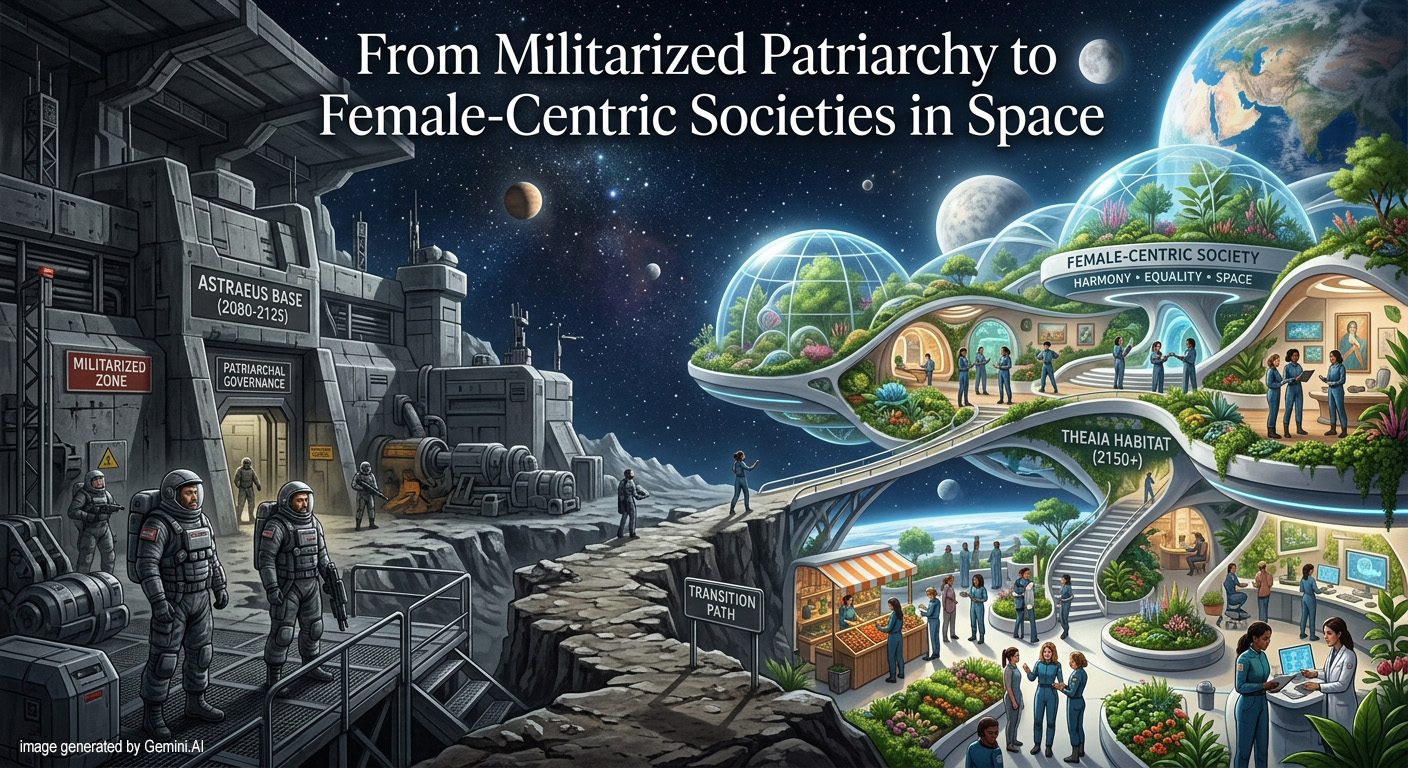
Expanding humanity into outer space would represent one of the greatest transitions in human history. If millions of people eventually live and work in space, the social structures familiar to us today are likely to evolve into very different forms. Predicting those structures is difficult. Few, if any, could have predicted the profound societal transformation that occurred in Europe following the Industrial Revolution. The transition from extended families living within largely rural and feudal systems to nuclear families living in densely populated industrial cities and democratic states is now well studied, yet it would have been difficult to foresee before it occurred.
Similarly, when hunter-gatherer communities began settling permanently and developing agricultural villages, their social structures changed dramatically. We understand many aspects of this transformation today, but those living before the transition could hardly have predicted its consequences.
This article attempts to connect the consequences of large human populations living in space with the possible evolution of societies both on Earth and beyond it. One major consequence considered here is the possible abolition—or fundamental transformation—of the military institution, along with other highly hierarchical institutions.
The argument builds upon the historical development of the military institution and the ways in which ancient societies were transformed by its growing influence. Although many institutions contributed to the development of patriarchal societies, this article focuses specifically on the military institution and its possible relationship with the social status of women.
The High Cost of Conflict in a Spacefaring Civilization
I would like to begin with a quotation from Gerard K. O’Neill’s The High Frontier:
“If irritations and misunderstandings do appear, as is inevitable in human relationships, fortunately neither side will be likely to risk a complete breakdown of trade; the price of serious conflict will almost surely be too high.”
O’Neill made this observation in the context of large rotating space habitats. His argument was that armed conflict between such settlements would be unlikely because the economic and physical costs of conflict would simply be too high for everyone involved.
I believe we may already be moving toward a world in which the cost of armed conflict is becoming too high for everyone.
Communications systems, electrical grids, transportation networks, water systems, digital infrastructure, and other technological systems have become essential to modern survival. At the same time, relatively inexpensive technologies such as drones can potentially damage highly valuable infrastructure. When combined with more destructive weapons, this creates a paradox: the more technologically advanced a society becomes, the more infrastructure it possesses that can potentially be disrupted.
The conflicts of the mid-2020s provide examples of this changing relationship between military power and technological vulnerability. Actors with relatively limited industrial and economic resources have demonstrated that inexpensive drones and missiles can impose significant costs on far wealthier and more technologically advanced states.
This raises a wider question. If relatively inexpensive technologies allow poorer or less-industrialized societies to threaten the infrastructure of industrialized states, what prevents this model from spreading elsewhere? Could other economically weaker states or non-state actors eventually acquire similar capabilities?
Historically, one of the principal justifications for the military institution has been the defense of the nation. Yet technological development may gradually produce circumstances in which military confrontation becomes increasingly incapable of providing genuine security. If every technologically advanced society becomes vulnerable to relatively inexpensive attacks, the solution may eventually depend less on overwhelming military superiority and more on creating conditions in which societies have less incentive to engage in destructive conflict.
Prosperity, therefore, may become a form of collective security. A more industrialized Africa, Latin America, Middle-East, and Asia, accompanied by a stronger international rule of law, could contribute to the gradual reduction of military institutions in much the same way that institutions once considered permanent, such as slavery, were eventually abolished.
Space Development as an Alternative Form of Security
The previous argument is important to the central hypothesis of this article. This article assumes that human civilization can survive in the long term only if humanity collectively recognizes that increasingly destructive armed conflicts may no longer protect individual nations. Instead, they may threaten the technological systems upon which all modern societies depend.
Under such conditions, redirecting a significant portion of military expenditure toward civilian space development may ultimately become a more effective long-term strategy for security.
Space contains enormous resources. Access to energy, raw materials, living space, and industrial capacity beyond Earth could generate entirely new forms of wealth. Instead of competing over limited terrestrial resources, advanced civilizations could increasingly expand their economic activity beyond Earth.
Human history has repeatedly demonstrated that irrational and radical political decisions remain possible. Nevertheless, this article deliberately explores a more optimistic scenario: one in which human wisdom, cooperation, and mutual interest gradually overcome destructive ideologies and hatred.
If military expenditure were increasingly redirected toward civilian space development, the resulting expansion of wealth could fundamentally change society.
That raises the central question of this article:
What type of family and social structure might emerge in an abundant, highly industrialized, and increasingly demilitarized civilization?
Women Before the Rise of Highly Hierarchical Societies
Before the rise of large agricultural states, female figures appear prominently within the archaeological record.
From approximately 40,000 to 35,000 BCE onward, numerous prehistoric female figurines have been discovered across Europe and parts of Eurasia. These objects are often collectively described as “Venus figurines.” Their precise religious and cultural meanings remain debated, but they demonstrate that representations of the female body occupied an important symbolic place in many prehistoric cultures.
Women within hunter-gatherer communities also participated in a wider range of economic activities than traditional nineteenth- and twentieth-century stereotypes often suggested. Archaeological and anthropological research increasingly indicates that women could participate in hunting as well as gathering and other forms of food production.
Women also possessed one biological capability that men could not provide: childbirth. In small communities where population survival was uncertain, reproductive capacity would have had significant social importance.
Early humans also carefully observed astronomical cycles. The cycles of the Moon, the seasons, and other celestial phenomena played important roles in early cultures. The approximate relationship between the lunar month and the human menstrual cycle may also have contributed to symbolic associations between femininity, fertility, and celestial cycles.
For these reasons, some prehistoric and early agricultural societies may have provided women with relatively high social status compared with the highly institutionalized patriarchal hierarchies that later emerged in parts of the ancient Near East.
Some societies were also matrilocal or matrifocal, meaning that family and household organization centered strongly around women or maternal kinship.
The transition toward increasingly patriarchal societies occurred gradually and differently across regions. Nevertheless, the rise of powerful centralized states, professional armies, property systems, and rigid social hierarchies appears to have contributed significantly to changing gender relations.
The Rise of the Military Institution
Wars certainly existed before the emergence of what I refer to here as the military institution.
However, there is an important difference between occasional warfare among small communities and the creation of a permanent professional military supported by a centralized state.
The transition toward professional, full-time military forces capable of conducting long-distance campaigns created a new class of political and economic power based heavily on warfare, conquest, and territorial expansion.
Because organized warfare historically depended primarily on male soldiers, the political importance of warriors increased.
In other words, warfare gradually became an institution—and, in some societies, effectively an industry.
Professional soldiers required resources, privileges, land, social recognition, and political authority to sustain that institution. As military power became increasingly important to the survival and expansion of states, societies had strong incentives to elevate the status of warriors.
Since those warriors were overwhelmingly men, the rise of the military institution may have contributed to the erosion of women’s social status and to the emergence of increasingly patriarchal political systems.
The transformation from some matrifocal or matrilocal arrangements toward strongly patriarchal societies therefore cannot necessarily be separated from the emergence of centralized states and organized military power.
Marduk, Tiamat, and the Symbolism of Patriarchal Power
The Babylonian creation epic, the Enuma Elish, provides a striking symbolic example of this transformation. In the myth, the warrior god Marduk defeats the primordial goddess Tiamat. After defeating her, Marduk uses her body to create the cosmos and establishes a new divine order in which he occupies the highest position among the gods.
The story can therefore be interpreted symbolically as the replacement of an older female-associated cosmic power by a militarized male authority.
Whether this mythology directly reflects a historical social transformation is open to interpretation. Nevertheless, the symbolism is remarkable: political order emerges through the victory of a male warrior deity over a primordial female figure.
Marduk’s rise therefore provides a useful metaphor for the broader argument of this article—the possibility that the rise of organized military hierarchy contributed to the institutionalization of patriarchal authority.
The Warrior as a Social Institution
Historically, the military institution has depended heavily on young men. Physical strength, aggression, loyalty, courage, and willingness to accept personal risk are qualities that military systems have traditionally cultivated among soldiers. In many cultures, the warrior has consequently become an idealized masculine figure.
The individual soldier, however, may know relatively little about the deeper historical, geopolitical, or economic causes of the conflict in which he participates. Propaganda can simplify complex conflicts into moral narratives in which one side represents righteousness and the other becomes an enemy.
Once opponents are dehumanized, violence becomes psychologically easier. The warrior is then promised honor, glory, social recognition, and heroic status in exchange for his willingness to fight and potentially die. This pattern has appeared repeatedly throughout history.
The mythology of the heroic warrior therefore serves not merely as entertainment or religion but also as a social mechanism capable of reinforcing military institutions.
War, Law, and the Status of Women
As military institutions became increasingly important, legal systems often developed mechanisms that privileged warriors and regulated the status of women around them.
In several ancient societies, clothing, marriage, sexuality, slavery, inheritance, and family status became highly regulated. For example, some ancient Near Eastern legal codes distinguished between different categories of women through clothing requirements, including veiling. Social status, marital status, class, and relationships with male household members could determine whether particular women were permitted or required to wear certain forms of dress.
Military conquest also contributed to slavery. Female captives could become domestic or sexual slaves, while prostitution and sexual exploitation became connected to the economies surrounding armies and expanding cities.
Military institutions therefore influenced far more than warfare itself. They contributed to legal systems, economic structures, gender expectations, family arrangements, and political authority.
Abundance and the Declining Logic of War
Abundance requires highly productive societies. Industrialization can create extraordinary wealth, but it also produces increasingly powerful and inexpensive weapons. At the same time, advanced societies become more dependent upon technological systems that are vulnerable to disruption. This combination may ultimately reduce the usefulness of warfare. The more advanced civilization becomes, the greater the potential cost of destroying the systems upon which everyone depends. Abundance can also reduce conflict by changing the psychology surrounding scarce resources.
A useful example can be found in the Arabian Peninsula. Historically, communities sometimes competed violently over access to water. Water scarcity directly affected survival, agriculture, and political power. Today, desalination technology combined with abundant energy has transformed this relationship in several Gulf states. Water remains valuable, but access to drinking water is no longer governed by the same scarcity dynamics that existed historically. Indeed, free public drinking-water coolers are commonly provided outside homes, mosques, and public spaces as an act of charity. Technology did more than simply resolve a resource problem. It changed the social relationship surrounding the resource.
The same principle could eventually apply to many other resources. If space-based civilization creates enormous supplies of energy, raw materials, industrial capacity, and living space, traditional territorial competition may become less important.
The Return of Female Social Centrality
Over roughly the last century, women have gained substantial legal, political, educational, and economic rights across much of the world. Female participation in the workforce has increased dramatically. Women now contribute to science, engineering, medicine, business, government, education, and nearly every other part of the modern economy. Women therefore increasingly perform many of the same productive roles as men while also retaining reproductive capabilities that men biologically cannot provide.
This creates an important social asymmetry. In a prosperous and highly automated civilization, physical strength becomes progressively less economically valuable.
Machines increasingly perform tasks that once required significant physical strength. Automation and artificial intelligence may accelerate this process further.
If the military institution also declines in importance, one of the major historical institutions that disproportionately elevated traditionally masculine characteristics—physical strength, aggression, and warrior status—would weaken. Women, meanwhile, would continue participating economically, intellectually, scientifically, and politically while also remaining essential to biological human reproduction.
The abolition or major transformation of the military institution could therefore contribute to a significant increase in the relative social status of women.
In a prosperous civilization with abundant resources and relatively small populations compared with available living space, the human individual may become more valuable rather than less. A human life could become one of civilization’s most precious resources.
Could Space Societies Become Matrifocal?
This raises the possibility that large space settlements may gradually develop social structures that are more female-centric than many contemporary societies. This does not necessarily mean the creation of societies dominated politically by women or the replacement of patriarchy with a reversed hierarchy. Instead, societies may become increasingly matrifocal: organized more strongly around mothers, children, family networks, reproduction, education, and long-term social continuity.
Space settlements may reinforce this tendency. In early colonies, population growth would be strategically important. Pregnancy, childbirth, child development, radiation protection, education, and family stability would therefore become major societal concerns. Rather than the warrior occupying the symbolic center of civilization, the mother, the family, the scientist, the engineer, the teacher, and the builder may become increasingly central social figures.
In this sense, the expansion of humanity into space could produce something unexpected. Technologically, civilization would move further into the future. Socially, however, it may partially rediscover structures that existed before the rise of highly militarized patriarchal states.
Security After the Military Institution
The abolition of the military institution as we know it would nevertheless create an important institutional gap. Conflict would not disappear simply because societies become prosperous. As discussed earlier, wars and violent confrontations can emerge from irrational beliefs, ideological movements, political extremism, personal ambition, or small groups capable of using powerful technologies.
Indeed, advanced technology may allow relatively small organizations to threaten entire societies. A demilitarized civilization would therefore still require security institutions. However, these institutions may look very different from the national militaries of the twentieth and twenty-first centuries. Their primary purpose might not be territorial conquest or competition between nation-states. Instead, they could resemble highly specialized international security, policing, civil-defense, intelligence, and emergency-response organizations whose purpose is to protect technological infrastructure and civilian populations.
Historical transitions often initially appear impossible. Before the abolition of slavery, many societies struggled to imagine how their economies could function without enslaved labor. Yet economic and social institutions eventually evolved. The same conceptual difficulty applies to the military institution today. Because permanent armies have existed for thousands of years, imagining civilization without them can appear unrealistic.
But permanence in history is often an illusion. Institutions survive only while the economic, technological, and social conditions that created them continue to exist.
A highly industrialized, spacefaring civilization characterized by abundant resources, extreme technological interdependence, and enormous costs associated with warfare may eventually create conditions in which the traditional military institution no longer serves the function it once did. If that happens, the decline of militarized hierarchy may also alter gender relations. Human expansion into space could therefore produce not only a technological revolution, but a social revolution—one in which female social centrality, family continuity, and the preservation of human life become increasingly important foundations of civilization.
———————
See the Final Resolution of the Space Renaissance International 4th World Congress:
https://2026.spacerenaissance.space/wp-content/uploads/2026/07/SRIC4-Final-Resolution.pdf
Join the Space Renaissance: https://spacerenaissance.space/membership/international-membership-registration/
Also see a pdf version of this article.





















 Space Renaissance France (French Chapter of SRI)
  Space Renaissance USA, Inc. (USA Chapter of SRI)
 Space Renaissance (Italian Chapter of SRI)
 Space Renaissance India (Indian Chapter of SRI)
 African Space Renaissance (African Chapter of SRI)
 Space Renaissance Academy
 Space Renaissance Initiative Group